Updated
The fear of gorillas Uganda trekking Rushegura family Bwindi is one of the habituated mountain gorilla groups that trekkers can visit in Uganda or Rwanda, offering an intimate encounter with these remarkable primates. I was terrified of gorillas, and I mean this in the precise sense: a phobia rooted not in general wildlife anxiety but in the specific features of great apes that trigger a particular quality of dread in some people — the combination of human-like intelligence with non-human size and strength. The eyes that look too much like eyes. The hands that look too much like hands. I had felt this fear watching documentaries and assumed that the encounter in person would be intolerable. Then I met the Rushegura family of Bwindi Impenetrable Forest, and the fear resolved itself in a way I had not anticipated.
I Was Terrified of Gorillas: Then I Met the Rushegura Family
The Nature of the Fear
My fear of gorillas was not the fear of dangerous animals. I am comfortable with lions on a vehicle safari, comfortable with elephants at close range, comfortable with the general category of large wildlife. The gorilla fear was something different: a visceral response to the uncanny valley at scale. Too human. Too large. Too much of both at once.
I am a secondary school teacher of biology. I understand, intellectually, that mountain gorillas are gentle, social animals who rarely display aggression toward humans and who, in their habituated state, are generally calm around visitors. This understanding did not help with the fear. Understanding and feeling are not the same thing, as I tell my students regularly without applying the lesson to myself.
I booked the gorilla trek as a deliberate act of confrontation with the fear. My reasoning: I am telling sixteen-year-olds to do difficult things every day. I should be able to do a difficult thing myself. My wife, who is more sensible than I am, said: “Or you could just not go.” I ignored this.
The Briefing
The briefing at Buhoma was given by a ranger named Joseph who had been leading gorilla treks for fourteen years. When I mentioned, quietly and slightly embarrassed, that I had a fear of gorillas that I was trying to address, he did not laugh. He asked two questions: What specifically frightens you? Have you been charged by any animal before?
I described the uncanny valley fear — the combination of human-like and non-human, the intelligence behind the eyes. He nodded. “That is a common fear,” he said. “The fear comes from not knowing the animals. The Rushegura family are very settled. They will not find you interesting. You will find them interesting. That will help.”
He was right. I did not know that yet.
The Trek
The walk in gave me time to manage the fear in the way I manage most fears: by focusing on what was directly in front of me rather than what was ahead. The forest was extraordinary and the guide, Christine, pointed out birds and plants with the calm of someone who has spent years in this ecosystem and still finds it interesting. By the time we stopped — Christine raising her hand, the tracker speaking quietly into his radio — I was tired and attentive and the fear had gone somewhere to wait.
Then it came back.
First Contact: The Fear Returns
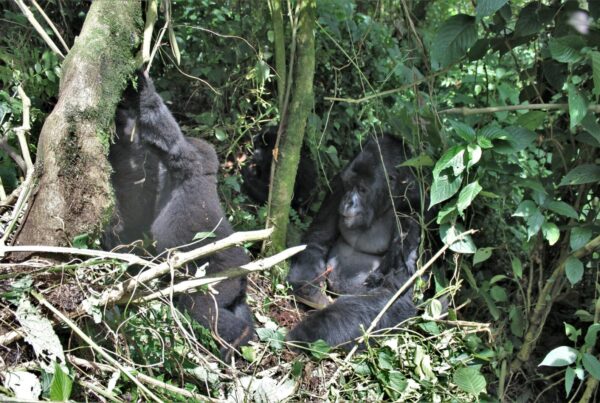
The first gorilla I saw clearly was a female, sitting about five metres away. She was eating leaves with focused concentration. She had not noticed us yet.
The fear arrived in full. The size, the specific movement of hands that looked too much like hands, the quality of the face — present, aware, intelligent in a way that I recognised without being able to map it onto existing categories. My heart rate was high. I was very still.
Christine was beside me. She said nothing. She watched the gorilla with the same attentive calm she had used all morning. This, I later understood, was itself a form of guidance: she was showing me what the appropriate emotional register was for this encounter. Not excitement, not fear — calm attention. I followed her lead as best I could.
The Moment the Fear Changed
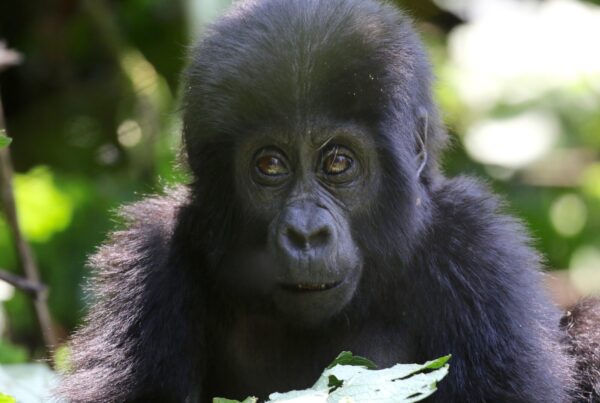
The moment the fear changed is specific and I can place it exactly. A juvenile gorilla, perhaps three years old, had been watching our group from the edge of the vegetation for several minutes. He approached — not directly, with the specific indirectness of a curious animal that has learned not to commit to an approach until it has assessed the situation — and settled about two and a half metres away.
He looked at me with the expression of a child examining something new: not particularly excited, not afraid, not performing any emotion, just — looking. The specific quality of his attention was the attention of a mind engaged with a problem. What is this thing? Is it interesting? Does it require further investigation?
He decided, after perhaps ten seconds, that I did not require further investigation. He turned back to the more interesting business of the vegetation behind me.
In those ten seconds, the fear did not disappear. It transformed. The uncanny quality — the human-like intelligence in a non-human body — stopped being threatening and became what it actually was: a very close encounter with a mind. Not my mind. Not a human mind. But a mind.
The fear of what was too human resolved into wonder at what was genuinely present. I do not know if I can explain this transition more precisely than that. It happened, and it was complete, and I was left with something that had none of fear in it.
The Rushegura Family: An Hour
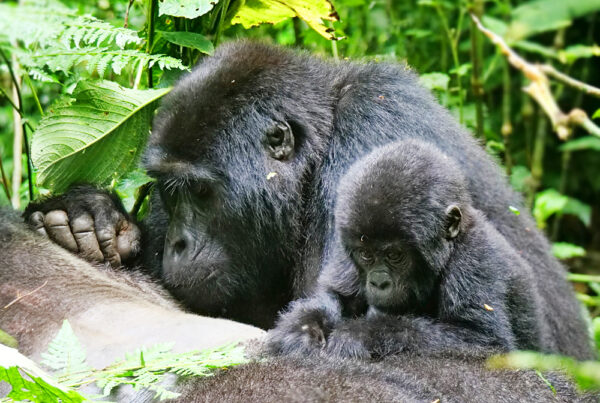
We stayed for the full hour. The Rushegura family includes, by Christine’s count that morning, seventeen individuals: one silverback, four adult females, several adolescents and sub-adults, and four young infants. Over the hour, I watched: the silverback (Mwirima) move through the clearing with the authority of someone who has never questioned his position in the world. A female nurse her infant while simultaneously eating, with the multitasking efficiency of someone who does not have the option of doing one thing at a time. Two adolescents engage in a play fight that resolved in approximately eight seconds. A juvenile approach within two metres of my boots, regard me carefully, and move on.
I took photographs. I made notes in the small notebook I had brought. I did none of these things with any of the self-conscious anxiety that had characterised the first fifteen minutes. The fear was gone and what replaced it was the kind of focused, clean attention that I know from teaching: the specific quality of presence that arrives when you are genuinely engaged with something that is genuinely interesting.
What I Brought Back to the Classroom
I teach biology. I teach the evolutionary relationship between primates. I have, since returning from Uganda, taught this material differently — not because I know more of the facts, but because I know, now, something embodied that the facts point at. When I tell students about the 98.3% DNA overlap, I am no longer describing a statistic. I am describing something I have experienced directly.
Two of my students have since booked gorilla treks with their families. One of them came back and wrote an essay about it that was the best piece of writing I have seen from a student in fifteen years.
For Anyone With a Similar Fear
If you have the uncanny valley fear of great apes — the specifically disconcerting response to the too-human, too-animal combination — I am not able to promise that the encounter will resolve it the way it resolved mine. But I can say that the resolution, when it comes, comes through direct experience rather than through any amount of rational preparation. The fear is based on not knowing the animals. Knowing them — in person, in their forest — tends to correct it.
Contact Uganda Gorilla Trekking to book your permit. Tell the guide about your fear if you have one. They have handled it before. The Rushegura family have been resolving it for thirty years.