What one hour with mountain gorillas teaches you about being human is not something you can prepare for in advance. You can read everything available about mountain gorilla behaviour, social structure, and evolutionary kinship with humans. You can watch every documentary. You can know, as a fact, that you share 98.3% of your DNA with these animals. None of this will fully prepare you for what an hour in their presence actually teaches — because what it teaches is not information. It is experience. And experience, as anyone who has ever confused knowing about something with having done it will recognise, is a different category of knowledge entirely.
Lesson One: You Are a Body
The gorilla trek begins with your body. The physical demands of the terrain — the climb, the sweat, the mud, the specific exhaustion of moving through a forest that does not accommodate human preferences — arrive before the gorillas do. By the time you stop, guided into position at the edge of the clearing where the family is feeding, you have already been reminded of something that daily life works hard to obscure: you are a physical creature, made of the same materials as everything else alive on Earth, subject to the same basic requirements of effort and rest.
This reminder is not negative. It is grounding. The person who enters the gorilla family’s territory after ninety minutes of genuine physical effort is not the same person who left the briefing room. They are more present, less defended, more in their body and less in their head. The body-first entry to the experience is not incidental to what the experience teaches. It is the first lesson.
Lesson Two: Intelligence Is Not Uniquely Human
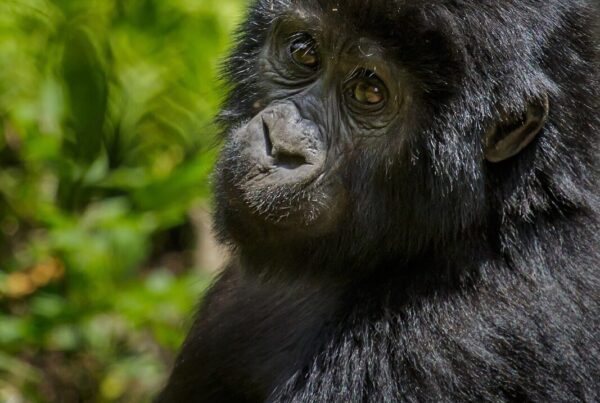
The face of a mountain gorilla at close range dismantles, quietly and completely, any remaining conviction that intelligence is a uniquely human attribute. The specific quality of attention in those eyes — the assessment, the curiosity, the social awareness — does not look like the face of something operating on instinct. It looks like something thinking.
This lesson is the one most often described by trekkers as the most affecting. It is not news, exactly — the scientific literature on great ape cognition is extensive and clear. But knowing it as a fact and having it confirmed by direct encounter are different experiences. When a juvenile gorilla looks at you for ten seconds with the specific quality of attention that is thinking, the scientific fact becomes a lived understanding. Something reorganises itself in how you understand what a mind is and where it exists.
Lesson Three: Social Life Is Ancient
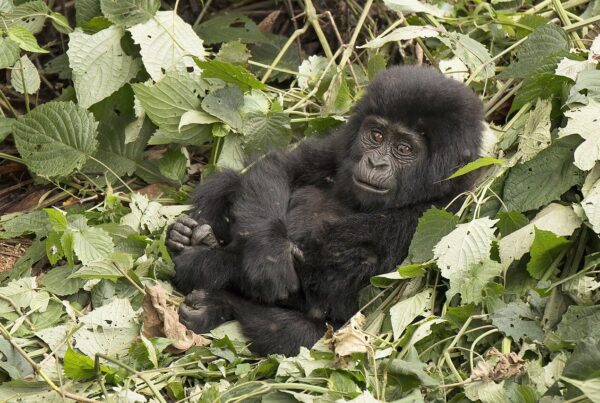
Watching a gorilla family for an hour is watching a social system operate in real time — a system with a structure that is recognisable from the outside, that involves hierarchy, care, play, conflict, and resolution, and that has been running in essentially this form for millions of years. The silverback’s authority. The mothers’ attentiveness. The adolescents’ testing of limits. The infants’ complete dependence and absolute trust.
These dynamics are not uniquely gorilla dynamics. They are primate dynamics, which means they are also, with modification, human dynamics. The social architecture of a gorilla family is ancient in a way that connects directly to the social architecture of every human family that has ever existed. Watching it in the forest is watching the deep structure beneath human social life — stripped of its language and its clothing and its cultural elaboration, but recognisably present.
Lesson Four: Status Is a Local Concept
The silverback does not know about your professional achievements. He does not know your salary, your job title, your educational qualifications, your social media following, or any of the other markers by which you organise your position in human society. He assesses you briefly — threat? no threat — and categorises you as irrelevant to current activities. That is the only status assessment you will receive from him.
This is unexpectedly liberating for a significant number of visitors, particularly those for whom status is a primary organising principle of daily life. The gorilla’s indifference to human hierarchy strips away a layer of concern that, once removed, turns out to have been heavier than you knew it was. Several guides describe visitors arriving at the trailhead with a specific quality of tightness — the held-in quality of people managing an identity — and departing from the forest with the more relaxed quality of people who have temporarily let it down.
Lesson Five: Presence Is the Default
Mountain gorillas, in their habituated state, exist entirely in the present moment. They are not planning the future or processing the past. They are eating, grooming, playing, resting, caring for their young — activities that exist entirely in the present tense. There is no evidence of the rumination, the anticipatory anxiety, the retrospective analysis that consume a significant portion of human cognitive bandwidth.
Being in their presence for an hour tends to have a contagious effect on this quality. The specific quality of attention required by the encounter — the regulation of sound and movement, the focusing on what is directly in front of you, the impossibility of dividing your attention between the gorillas and a screen — produces a state of presence that many people describe afterward as one of the most sustained and clear-headed periods of attention they have had in years.
One visitor, a consultant who described himself as “incapable of not checking my phone every four minutes,” told me that during the gorilla hour he did not think about his phone once. “Not because I was disciplined,” he said, “but because there was simply nothing else. The gorillas took up all the space.”
Lesson Six: Beauty and Grief Coexist
There are just over 1,100 mountain gorillas on Earth. This number — the rarest great ape population, living in two isolated forest habitats that together cover an area smaller than many major cities — hangs over the encounter in a way that makes the beauty more acute and the grief more present simultaneously. You cannot fully appreciate what you are seeing without comprehending how close it came to being gone, and how much continued effort is required to keep it from going.
The coexistence of beauty and grief is not comfortable, but it is real. It is, in fact, one of the most honest emotional states available to a human being who is paying attention to what is happening to the world. The gorilla encounter makes this coexistence concrete and immediate in a way that most daily life does not. It teaches, in an hour, a quality of emotional honesty that many people spend years trying to achieve through other means.
Lesson Seven: You Are Not Alone
The last thing an hour with mountain gorillas teaches you about being human is the simplest: you are not alone in the way you might have thought. Not alone in the sense of being accompanied by other people — though the shared experience of the trekking group has its own value. Alone in the deeper sense of being the only creatures on Earth with minds, with social bonds, with the capacity to care for young and grieve for the dead and form relationships that persist across time.
The gorillas share all of these things. They are not us, and the differences matter and should be respected. But the similarities — 98.3% of the same DNA, the same basic architecture of social life, the same fundamental orientation toward others of their kind — make “alone” a harder word to use, in the same way that “animal” becomes a harder category to draw a clean line around.
You are not alone. You are in a family — a very large, very ancient, very distributed family — most of which you have never met. The hour in Bwindi is one of the few chances available to meet a few of them.
Planning Your Hour
Uganda gorilla trekking permits are $800 per person and include one hour with a habituated gorilla family in Bwindi Impenetrable National Park. The physical demands of the trek are real and preparation is worthwhile. The guide will handle the rest. Contact Uganda Gorilla Trekking to book your permit and arrange your visit.
Go. Have the experience. Let it teach you what it will. Whatever that is, it will be more than information.