Updated
gorilla trekking elderly mother Uganda 80 years old is one of Africa’s most extraordinary wildlife experiences, connecting travellers with mountain gorillas in their natural forest habitat. Gorilla trekking with my 80-year-old mother was the most ambitious thing either of us had ever agreed to, and the most rewarding. My mother had been talking about mountain gorillas since David Attenborough first brought them into her living room in the 1970s. For fifty years, “see the gorillas” had been a sentence she ended with “someday.” Her eightieth birthday felt like a deadline worth taking seriously. I booked two permits, booked the lodge, told her we were going to Uganda, and watched her expression move through surprise, delight, and then the specific pragmatic focus of a woman who has decided to accept the gift and prepare properly.
Gorilla Trekking With My 80-Year-Old Mother: A Bucket List Story
The Conversation About Whether It Was Possible
My mother is, at eighty, in good health for her age. She is not frail. She walks daily, she is mentally sharp, and she has the characteristic stubbornness of a woman who has outlasted most of the things people told her she could not do. She also has arthritis in both knees and is not, by any reasonable measure, a person who should be climbing steep tropical terrain.
The conversation about whether it was possible was therefore both straightforward and complicated. Straightforward because she had already decided she was going regardless of what I said. Complicated because I needed to ensure the decision was informed rather than wilful.
I called Uganda Gorilla Trekking and explained the situation in detail. The response was reassuring: porters were available and could provide physical support on difficult sections, some family groups were more accessible than others, and guides were experienced in managing varying fitness levels with sensitivity. The key question was which family group and which sector of the park would be most appropriate.
After that conversation, the planning became straightforward. We chose the Rushegura family at the Buhoma sector — relatively accessible terrain. We booked two porters, one for each of us. We prepared carefully over three months.
The Preparation
My mother’s preparation was more systematic than mine. She increased her daily walks from thirty minutes to ninety. She worked with a physiotherapist on the specific demands of hill descent, which is often harder on arthritic knees than ascent. She acquired trekking poles and broke them in thoroughly. She lost four kilograms over the three months before the trip, which she described as “accidental” but which I suspect was deliberately calculated.
By the time we flew to Entebbe, she was more prepared for the physical demands of gorilla trekking than I was. This was consistent with her general approach to challenges, which I recognised from childhood and had not expected to still find both impressive and slightly intimidating.
Uganda: What She Made of It
My mother had been to Africa before — Kenya in the 1980s — but not Uganda, which she described as “different in ways that are hard to specify.” The directness of the welcome, the quality of the food, the extraordinary landscapes on the drive south. She was fascinated by Kampala and wanted to stay longer than the two days we had planned. We stayed three.
On the drive to Bwindi, she read me sections from a field guide she had brought and asked our driver, Samuel, questions about birds that he answered with the helpfulness of someone who has been asked bird questions by enthusiastic foreign visitors before. By the time we reached the lodge, she had identified nine species from the car window.
The Morning of the Trek
My mother wore her trekking clothes with the calm authority of someone who has dressed for an important occasion and is satisfied with the result. She hired her porter without hesitation — his name was Emmanuel, and he would turn out to be one of the more important people in the success of the day. Our guide was Christine, who had been working with the Rushegura family for eight years.
Christine assessed my mother at the briefing with the quick, experienced eye of someone who has evaluated many visitors’ physical capabilities and adjusted the day accordingly. She said: “We will go at a comfortable pace. We will stop when we need to. We have time.”
The Trek
The walk in took two and a half hours. For most trekkers the Rushegura route takes ninety minutes; the extra hour reflected our pace, which was unhurried, and the four rest stops that Christine called with the casual decisiveness of someone exercising professional judgment.
Emmanuel was exceptional. He was physically present on every difficult section — not intrusive, not patronising, but precisely available when support was needed. My mother, who is not someone who accepts help easily, accepted his without commentary, which told me everything about the quality of his support.
At the most difficult section — a steep descent on wet earth — my mother took Emmanuel’s hand, descended carefully, arrived at the bottom, and said: “Good. What is next?” Christine looked at me. I looked at Christine. We both looked at my mother. She was already scanning the forest ahead.
The Rushegura Family
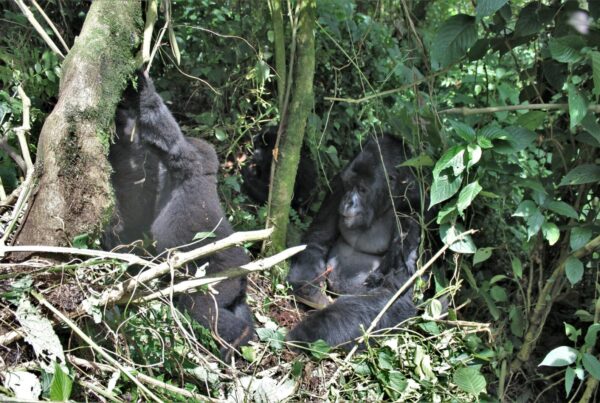
The family was feeding in a valley below the final ridge — a large group, well settled, with the specific calm of animals who have been habituated for a long time. Christine guided us into position at the edge of the clearing.
My mother stood still. She did not speak. She did not move. She simply looked, with the expression of someone who has waited fifty years for something and is now taking it in properly.
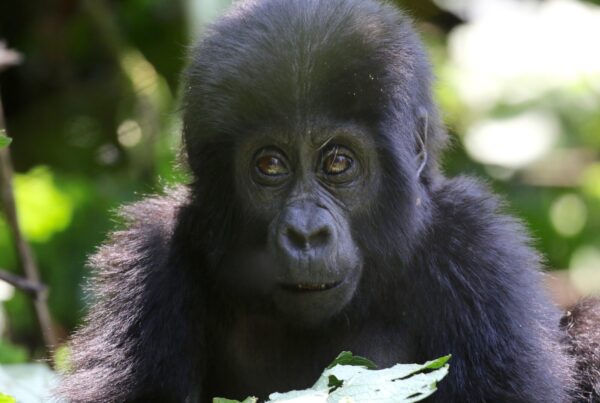
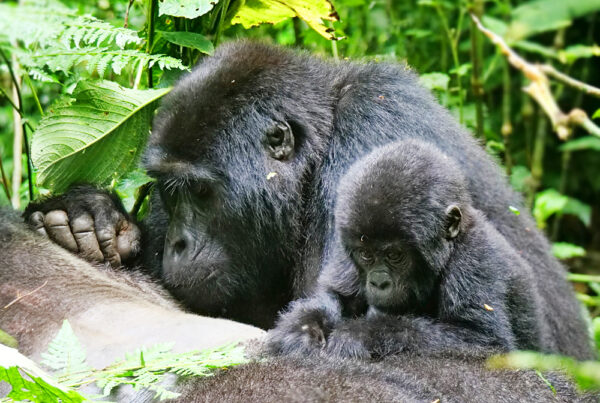
A female gorilla was sitting four metres away, eating. An infant was on her back, sleeping. The silverback was visible further back in the clearing. Juveniles were moving through the undergrowth with the specific energy of a species that has no schedule and nowhere to be.
After perhaps five minutes, my mother said very quietly: “There they are.” Not to me. To herself.
The Hour
Christine had arranged for us to sit — she had a small folding seat in her pack, which she produced with the manner of someone who has done this for eighty-year-olds before. My mother sat, and the family came and went around her, and she watched every movement with the focused attention of a woman who has spent fifty years waiting for this and has no intention of looking away.
She cried once, briefly, when the infant woke and looked at her. She did not comment on this. She wiped her face with the efficiency of someone addressing a minor practical matter and went back to watching.
When Christine said “time,” my mother sat for an additional moment, looking at the forest where the family was disappearing. Then she stood, thanked Christine and Emmanuel, turned to me, and said: “Right. I am hungry. Let us get lunch.”
The Celebration
The lodge had arranged a small birthday celebration for the evening — a cake that had been transported to Bwindi in circumstances I chose not to investigate too carefully, candles, a small gathering of the lodge staff who had heard the story of the eighty-year-old who had come for the gorillas. My mother received this with the gracious composure of someone who is pleased and embarrassed in equal measure.
After the cake, after the speeches, she sat on the veranda in the dark and looked at the forest below and said nothing for a long time. I sat with her. The forest was making its night sounds. Below us, somewhere in the dark, the Rushegura family was sleeping in their nests.
“That was worth fifty years,” she said finally. I believe her completely.
For Families Considering a Multi-Generational Trek
Uganda Gorilla Trekking works with visitors of all ages and fitness levels. Porters are available and make a real difference on demanding sections. Some gorilla family groups and sectors of the park are more accessible than others, and advance consultation about the specific situation is possible and valuable.
Contact Uganda Gorilla Trekking to discuss your family’s situation and plan the appropriate itinerary. Eighty is not the limit. It is, as my mother would say, merely a number.