Updated
There is no law stopping you from boarding a flight to Uganda as an American citizen. You can go. What is waiting for you when you come home is the problem — and it is a real problem worth planning around, not ignoring. This post explains exactly what the “ban” means in practical terms, what happens at US immigration when you return from Uganda during an active Level 4 advisory, and how a well-constructed East Africa itinerary lets you see Uganda’s mountain gorillas while legally and completely sidestepping the quarantine risk before you ever set foot on the plane home.
Americans and Uganda in 2026: The Ebola Travel Ban, the Quarantine Risk, and the East Africa Safari Strategy That Gets You Around Both
What the Level 4 Advisory Actually Does to Americans Who Visit Uganda
The US State Department’s Level 4 advisory for Uganda — issued in response to the active Ebola Bundibugyo outbreak and WHO Public Health Emergency of International Concern — does not legally prohibit American citizens from travelling to Uganda. But it creates a set of consequences that feel, practically, very much like a ban:
Your travel insurance is voided for Uganda. Almost every travel insurance policy — including comprehensive policies that cover medical evacuation — contains a clause that voids all coverage for travel to destinations under a Do Not Travel (Level 4) advisory. This means: if you get sick in Uganda, your medical evacuation — which can cost USD $50,000-150,000 from East Africa — comes entirely out of your pocket. If you have to cancel the Uganda portion, you are not reimbursed. The policy simply does not apply once the Level 4 is in effect.
US Embassy assistance is limited. The State Department cannot guarantee full consular services to Americans who travel against a Do Not Travel advisory. If something goes wrong — not Ebola, anything — the embassy’s capacity to assist you is reduced.
Enhanced screening awaits you at US immigration on return. Any traveller arriving in the United States from Uganda during an active Ebola PHEIC will be identified at the port of entry, directed to a secondary health screening area, and assessed by CBP health officers. This is not a quick temperature check — it involves a detailed travel history interview, symptom assessment, and a determination of your exposure risk category.
A 21-day monitoring period begins from your last day in Uganda. The CDC’s standard protocol for returning travellers from an active Ebola outbreak zone is 21-day post-exposure monitoring — the maximum incubation period for Ebola Bundibugyo. This means twice-daily temperature checks, symptom logging, and registration with your local health department. In most US states, this monitoring is mandatory, not voluntary, for travellers from Level 4 Ebola-affected countries. If you develop a fever above 38.6°C / 101.5°F during that 21-day window, you will be assessed for Ebola, likely hospitalised in isolation, and your contacts will be traced. This is not hypothetical — this is the CDC protocol as it was applied during the 2014 West Africa outbreak and would be applied again.
Your employer, children’s school, and social circle may react. This is the quiet reality that rarely appears in travel advice articles. A returning traveller on 21-day CDC monitoring who reports to their workplace or sends their children to school may find that institutions respond based on fear rather than the actual (low, if asymptomatic) risk. Disclosure requirements vary by state. Some returning travellers during the 2014 Ebola period found themselves in de facto social quarantine not because the law required it but because their communities responded that way.
This is the real “ban.” Not a law. A cascade of consequences that many travellers cannot or do not want to navigate.
The Strategy: Do Uganda First, Then Let East Africa Be Your Quarantine
Here is the solution, and it is elegant: Ebola Bundibugyo has a maximum incubation period of 21 days. If you leave Uganda and spend 21 days in countries that are not under a Uganda-level advisory — Rwanda, Tanzania, Kenya — and you remain symptom-free throughout that period, you have medically cleared the incubation window before you ever board the flight home. By the time you land at JFK, LAX, or Chicago O’Hare, your 21-day window has already passed, in Africa, while you were on safari and on the beach.
US immigration and the CDC date monitoring from your last day in Uganda, not from your day of arrival in the US. A traveller who left Uganda on Day 1 and spent 21 days in Rwanda, Tanzania, and Kenya before flying home on Day 22 arrives in the United States already past the monitoring window. Enhanced screening at the port of entry will still ask about your Uganda travel. You will still need to disclose it. But a traveller who is 22 days out from their last Uganda exposure, symptom-free, with documented travel through non-affected countries in between, is assessed very differently from a traveller who stepped off a direct flight from Entebbe 48 hours ago.
This strategy also — not coincidentally — produces one of the great East Africa safari itineraries. You are not padding your trip with time-killing. You are doing Rwanda gorilla trekking, Serengeti migration safari, Ngorongoro Crater, and Zanzibar beach, all of which you should be doing anyway on a proper East Africa trip. The “quarantine bypass” is a luxury multi-country safari. This is what we build for clients who want to see Uganda’s gorillas and still come home without complications.
The Full Itinerary: Uganda to Kenya via Rwanda and Tanzania (28-32 Days)
This is a complete, bookable East Africa circuit structured specifically to put 21+ days between your Uganda departure and your US return flight. It is also the best long-form East Africa itinerary available — nothing is filler, every country earns its place.
Days 1-2: Arrive Entebbe, Uganda. Fly in overnight from your US departure city via Amsterdam, London, Istanbul, Addis Ababa, or Nairobi. Rest day at an Entebbe lake hotel. Brief city orientation — Botanical Gardens, Entebbe waterfront. Do not linger in Kampala.
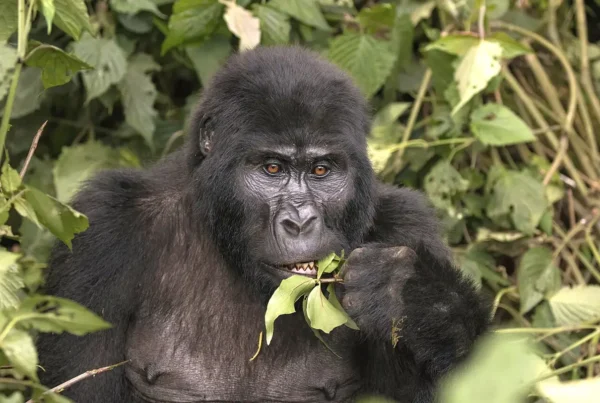
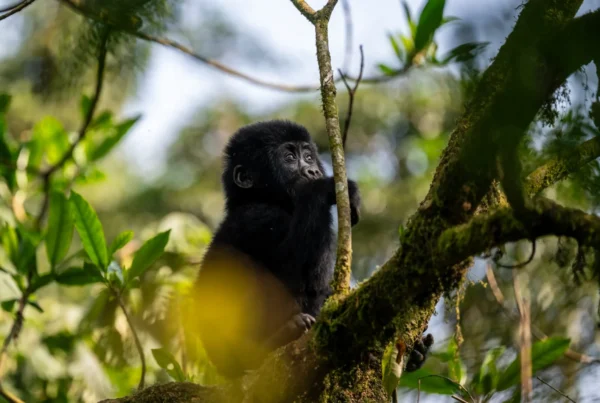
Days 3-5: Bwindi Impenetrable Forest — Gorilla Trekking. Drive directly southwest from Entebbe via the Fort Portal or Mbarara corridor to Bwindi — approximately 8-10 hours, or fly domestic to Kihihi. This is the anchor of the entire trip: your Uganda gorilla permit, an early morning sector briefing, and one of the most profound wildlife experiences available anywhere on earth. Sixty minutes with a habituated mountain gorilla family in ancient forest that has existed continuously for 25,000 years. Stay at Buhoma, Rushaga, or Nkuringo depending on your permit sector. Two nights at Bwindi minimum.
Days 6-7: Queen Elizabeth National Park. Drive northeast from Bwindi to Queen Elizabeth — approximately 3-4 hours. This is Uganda’s most diverse park: savannah game drives on Kasenyi Plains for lion, buffalo, elephant, and warthog; the Kazinga Channel boat safari for hippos and Nile crocodiles at close range; the Ishasha sector in the south for tree-climbing lions, one of the few populations of lions that habitually rest in fig tree branches. Two nights, two game drives, one boat safari.
Day 8: Cross into Rwanda — Katuna/Gatuna Border. Drive south from Queen Elizabeth through Kabale to the Katuna border crossing into Rwanda. The crossing takes 1-2 hours under normal conditions. East African Tourist Visa holders cross without additional visa cost. You are now out of Uganda. Day 8 is Day 1 of your 21-day clock running down outside the outbreak zone.
Days 9-11: Rwanda — Volcanoes National Park, Second Gorilla Trek. Drive from Gatuna to Musanze (formerly Ruhengeri) — approximately 2 hours. Volcanoes National Park is where Dian Fossey conducted her research and is buried. Your Rwanda gorilla permit (USD $1,500) gives you access to a different habituated family group in a different forest sector — more open terrain than Bwindi, shorter average trek, with the Virunga volcanoes visible above the canopy. The double gorilla trek — Uganda and Rwanda in the same trip — is the most complete mountain gorilla experience available on earth. Two nights in Musanze, then drive to Kigali.
Days 12-13: Kigali, Rwanda. Rwanda’s capital is one of the most surprising cities in Africa — clean, safe, organised, with a food and coffee scene that punches well above its weight. The Kigali Genocide Memorial is essential — a sobering, extraordinarily well-presented account of the 1994 genocide that provides critical context for understanding modern Rwanda and East Africa. The Inema Arts Centre in Kinyinya is the best contemporary art gallery in the region. Nyamirambo neighbourhood for evening dining and street food. Two nights in Kigali at a rooftop hotel with Nyungwe views.
Days 14-16: Nyungwe Forest, Rwanda. Drive southwest from Kigali to Nyungwe Forest National Park — approximately 5-6 hours through Rwanda’s spectacular thousand-hills landscape. Nyungwe is one of Africa’s oldest and most biodiverse montane rainforests: chimpanzee trekking through a primate community of 13 species, the canopy walkway suspended above the forest floor, colobus monkey troops, and over 300 bird species. This is the Rwanda that most visitors miss by flying straight from gorillas to Kigali. Three nights in the forest.
Day 17: Lake Kivu, Rwanda. Drive from Nyungwe to Kibuye (Karongi) or Rubavu on Lake Kivu — Rwanda’s highland lake, shared with DRC, at 1,460 metres altitude with a climate that feels like permanent spring. Boat trip to Amahoro Island, local fishing village visit, evening on the lake terrace. One night on the water. By Day 17 you are 10 days out of Uganda.
Day 18: Fly Kigali to Kilimanjaro or Arusha, Tanzania. Morning flight from Kigali International Airport to Kilimanjaro International Airport — approximately 2 hours. Tanzania is now under no Ebola advisory, no Level 4, no monitoring concern. You have entered a different advisory universe entirely. Transfer to Arusha, the northern safari hub.
Days 19-22: Serengeti National Park, Tanzania. The Serengeti is the largest intact savannah ecosystem remaining on earth — 14,763 square kilometres of grassland, kopjes, and acacia woodland supporting the largest concentrations of wildlife on the planet. The wildebeest migration (1.5 million animals) moves through different sectors by season: the calving grounds of the southern Serengeti in January-February; the Grumeti River crossings in June-July; the dramatic Mara River crossings at the northern Masai Mara border in August-October. Four nights in the Serengeti, mobile or fixed tented camp depending on season, twice-daily game drives. Lions, cheetah, leopard, elephant, wild dog if you are fortunate. By Day 22 you are 15 days out of Uganda and well into the back half of your monitoring window.
Days 23-24: Ngorongoro Crater, Tanzania. The world’s largest intact volcanic caldera, 20 kilometres across, containing a self-sustaining ecosystem of approximately 25,000 large mammals including the densest lion population in Africa and one of the few remaining black rhino populations accessible to safari visitors. The descent into the crater is one of the great moments in travel — the rim drops away and you see the entire ecosystem laid out below you. Two nights at a crater rim lodge, one full day on the crater floor.
Days 25-27: Zanzibar, Tanzania. Fly from Kilimanjaro to Zanzibar — approximately 1 hour. The island of Unguja (Zanzibar proper) offers Stone Town’s UNESCO-listed Swahili-Arab architecture, the world-class beaches of the northern coast (Nungwi, Kendwa), and the spice farms of the interior. Three nights. Rest, ocean, seafood, the dhow harbour at sunset. By Day 27 you are 20 days out of Uganda — one day short of your full 21-day window.
Day 28: Fly Zanzibar to Nairobi or direct to your US hub. You are now 21 days past your last day in Uganda, symptom-free, with a travel history that documents your route through Rwanda, Tanzania, and Zanzibar. If flying home via Nairobi, one final night at a Nairobi airport hotel. The Giraffe Centre and Karen Blixen Museum are both within easy distance for a half-day. Your US-bound flight departs from JKIA Nairobi or direct from Zanzibar depending on routing.
Total trip: 28-32 days, four countries, two gorilla encounters, Serengeti and Ngorongoro, Zanzibar beach. The 21-day monitoring window completes while you are still in the field. You land in the United States as a traveller who visited Uganda 22-25 days ago, has been symptom-free throughout, and has the travel documentation to prove it.
How to Survive Quarantine If You Do Face It on Return
Despite the strategy above, some travellers will face enhanced scrutiny on return — either because their 21 days are not quite complete, because a local health authority applies stricter rules than the federal protocol, or because a symptom triggers assessment. Here is how to handle it.
Know the difference between monitoring and quarantine. Monitoring means you check your temperature twice daily, log it, and report to your local health department. You may continue your daily life, go to work, and see people — unless your jurisdiction has issued a specific quarantine order. Quarantine (mandatory home isolation) is a separate legal instrument, issued by a public health authority, and requires evidence of exposure risk. Asymptomatic returning travellers are almost always on monitoring, not quarantine. The 2014 West Africa Ebola crisis produced extensive CDC guidance on this distinction because of the public confusion between the two.
If you are placed on monitoring: register with your local health department immediately. Do not wait for them to find you. Proactive registration makes you a known, low-risk case rather than an unknown. The health department will give you a protocol — follow it exactly. Keep temperature logs. Keep your travel documentation (flight records, hotel receipts, border crossing stamps) organised and accessible.
If you develop any fever or symptoms during the monitoring period: Call the CDC Emergency Operations Center (770-488-7100) and your local health department before going anywhere. Do not drive yourself to an emergency room. Do not take public transport. The protocol is to call first, let health officials direct you to an appropriate assessment facility, and tell them your Uganda travel history upfront. The outcome for people who follow the protocol is dramatically better than for those who present at an ER without advance notice.
Practical home quarantine if it comes to that: Most travellers placed on actual quarantine during 2014 West Africa described it as intense boredom more than anything physically difficult. The 21 days of Ebola’s maximum incubation period, spent at home, pass. Have your work arrangements sorted in advance — remote work, leave, whatever is needed. Stock your home. Tell the people who need to know. Most quarantined travellers in 2014 tested negative, completed their monitoring period, and returned to normal life. The fear is worse than the experience for people who are not actually infected.
The practical reality for travellers who followed the safari strategy above: If you are 22+ days out of Uganda, symptom-free, with documented travel through Rwanda, Tanzania, and Kenya, the probability that you face mandatory quarantine on return is very low. You will be screened. You will be interviewed. Your travel history will be recorded. You will almost certainly go home the same day. The extended safari is not a guarantee — nothing in travel is — but it is the most rational risk-reduction strategy available within the framework of wanting to see Uganda’s gorillas during the current advisory period.
Frequently Asked Questions
No legal ban prevents US citizens from travelling to Uganda. The Level 4 Do Not Travel advisory means your travel insurance is voided for the Uganda portion, US Embassy assistance is limited, and you face enhanced health screening and mandatory 21-day monitoring when you return. These consequences function as a practical deterrent even without being a legal prohibition. The strategy for Americans who want to proceed anyway is to complete Uganda first and then spend 21+ days in neighbouring East African countries before flying home, so the Ebola incubation window passes while you are still travelling rather than after you return.
Americans returning from Uganda during an active Ebola Level 4 advisory face mandatory 21-day health monitoring — twice-daily temperature checks and symptom logging, registered with your local health department. This is monitoring, not quarantine. Mandatory home quarantine (isolation order) is a separate legal instrument applied only if symptoms develop or if a specific high-risk exposure is confirmed. Asymptomatic returning travellers are placed on monitoring, not quarantine. Travellers who spend 21+ days in Rwanda, Tanzania, and Kenya after leaving Uganda before flying home will have already completed their monitoring window before arriving at a US port of entry.
Ebola Bundibugyo has a maximum incubation period of 21 days. If you leave Uganda and spend at least 21 days in non-affected countries (Rwanda, Tanzania, Kenya) before returning to the US, you have passed the full incubation window. A traveller who is 22+ days out of Uganda, symptom-free, with documented travel through non-outbreak countries arrives in the US in a fundamentally different risk category than one flying home directly from Entebbe. Enhanced screening will still ask about Uganda travel — the 21-day post-Uganda stay does not erase the disclosure requirement, but it changes the assessment outcome significantly.
Rwanda, Tanzania, and Kenya all have normal US travel advisory levels during the current Uganda Ebola outbreak and offer outstanding safari experiences that combine naturally with a Uganda gorilla trek. Rwanda (gorilla trekking at Volcanoes NP, Kigali, Nyungwe chimpanzees) is the most natural first stop after crossing south from Uganda. Tanzania (Serengeti migration, Ngorongoro Crater, Kilimanjaro, Zanzibar beach) is the second-largest component and easily covers 7-10 days. Kenya (Masai Mara great migration, Amboseli, Nairobi, Diani beach on the south coast) can anchor your departure with flights home from Nairobi via most major US-connecting hubs.
If you develop fever (above 38.6C / 101.5F), severe headache, unexplained fatigue, vomiting, diarrhoea, or unexplained bleeding within 21 days of leaving Uganda, call the CDC Emergency Operations Center (770-488-7100) and your local health department immediately. Do not drive yourself to an emergency room or take public transport. Tell the operator your Uganda travel history at the start of the call. Health officials will direct you to an appropriate assessment facility. Early contact with health authorities produces significantly better outcomes than self-presenting at a clinic without advance notice. This protocol applies whether or not you followed the 21-day extended safari strategy — disclosure and early contact are always the correct response to symptoms post-Uganda travel.