Two Giants of African Forests
When people talk about gorillas, they often treat the species as a single entity. In reality, gorillas are divided into two species — the western gorilla and the eastern gorilla — each with two subspecies. The eastern gorilla species (Gorilla beringei) includes two distinct subspecies: the mountain gorilla (Gorilla beringei beringei) and the eastern lowland gorilla, also known as Grauer’s gorilla (Gorilla beringei graueri). These two subspecies share a species but have diverged significantly in size, habitat, distribution, and conservation status.
Understanding the differences between them deepens appreciation for both and clarifies why mountain gorilla conservation, with its tight geographic focus on Uganda, Rwanda, and DRC’s highlands, is distinct from eastern lowland gorilla conservation in the Congo Basin.
Size: The Biggest Ape on Earth
The eastern lowland gorilla holds the record as the largest of all gorilla subspecies — and therefore the largest living primate on Earth. Adult male eastern lowland silverbacks can weigh up to 250 kilograms, significantly exceeding the 160 to 200 kilogram range typical of mountain gorilla silverbacks. Their greater body mass is accompanied by a larger, more barrel-shaped trunk and proportionally shorter arms relative to body size than mountain gorillas.
Mountain gorillas are not small — a 170-kilogram silverback is an extraordinarily impressive animal — but side by side, an eastern lowland gorilla silverback would appear visibly larger and more massively built. Females of both subspecies are significantly smaller than males, averaging 70 to 100 kilograms, with eastern lowland females slightly heavier on average.
Physical Appearance
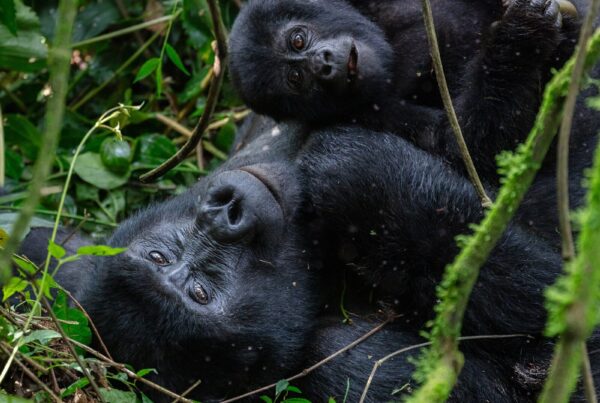
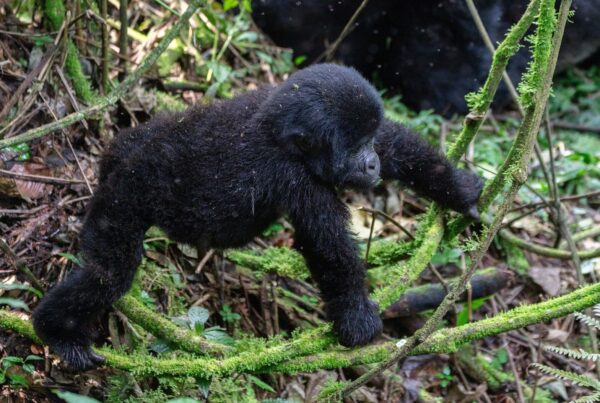
The two subspecies are visually distinguishable to experienced observers. Mountain gorillas have several distinct physical characteristics: longer, thicker, darker fur (an adaptation to the cold highland environment), a shorter, rounder face, and a more muscular, compact body build. The longer coat is the most immediately apparent difference — a mountain gorilla in Bwindi’s misty forest looks substantially shaggier than its lowland cousin.
Eastern lowland gorillas have shorter, finer fur suited to their warmer, lower-altitude habitat. Their faces are slightly longer, their noses broader, and their overall build is larger and more elongated. The silverback’s saddle — the silver hair across the back that gives the designation — appears in both subspecies, though the colour and extent can differ subtly.
Habitat: Altitude and Forest Type
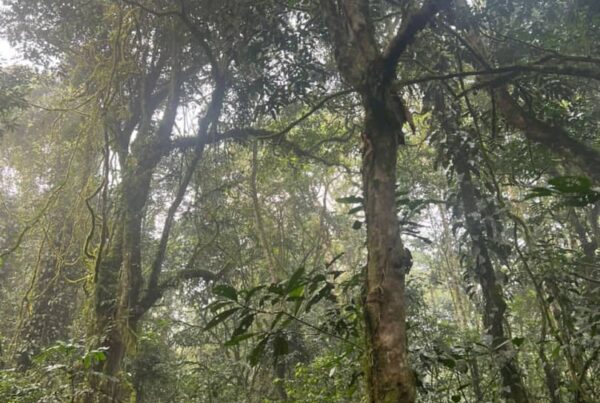
The habitat difference is the most fundamental ecological distinction between the two subspecies. Mountain gorillas inhabit high-altitude montane forest from approximately 1,500 to 4,000 metres above sea level. They are cold-adapted, capable of surviving temperatures near freezing at their highest elevations, and their long fur is the primary physiological adaptation to these conditions.
Eastern lowland gorillas inhabit tropical and subtropical lowland and montane forest in the Democratic Republic of Congo, primarily in the eastern provinces. Their altitude range overlaps with mountain gorillas at the upper end — some Grauer’s gorilla populations live at elevations approaching 2,500 metres — but the typical habitat is warmer, lower, and more humid. Their forest is less open, more canopy-dense, and dominated by different plant communities that produce different foraging opportunities.
Geographic Distribution
Mountain gorillas exist in only two isolated populations: Bwindi Impenetrable National Park in Uganda, and the Virunga Massif shared between Uganda, Rwanda, and DRC. Their total range is tiny — the two populations together occupy approximately 1,000 square kilometres of protected forest.
Eastern lowland gorillas have a substantially larger geographic range across DRC’s eastern provinces, covering perhaps 90,000 square kilometres of forest. However, this range has been dramatically fragmented by decades of civil conflict, mining, and agricultural expansion. Despite their larger range, eastern lowland gorillas are considered Critically Endangered — the same category that mountain gorillas have recently been reclassified out of.
Population Numbers
Mountain gorillas number approximately 1,063 individuals, a figure that represents a remarkable recovery from fewer than 250 in the 1980s. This recovery is the result of intensive, focused conservation investment in a small, well-defined area.
Eastern lowland gorilla population estimates are considerably more uncertain. Pre-conflict surveys in the 1990s estimated approximately 17,000 individuals, but decades of civil war, illegal mining activity, and bushmeat hunting have caused dramatic population declines. Current estimates suggest as few as 3,800 remain, representing a decline of approximately 77% over less than 30 years. This makes eastern lowland gorillas arguably more imperilled in terms of rate of decline than mountain gorillas, despite their nominally larger numbers.
Conservation Status and Challenges
Mountain gorillas were reclassified from Critically Endangered to Endangered by the IUCN in 2018, reflecting genuine population recovery. This reclassification, while encouraging, does not mean the species is secure — 1,063 individuals in two isolated populations remain highly vulnerable.
Eastern lowland gorillas remain Critically Endangered, and their conservation situation is far more challenging than mountain gorillas. The ongoing conflict in eastern DRC makes systematic ranger protection, anti-poaching patrols, and veterinary monitoring extremely difficult. Tourism, which has been the financial engine of mountain gorilla recovery, is largely impractical in Grauer’s gorilla habitat due to security concerns. International attention and funding disproportionately favour mountain gorillas, leaving eastern lowland gorillas in a more precarious situation despite their critical status.
Can You See Eastern Lowland Gorillas?
A small number of eastern lowland gorilla groups have been habituated for tourism in Kahuzi-Biega National Park in eastern DRC. When security conditions allow — which has been intermittent — visitors can trek to see these gorillas in a park that also protects exceptional biodiversity. The experience is rawer and less developed than Uganda’s gorilla trekking, but for those seeking an off-the-beaten-path primate encounter, it is extraordinary when accessible.
For most travellers, the practical choice remains Uganda or Rwanda for mountain gorillas, with the eastern lowland gorilla remaining an aspirational encounter tied to the stabilisation of eastern DRC.
Final Thoughts
Eastern lowland and mountain gorillas are two distinct subspecies facing different but equally serious conservation challenges. The mountain gorilla’s recovery story offers lessons — particularly the transformative power of regulated tourism revenue — that could benefit eastern lowland gorillas if political stability ever makes large-scale tourism feasible in their range. Until then, understanding the differences between these two remarkable animals enriches appreciation for both.
Frequently Asked Questions
Uganda is significantly cheaper. Uganda’s standard permit costs $800; Rwanda’s costs $1,500. For 4-hour gorilla habituation, Uganda charges $1,800 — Rwanda has no equivalent experience. The $700 saving on a standard permit is the primary reason most budget-conscious travellers choose Uganda.
Uganda. Bwindi and Mgahinga together have 20+ habituated gorilla families and issue more daily permits than Rwanda’s Volcanoes National Park. Uganda also offers the Gorilla Habituation Experience, which Rwanda does not. Rwanda’s advantage is accessibility — Volcanoes NP is 2 hours from Kigali airport.
Yes — this is a popular combination. The Kigali to Bwindi road journey takes approximately 4 hours via Kabale. Some visitors trek in Mgahinga (Uganda) one day and cross into Rwanda for Volcanoes the next. Note that your Uganda permit cannot be used in Rwanda and vice versa — separate permits are required.
Rwanda’s Volcanoes National Park offers easier access (2 hours from Kigali airport), high-end lodge infrastructure, and the Dian Fossey research legacy. Rwanda also offers golden monkey trekking in the same park. However, at $1,500 per permit, it costs nearly double Uganda’s $800 rate for the same 1-hour trek.
Uganda is home to the mountain gorilla (Gorilla beringei beringei), one of two subspecies of eastern gorilla. They live exclusively in the Virunga volcanic highlands (Uganda/Rwanda/DRC) and Bwindi Impenetrable Forest (Uganda only). Mountain gorillas are the only gorilla subspecies that cannot survive in captivity — every individual you can trek is a wild animal.