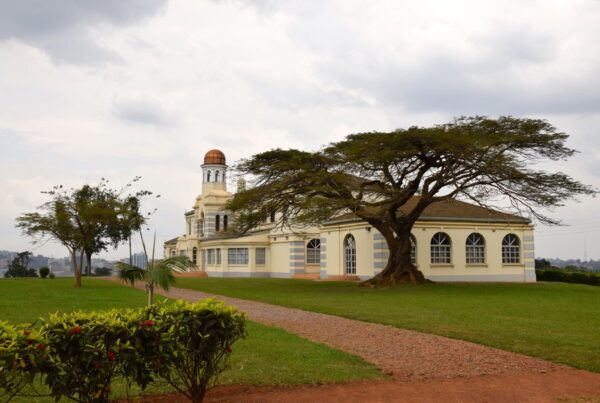
The Uganda National Mosque, widely known as the Gaddafi Mosque, stands on Old Kampala Hill and is one of the largest mosques in Africa. Construction began in the 1970s and it was completed with funding from Libya, opening in 2007. Visitors can tour the mosque and climb the minaret for one of the best views over Kampala’s hills.
What to see
The prayer hall can hold thousands of worshippers and is decorated with carpets, chandeliers and stained glass. The minaret climb, up a long spiral staircase, ends at a viewing platform looking over the whole city, including the other hills with their famous churches and palaces. Guides explain the history of Islam in Uganda, which arrived with Arab and Swahili traders in the 19th century.
Visiting
Guided tours run outside prayer times. Dress modestly: women are lent headscarves and wraps at the entrance, and everyone removes shoes in the prayer hall. There is an entry fee for tourists. Allow about an hour, including the minaret climb.
Combining your visit
Old Kampala Hill is also where Frederick Lugard built his fort in 1890. The gorilla permit costs US$800, or US$600 in April, May and November. See our guides to Kampala’s religious landmarks, Frederick Lugard, Namirembe Cathedral and the Uganda Museum.
Frequently asked questions
Because Libya funded its completion; it opened in 2007.
Yes, on guided tours outside prayer times.
Modest clothing; women are lent headscarves and wraps.
Yes, for panoramic views of Kampala.
The National Mosque’s Architecture and History
The Uganda National Mosque — commonly called the Gaddafi Mosque after the Libyan government that funded its 2007 completion — occupies Old Kampala Hill and is the largest mosque in sub-Saharan Africa by capacity, accommodating up to 15,000 worshippers in its main prayer hall and up to 35,000 when the surrounding grounds are used for major gatherings. The building’s architectural style combines North African Islamic design vocabulary with local construction materials and the scale that the elevated site’s panoramic visibility demanded — the minaret, reaching 50 metres, is visible from across central Kampala and serves as an orientation landmark from most elevated viewing points in the city.
The mosque’s construction history reflects the political relationship between Uganda and Libya during the Idi Amin period — Amin’s conversion to Islam and his cultivation of Libyan support during his presidency established the financing relationship that Gaddafi’s government eventually converted into the mosque project after a 30-year delay from the original 1970s planning. The current building replaced an earlier mosque on the same site and is managed by the Uganda Muslim Supreme Council, which oversees the mosque’s educational, welfare, and community functions alongside its devotional role.
Non-Muslim visitors are welcome at the National Mosque during visiting hours (outside of prayer times) with appropriate dress — headscarves for women, long trousers for men, and shoes removed at the entrance. Volunteer guides provide tours of the main prayer hall, the ablution facilities, and the minaret viewing platform, where the panoramic view across Kampala is one of the city’s most comprehensive. The 20-minute drive from the central business district makes the mosque accessible as part of a Kampala cultural half-day that includes the Bahá’í Temple and Namirembe Cathedral for visitors interested in the comparative religious architecture of the city’s hilltop institutions.
Visiting the Mosque: Practical Tips
The visit to the Uganda National Mosque is most rewarding when the visitor arrives outside of the five daily prayer times — particularly the Friday Jumu’ah prayer that draws several thousand worshippers to the mosque and the surrounding streets, which creates an atmosphere that is genuinely impressive but also makes a casual tourist visit logistically difficult. The visiting hours that allow access to the main prayer hall interior and the minaret are typically established between the morning and midday prayers, and between the midday and afternoon prayers — a window of approximately 2 to 3 hours on either side of the midday prayer time. The volunteer guide who meets visitors at the entrance will explain the prayer time restrictions and will organise the dress requirement compliance (borrowing headscarves and robes for visitors who have not brought their own appropriate clothing, which the mosque provides as a visitor service at no additional charge). The panoramic view from the minaret viewing platform is one of Kampala’s most comprehensive, visible in all directions across the city’s hills, and the distance from the city centre to the mosque hill — traversed by the minaret staircase — provides a physical understanding of the city’s scale that the street-level view cannot. Photography inside the main prayer hall is permitted outside of prayer times, and the minaret view is one of the most consistently photographed Kampala city perspectives in the visitor community’s social media output.