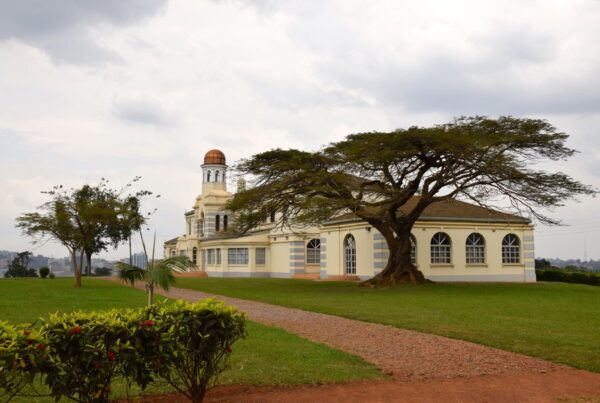
The Kabaka’s Lake, in Ndeeba near Mengo in Kampala, is a large man-made lake dug in the 1880s on the orders of Kabaka Mwanga II of Buganda. Tradition says he wanted a waterway from his palace to Lake Victoria as an escape route and for boat travel, but the channel was never completed. Today it is a quiet spot with a small island and views of the Lubiri palace hill.
History
Mwanga II reigned during a turbulent period of religious conflict and growing European influence. The lake was dug by hand by people from Buganda’s clans, each responsible for a section. It is often described as the largest man-made lake in Uganda. The lake and the nearby palace grounds remain important to the Buganda kingdom.
Visiting
You can walk around parts of the shore, and the lake is usually visited on a Kampala city tour combined with the Kabaka’s Palace at Mengo and the Lubaga Cathedral on the neighbouring hill. Birds such as herons, egrets and kingfishers feed along the edges.
Combining your visit
Allow 30 to 45 minutes. A local guide adds the history and stories behind the lake. The gorilla permit costs US$800, or US$600 in April, May and November. See our guides to the Kabaka’s Palace, the Kasubi royal tombs, Buganda culture and the Uganda Museum.
Frequently asked questions
It was dug in the 1880s on the orders of Kabaka Mwanga II.
Tradition says as a waterway and escape route towards Lake Victoria.
In Ndeeba, near Mengo in Kampala.
The Kabaka’s Palace at Mengo and Lubaga Cathedral.
The Lake’s Construction and Purpose
The Kabaka’s Lake in Kampala — a man-made reservoir covering approximately 0.8 square kilometres in the Lubiri neighbourhood near the Mengo Palace — was constructed in the 1880s on the orders of Kabaka Mwanga II as a demonstration of the Buganda Kingdom’s organisational capacity and as a leisure and transport resource for the royal court. The construction required the mobilisation of hundreds of workers from the communities under the Kabaka’s authority across multiple months, a scale of collective labour organisation that the Buganda Kingdom’s administrative structure could command and that few pre-colonial East African polities could match. The lake’s contemporary state — maintained as a public open space and wildlife habitat rather than as a functional water resource — reflects the transformation of its context from the active royal court of the 1880s to the constitutional monarchy’s symbolic landscape of the present.
The lake’s bird community — including the African Jacana, the Malachite Kingfisher, and the various heron and egret species that its shallow margins attract — makes it a practical birdwatching site within the urban fabric of Kampala for visitors who cannot access the more remote birding sites during a short city stopover. The walk around the lake’s perimeter, accessible from the Lubiri road that passes the Mengo Palace gates, takes approximately 45 minutes at a leisurely pace and provides the combination of historical context and urban wildlife observation that few other accessible Kampala destinations offer.
The Mengo Palace complex adjacent to the lake is the Buganda Kingdom’s official administrative seat and includes a museum documenting the kingdom’s history. The palace’s public access areas, including the torture cells maintained as a historical memorial from the Idi Amin period when the palace was used as a security services facility, are open to visitors and provide one of the most historically sobering accessible sites in Kampala.
Birdwatching at the Kabaka’s Lake
The Kabaka’s Lake’s bird community — concentrated in the papyrus fringe and the open water areas — makes it one of the more accessible urban birdwatching sites in Kampala for the visitor with a morning free before a departure or between city engagements. The African Jacana’s presence is reliable — the species’ laterally distributed weight (enabling it to walk on floating vegetation) makes the open papyrus mat its preferred habitat, and the lake’s papyrus fringe provides exactly this environment. The Malachite Kingfisher hunts the lake’s shallow margins with the brilliant blue-and-orange plumage that makes it among the most photographed small birds in Uganda, and the perch positions on the low papyrus stems at the water’s edge make it accessible at distances that allow the detail photography that the larger waterbirds’ wariness prevents. The herons — the Grey Heron and the Black-headed Heron that are among Uganda’s most common large wading birds — use the lake’s open water areas, and the rare Goliath Heron (Africa’s largest heron) occasionally visits. A morning walk around the full perimeter, combined with the historical context of the Mengo Palace visit that follows, creates a 3-hour Kampala cultural and natural experience that costs very little and provides a disproportionate return in both birdwatching content and historical understanding.