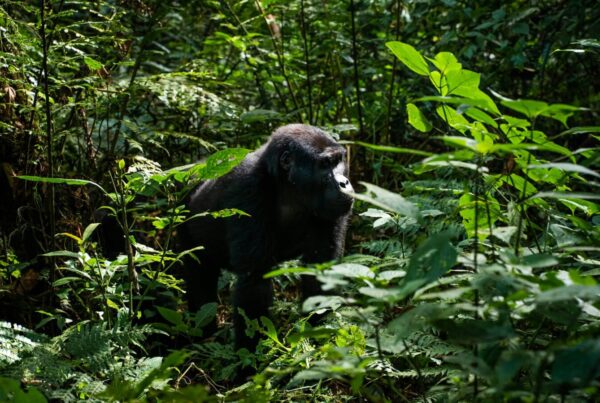
June marks the start of Uganda’s main dry season, and it is one of the best months for gorilla trekking: rain becomes less frequent, trails dry out and firm up, and mornings are cool and often clear. The permit is back to the full price of US$800, and demand rises through the month as European and North American summer holidays begin, so book permits and lodges several months ahead. Early June often still has some showers, and Bwindi, as a rainforest, can see rain in any month.
Weather in June
After the long rains, June brings longer dry spells, with mornings around 10–15°C at Bwindi’s altitude and afternoons in the low 20s°C. Nights can feel chilly, especially in Ruhija and the southern sectors. Some showers still fall, more often early in the month, but the heavy, prolonged storms of April are rarer. See our guide to weather at Bwindi.
Trekking conditions
As the trails dry, the walk becomes easier and faster, though Bwindi’s slopes are steep in any season. Light is often better for photography, and road transfers and domestic flights are less likely to be delayed. The gorillas are tracked every morning, and the hour with them is the same as in any month. The drier conditions also make June a good time to combine Bwindi with savanna parks such as Queen Elizabeth, where shorter grass makes wildlife easier to see. See our 7-day gorilla and wildlife itinerary.
Booking in June
June is the start of the high season. Book the gorilla permit three to six months ahead, then a lodge in the same sector; early June is usually easier than late June. In 2027, the Africa Cup of Nations, co-hosted by Uganda, Kenya and Tanzania, is scheduled from mid-June to mid-July and is expected to add demand for flights and hotels, especially around Kampala, so book early if your trip falls then. See our guide to permit availability.
Public holidays in June
Martyrs Day on 3 June brings huge crowds of pilgrims to Namugongo near Kampala and heavy traffic for several days, and National Heroes Day follows on 9 June. Parks operate normally on public holidays, but plan Kampala transfers around the crowds. See our guides to Martyrs Day and public holidays.
What to pack
Even in June, bring a rain jacket, as forest showers happen. Add a warm fleece for cool mornings and evenings, broken-in boots, gardening gloves, long trousers and sleeves, insect repellent and sun protection for savanna days. See our packing list, compare May and July, or read our guide to the best time for gorilla trekking.
Frequently asked questions
Yes. It is the start of the dry season, with firmer trails and good conditions for combining parks.
US$800 for foreign non-residents.
Less than in the wet season, but showers are still possible, especially early in the month.
Three to six months ahead, and earlier for groups or late June.
June’s Position in Uganda’s Safari Calendar
June marks the beginning of Uganda’s main dry season — the period that runs through September and draws the highest visitor numbers to Bwindi Impenetrable National Park. The forest is at its most accessible: trails are dry, the ascent to higher-altitude gorilla family ranges is manageable, and the long evening light of June’s clear skies creates excellent conditions for photography during the walk to and from the encounter. Accommodation lodges near Bwindi’s sectors typically operate at peak occupancy from June onwards, and the atmosphere at the morning briefing is often more social as larger groups of visitors from multiple nationalities assemble for the day’s treks.
Booking Urgency in June
June permits are among the most sought-after in the Uganda gorilla trekking calendar, and booking lead times of 6 months or more are standard for peak dates. Visitors who secure June permits and accommodation in advance find the experience seamlessly organised; those who enquire in March or April for June dates frequently find preferred sectors and lodges already at capacity. The lesson from Uganda’s gorilla trekking booking calendar is consistent: June is a month where flexibility about specific dates is more valuable than flexibility about the general timing.
For travellers booking a June gorilla trek as part of a broader East Africa itinerary, the key logistical advice is to position Bwindi at the end of the trip rather than the beginning when possible. Arriving in Uganda after experiencing other safari destinations primes visitors for the contrast of the gorilla encounter — the intimate, forest-based nature of trekking registers differently when experienced after the open-vehicle game viewing of parks like the Serengeti or Masai Mara, and the emotional impact of the encounter benefits from that context.