

Updated
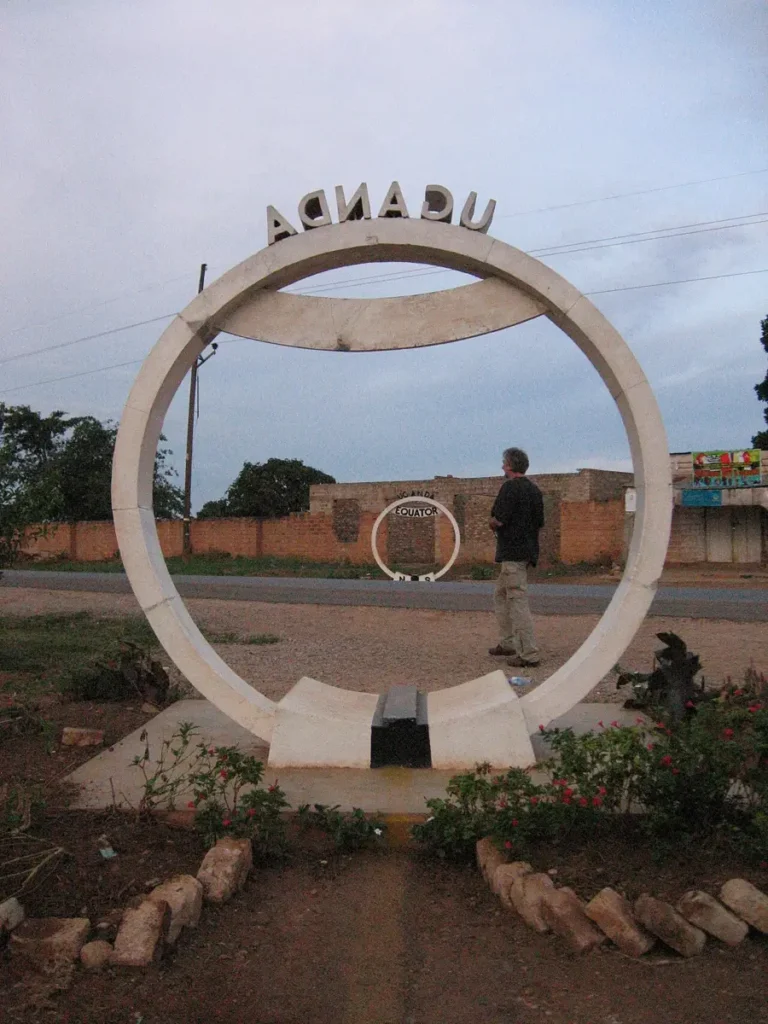
The most popular equator stop in Uganda is at Kayabwe on the Kampala–Masaka road, about 70 km and 1.5–2 hours south-west of Kampala, on the route most travellers take to Lake Mburo and Bwindi. Two concrete rings mark the line, surrounded by craft shops, cafés and demonstrators who show water swirling in different directions on each side. It makes a good 20–30 minute break on the long drive west. The equator also crosses Queen Elizabeth National Park, where another marker stands near Kasese.
What you will find at Kayabwe
The equator monument, a pair of rings standing either side of the road, is the classic photo spot, with one foot in each hemisphere. Around it are craft shops selling baskets, carvings, bark cloth items, kitenge fabric and gorilla souvenirs, plus cafés serving coffee, snacks and lunch, and clean toilets, welcome on a long drive. Prices are higher than in town markets, so a little bargaining is normal. See our guide to craft shopping in Uganda.
The water experiment
Demonstrators pour water through a basin a few metres north and south of the line and show it draining clockwise on one side and anticlockwise on the other, then straight down on the line itself. It is a fun show, but the effect is produced by how the water is poured and swirled: the Coriolis force is far too weak to decide the direction of draining in a small basin. Enjoy it as entertainment and tip the demonstrator if you watched.
Fitting it into your journey
Most drivers stop at Kayabwe on the first morning heading to Lake Mburo, Bwindi or Lake Bunyonyi, or on the way back to Entebbe. In Queen Elizabeth, the equator markers near the Kasese road are a quick stop between Kibale and the park. Beyond the equator, the route passes Mpigi, known for bark cloth and drums, and the busy town of Masaka. See our guides to bark cloth, Lake Mburo and a 10-day itinerary. The gorilla permit costs US$800, or US$600 in April, May and November.
Frequently asked questions
At Kayabwe on the Kampala–Masaka road, and in Queen Elizabeth National Park.
About 70 km, or 1.5–2 hours by road.
It is a fun demonstration, but the effect comes from how the water is poured, not the Coriolis force.
Usually 20–30 minutes.










