Updated
Among the many dimensions of a gorilla trekking encounter, the observation of a mother gorilla caring for her infant is consistently identified by families as among the most emotionally affecting. The quality of gorilla maternal care—the patient nursing, the constant physical contact, the vigilant protection—is immediately legible to human observers, and for children old enough to have younger siblings or to understand caregiving relationships, the encounter provides a living illustration of nurture that crosses the species boundary in deeply affecting ways.
The reality of gorilla maternal care
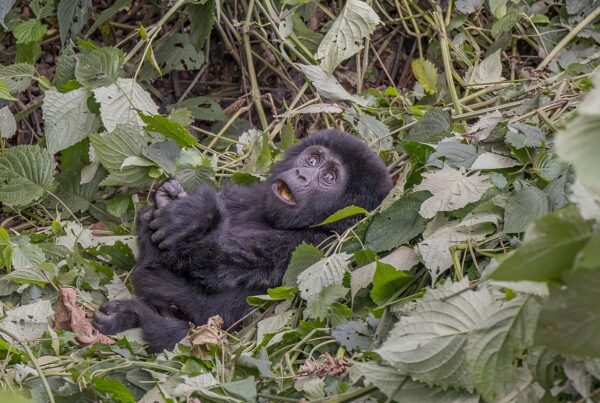
Mountain gorilla mothers carry their infants constantly for the first three to four months of life, with the infant clinging to the mother’s chest ventrum-to-ventrum in a hold that requires virtually no active muscular effort from the infant but demands continuous postural adjustment from the mother. From around four months, infants begin to ride on the mother’s back—a position they maintain through the first year and beyond during long treks or in situations the mother perceives as potentially threatening. Nursing continues for up to three years, providing both nutrition and the constant physical reassurance that supports the infant’s psychological development.
Gorilla mothers groom their infants—using fingers and lips to remove debris, insects, and dead skin from the infant’s coat—in a practice that serves both hygienic and bonding functions. Grooming in primates releases endorphins and oxytocin in both the groomer and the groomed, creating the neurochemical basis for social bonding that is homologous to the human experience of physical affection. When a child watches a gorilla mother patiently grooming her infant while the infant lies relaxed and trusting, they are witnessing a version of the same affective infrastructure that underlies human parent-child relationships.
The conversation to have before and after the encounter
Before the trek, introduce children to the concept of gorilla maternal care through age-appropriate materials—books, short documentary clips, or conversations about the similarities and differences between gorilla and human families. This preparation creates a conceptual frame that the encounter fills with direct sensory experience, and it prepares children for the specific observation task of watching how the mother and infant interact rather than simply looking at the scene as spectacle.
After the encounter, while the experience is fresh, ask open questions: “What did you notice about how the mother was with the baby?” “How do you think the baby felt when the mother held it?” “What was different about how the gorilla mother cared for her baby compared to how our family works?” These questions connect the observation to the child’s existing knowledge and emotional frameworks, deepening the memory and building the reflective capacity that transforms a wildlife sighting into an educational experience.
What this teaches about conservation
The mother-infant relationship is also the most powerful lever for communicating why gorilla conservation matters to children. Abstract threats—habitat loss, disease, poaching—are difficult for young people to relate to. But a child who has watched a mother gorilla hold her infant and can imagine the consequences of that family losing its home understands the moral urgency of conservation in a way that statistics and ecology lectures cannot create. Conservation educators consistently find that empathy-based approaches—helping people feel the cost of loss rather than merely understand it intellectually—produce stronger and more durable conservation commitment. A gorilla mother and her infant, seen in person, is one of the most effective empathy generators available anywhere in the natural world.
- How children learn conservation values through wildlife encounters in Uganda
- What children learn from watching gorillas: a guide for families with young wildlife lovers
- Preparing children for their first safari: age-appropriate lessons before Uganda
- How to explain endangered species to children: lessons from the mountain gorilla
- Travelling to Uganda With Children: Family Gorilla Safari Tips
- Gorilla Trekking for Families: Can Children Trek?
- How Gorillas Raise Their Young: Motherhood in the Forest
- Gorilla Doctors: Veterinary Care for Mountain Gorillas
- Bwindi Gorilla Trekking with Children: Family Safari Guide
- The Woman Who Trekked to See Gorillas 6 Weeks After Chemotherapy
The gorilla infant’s developmental arc — from helpless newborn to fully integrated family member — is visible to trekkers who visit the same habituated family across multiple years or who learn about specific infants’ histories from ranger briefings. Infant gorillas in their first year are carried continuously and rarely seen apart from their mothers; by their second year they make short exploratory ventures that the mother monitors without restraint; by their third or fourth year they play actively with peers and juveniles. These developmental stages, when understood, transform an apparently random scene of gorillas moving through the forest into a readable social narrative.