TALK TO AN EXPERT +256 716 068 279 WHATSAPP OPEN NOW.
Plants, Trees & Forest Ecology

Moss, lichen, and ferns: Bwindi’s ancient non-flowering plant world

Home / Travel News, Stories & Tips / Tales from the Mist / Moss, lichen, and ferns: Bwindi’s ancient non-flowering plant world

When most people think about Bwindi Impenetrable National Park’s vegetation, they think of trees — the towering canopy species, the strangler figs, the ancient mahogany. But the forest floor and the surfaces of every tree in Bwindi are covered by an entirely different category of plant life: the mosses, lichens, and ferns that collectively constitute some of the oldest and most ecologically important organisms in the entire ecosystem. Understanding this lower layer of the forest is to discover a biological world of extraordinary antiquity, diversity, and beauty that most visitors walk past without noticing.

Mosses: the forest’s moisture regulators

Mosses are non-vascular plants — they lack the specialised water-conducting tissue that allows ferns and flowering plants to grow tall. Instead, they absorb moisture directly through their surfaces, living in intimate contact with the water that passes over or through them. This direct dependence on moisture makes them both the most sensitive indicators of a forest’s hydrology and, paradoxically, some of its most important moisture managers.

Bwindi’s mosses are extraordinarily diverse. The park sits in the Albertine Rift at elevations where moisture condenses regularly on its forested slopes, creating the consistently humid conditions in which mosses thrive. On a typical forest walk, dozens of moss species are visible — from the flat, bright-green sheets that carpet the forest floor to the dense cushion mosses that colonise rotting logs, from the feathery pleurocarpous mosses that hang from branches to the upright, star-shaped acrocarpous mosses that form miniature forests on exposed bark.

The ecological role of mosses in Bwindi extends far beyond their modest appearance. A thick moss mat on the forest floor can hold many times its own weight in water — functioning as a sponge that absorbs rainfall during wet periods and releases it slowly during dry periods, moderating the hydrology of streams and springs that drain from the forest. The headwaters of rivers that supply drinking water to communities surrounding Bwindi are regulated, in part, by this moss sponge effect. Deforesting the catchment would destroy not just the trees but this invisible but critical water management system.

For insects, mosses provide microhabitat of enormous complexity. The spaces between moss stems, at scales invisible to the human eye, constitute a miniature three-dimensional landscape in which mites, springtails, nematodes, and a vast diversity of other invertebrates live out entire life cycles. These invertebrate communities are the base of food chains that feed spiders, frogs, birds, and ultimately the larger animals for which Bwindi is famous.

Lichens: the forest’s partnership organisms

Lichens are not a single type of organism but a symbiotic partnership between a fungus and a photosynthetic partner — usually an alga or cyanobacterium, sometimes both. The fungus provides structure and protection; the photosynthetic partner provides energy through photosynthesis. This partnership is so intimate and so stable that lichens function as unified organisms, occupying ecological niches that neither partner could survive alone.

Bwindi’s lichen diversity is remarkable. Crustose lichens — flat, paint-like organisms that grow directly on bark and rock surfaces — cover vast areas of tree trunk in the forest, their grey, green, orange, and white patches creating intricate patterns. Foliose lichens — leafy, lobed organisms that attach to surfaces at one point while remaining free at the edges — hang from branches and encrust the upper surfaces of larger mosses. Fruticose lichens — shrubby, three-dimensional structures — dangle from the highest branches of Bwindi’s canopy trees in conditions of high humidity and good light.

Lichens are among the most sensitive biological indicators of air quality available. They absorb nutrients and moisture — along with any pollutants present — directly from the atmosphere. In forests near industrial or agricultural pollution, lichen diversity collapses. In pristine environments like Bwindi, where the air carries nothing but moisture and the chemical byproducts of the forest itself, lichen communities can reach extraordinary diversity. The richness of Bwindi’s lichen flora is both a consequence of its ecological integrity and a living measurement of the air quality that the forest’s remoteness and protection have preserved.

Several lichen species at Bwindi are nitrogen-fixing cyanobacteria-containing lichens — organisms that take nitrogen from the atmosphere and convert it to biologically available forms that enrich the forest ecosystem. This nitrogen input is an important nutrient subsidy in forest systems where soil nutrient cycling is otherwise closed and conservative. Lichens falling from branches, decomposing on the forest floor, contribute nitrogen to the soil in ways that benefit the entire plant community above them.

Ferns: ancient vascular plants of the forest floor

Ferns are among the most ancient vascular plants, with a fossil record extending over 360 million years — predating both the dinosaurs and the flowering plants that today dominate most terrestrial ecosystems. In Bwindi’s shaded forest floor and disturbed edge zones, ferns are extraordinarily diverse and visually prominent, forming carpets of frond beneath the canopy that can extend for hundreds of metres.

Bwindi’s forest floor fern communities include some of the most species-rich assemblages in Africa. The park has been estimated to support over 100 fern species, ranging from tiny filmy ferns — so-called because their fronds are only a single cell thick and translucent — to the large tree ferns whose arching fronds reach several metres in height. Tree ferns in Bwindi’s mid-elevation zones create a distinctive visual character, their spiral crosiers unfurling in slow motion over weeks into full fronds that can exceed two metres in length.

Epiphytic ferns — species that grow on the surfaces of trees rather than in soil — are particularly notable in Bwindi. These ferns colonise the bark of large trees, the surfaces of mossy branches, and even the upper surfaces of large leaves in the canopy, using the elevated position to access light that does not reach the forest floor. Platycerium — the staghorn fern — is among the most visually striking, its antler-shaped fronds attached to tree trunks by a shield-like basal frond that captures falling debris and nutrients. Bird’s nest ferns (Asplenium nidus), with their wide, undivided fronds forming a rosette that collects organic matter, are common on large horizontal branches throughout Bwindi.

The role of non-flowering plants in gorilla diet

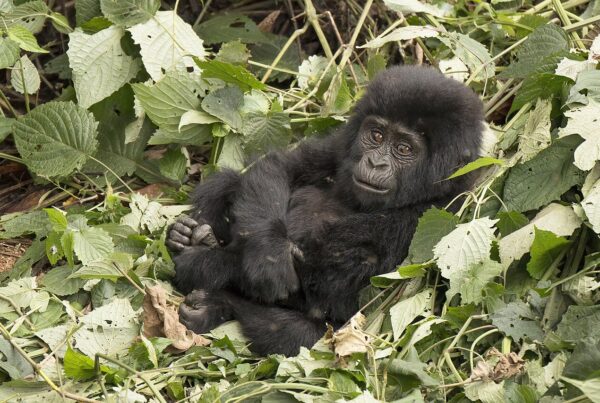
Mountain gorillas are highly selective but broadly plant-based feeders, and non-flowering plants feature in their diet. Several fern species are consumed by gorillas in Bwindi — particularly the young crosiers of certain species that are rich in protein relative to mature fronds. Gorillas are remarkably discerning in which fern parts they consume, often selecting only the newest growth, and researchers have documented significant seasonal variation in fern consumption depending on what other food sources are available and how nutritional composition varies through the growing season.

Mosses are not primary gorilla food but are occasionally consumed, possibly for their mineral content or incidentally when gorillas feed on soil or tree bark in which mosses are embedded. The relationship between gorilla ranging patterns and areas of high moss and fern diversity is not fully understood but is an active area of research — given that gorillas reshape vegetation through their feeding and movement, understanding how their presence influences the distribution of lower plant communities is an important component of the ecosystem ecology.

Bwindi’s altitude zones and non-flowering plant communities

Non-flowering plant communities in Bwindi change significantly with altitude. In the lower forest zones below 1,500 metres, the moss and lichen communities are rich but moderated by the higher temperatures and slightly lower humidity of these warmer elevations. As altitude increases and temperature drops, moisture retention increases and the moss, lichen, and fern communities become progressively denser and more diverse.

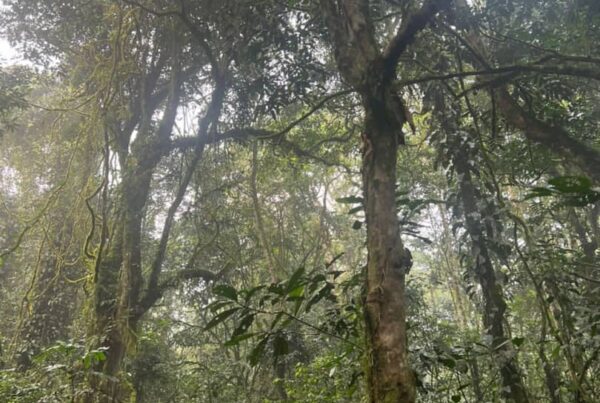
Above 2,000 metres, in the montane forest zone of Ruhija and the park’s highest ridges, the trees become festooned with epiphytic mosses and lichens to an extent that gives the forest an almost ethereal appearance — every branch coated in several centimetres of dense moss growth, every surface soft and saturated. This high-altitude moss forest is among the most visually extraordinary vegetation types in all of Uganda, and its ecological function in water retention and biodiversity support is disproportionately significant relative to its spatial extent.

Conservation significance

The conservation of Bwindi’s non-flowering plant communities is inseparable from the conservation of the forest as a whole. Many moss, lichen, and fern species at Bwindi are Albertine Rift endemics — found only in this narrow strip of montane forest along the western edge of the East African Rift Valley. Some species are known from only a handful of locations in the entire world. Their survival depends entirely on the integrity of the forest ecosystem in which they live — the specific temperature, moisture, light, and soil conditions that exist only inside an intact, mature forest.

This dependency is precisely why the seemingly abstract concept of biodiversity conservation is so concretely important at Bwindi. When the park is spoken of as protecting mountain gorillas, it is simultaneously protecting these ancient organisms, the ecological functions they perform, and the evolutionary history they embody. A forest reduced to its most charismatic megafauna — gorillas, elephants, chimpanzees — would be an ecological husk. The full forest, from the moss-covered forest floor to the canopy crowns, is what the park’s protection has preserved.

On your trek through Bwindi, the temptation is to look up and ahead — scanning for gorillas and large mammals through the forest. Take a moment occasionally to look down, and closer. The miniature forest growing on the surfaces all around you is as old as the mountains themselves and as essential to the ecosystem as the great apes at its heart.

Ready to experience Uganda’s mountain gorillas in 2026? Secure your gorilla permits early and let us craft a seamless safari tailored to your travel style, preferred trekking sector, and accommodation level. From luxury lodges to well-designed midrange journeys, every detail is handled for you. Every itinerary is carefully planned to maximize your time in the forest while ensuring comfort, safety, and unforgettable encounters.

Have questions about gorilla permits, travel dates, or the best itinerary for you? Speak with a safari expert and get clear, honest guidance to plan your trip with confidence.

When is the last time you had an adventure? African Gorillas!!! Up Close With Uganda’s Wild Gorillas Touched by a Wild Gorilla: An Unforgettable Encounter Inside Gorilla Families: Bonds, Hierarchies & Jungle Life Face to Face With a Silverback: The Wild Encounter You’ll Never Forget