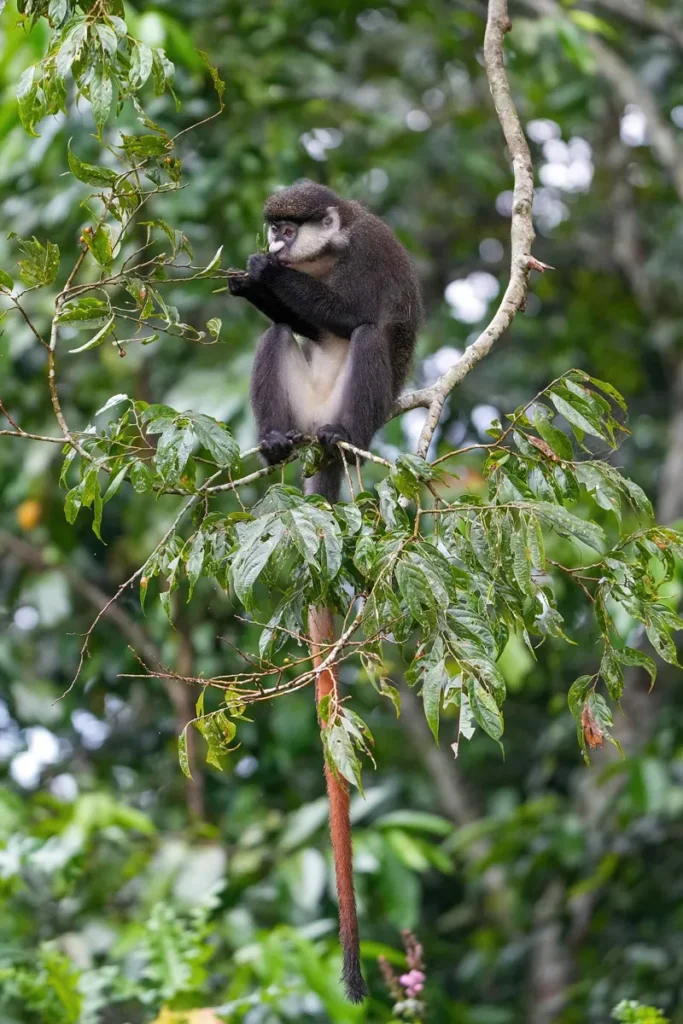
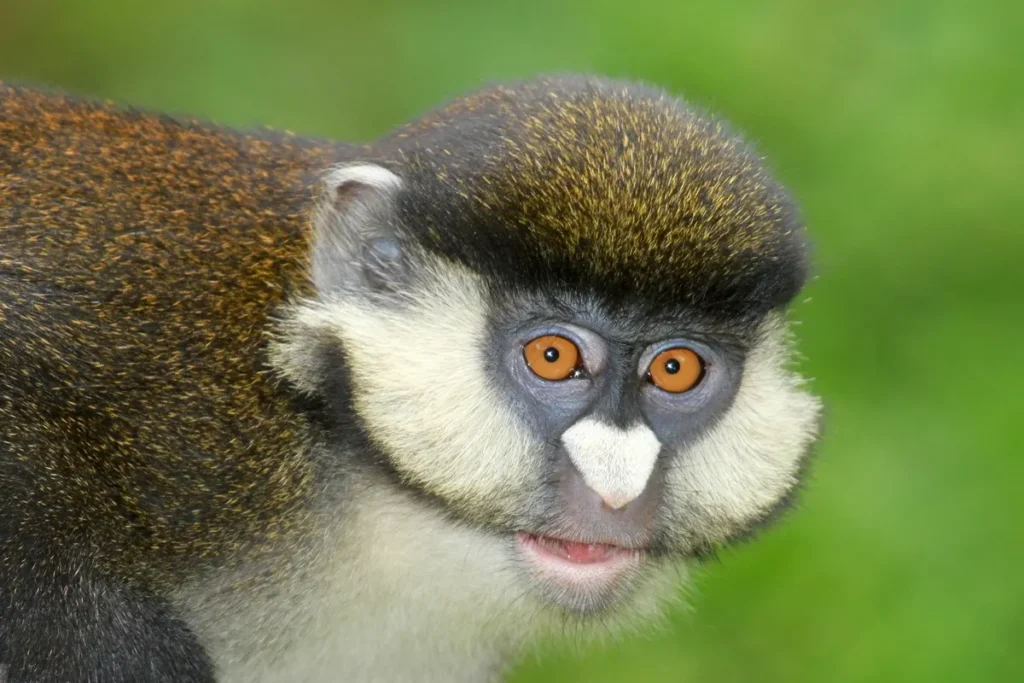
The red-tailed monkey is one of Uganda’s most widespread forest primates and one of the most reliably encountered on any visit to the country’s montane and lowland forests. Named for its distinctive reddish-orange tail and identified by a white nose spot on its otherwise dark face, the red-tailed monkey moves through the mid-canopy in noisy, active groups that are heard well before they are seen. It is abundant in Bwindi, Kibale, Budongo, and Mabira forests — and its combination of visual appeal, accessibility, and engaging behaviour makes it one of Uganda’s most enjoyable primate encounters.
Physical Description
The red-tailed monkey (Cercopithecus ascanius) weighs 2.5 to 4.5 kilograms. The face is dark — almost black — with a distinctive white nose spot that makes individuals recognisable at a glance. The body colouration is speckled grey-olive with a paler underside. The tail is long — significantly longer than the body — and the terminal portion is a vivid reddish-orange that gives the species its common name. The combination of the white nose spot and red tail makes the red-tailed monkey one of the easiest Ugandan forest primates to identify in the field.
Males are significantly larger than females. Cheek pouches — storage pouches inside the cheeks — allow rapid foraging: the monkey can fill its pouches quickly and move to a safe location to eat, reducing the time spent vulnerable to predation while feeding. Red-tailed monkeys are primarily frugivores, supplementing their diet with insects, leaves, and flowers depending on seasonal availability.
Social Structure and Behaviour
Red-tailed monkeys live in mixed-sex groups of typically 7 to 30 individuals, led by a single adult male who maintains his position through dominance displays and occasional combat with rival males. Group composition is stable, with females forming the long-term core and males moving between groups. The vocal repertoire is extensive — alarm calls, contact calls, and social vocalisations — and the species is among the noisiest of Uganda’s forest primates.
Red-tailed monkeys frequently form mixed-species associations with other forest primates — particularly blue monkeys and grey-cheeked mangabeys in Kibale. These associations are thought to improve predator detection (more eyes scanning the canopy) and may expand foraging success by allowing access to food resources defended by individual species. The multi-species groups that result are complex social arrangements that researchers have studied extensively in Kibale.
Predators and Alarm Behaviour
Crowned eagles are the primary aerial predator of red-tailed monkeys in Uganda’s forests. The monkeys have a specific alarm call for eagles — distinct from their response to terrestrial predators — that causes the group to drop into lower vegetation and freeze. Chimpanzees also hunt red-tailed monkeys in Kibale and Budongo, using coordinated group hunting techniques that can be disturbingly efficient. The red-tailed monkey’s anti-predator behaviour — alarm systems, mixed-species grouping, and rapid canopy movement — reflects millions of years of co-evolution with these threats.
Where to See Red-Tailed Monkeys in Uganda
Red-tailed monkeys are present in virtually every forest in Uganda. Kibale National Park offers the most reliable and close encounters, with habituated groups that allow observation at few metres distance. Bwindi Impenetrable Forest has abundant populations that are frequently seen along the gorilla trekking trails. Mabira Forest, accessible from Kampala on the way to Jinja, offers red-tailed monkey encounters within two hours of the capital. Budongo Forest in Murchison Falls NP is another consistent site. In short, any Uganda forest visit will produce red-tailed monkey sightings — the challenge is not finding them but choosing which forest to visit first.