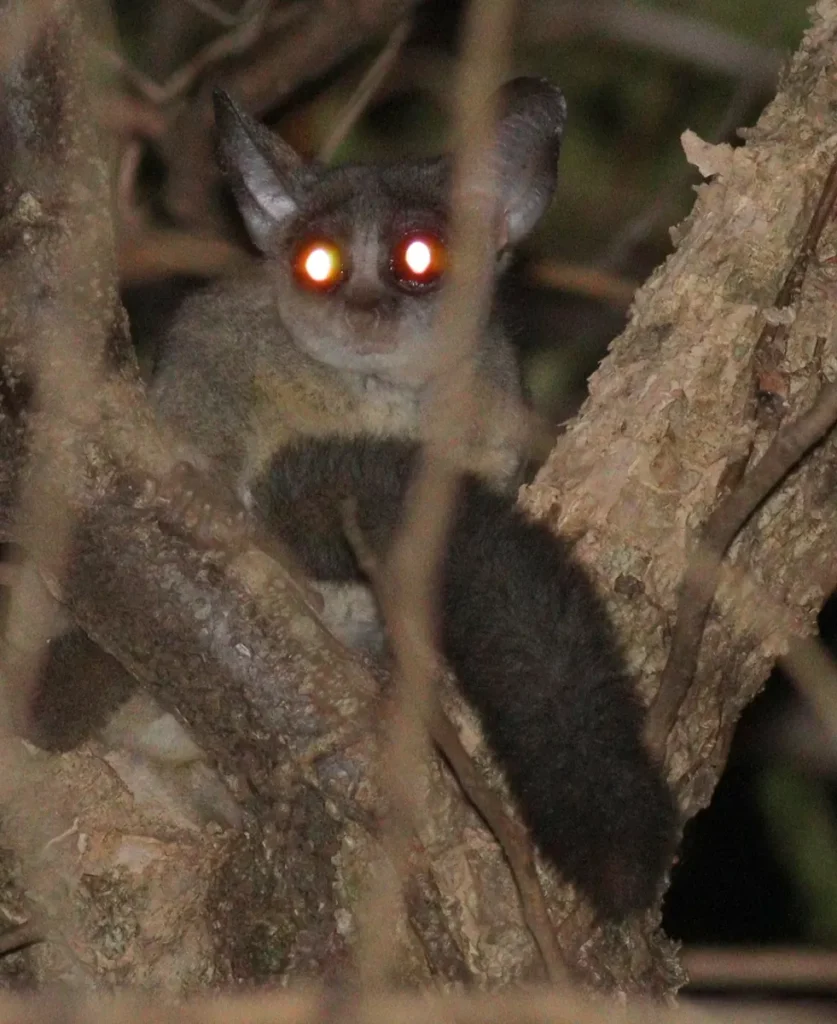
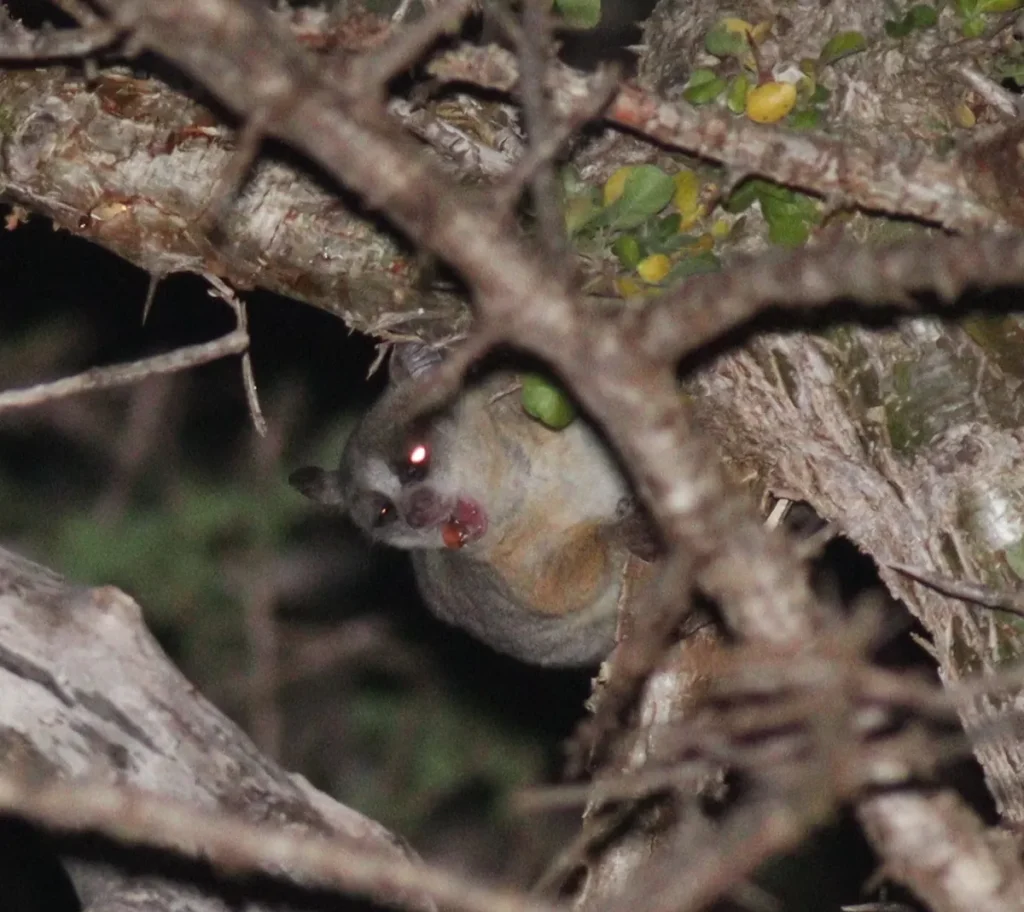
The lesser bushbaby is one of Africa’s most endearing and least-known primates — a tiny, large-eyed nocturnal prosimian whose cry in the night, resembling a human infant, gave it its common name. Present throughout Uganda’s woodland and forest habitats, the lesser bushbaby is active from dusk to dawn, moving through the canopy and undergrowth with a combination of precise leaping and slow stalking that makes it one of the most agile animals relative to its size in Africa. A night walk in any of Uganda’s national parks or forests has a realistic chance of producing an encounter.
Physical Description
The Senegal bushbaby (Galago senegalensis) — the species most commonly encountered in Uganda’s savanna and woodland areas — weighs 150 to 300 grams and fits in the palm of a hand. The body is compact, with long hind legs built for jumping, large rounded ears that can fold and rotate independently, and enormous eyes — among the largest relative to body size of any primate — adapted for low-light vision. The coat is grey-brown above and paler below. The long tail provides balance during leaping.
The eyes are fixed in the skull — they cannot rotate in their sockets — which is why bushbabies turn their entire head to track movement. The trade-off is that the fixed eye position allows extreme optical efficiency for nocturnal vision. The tapetum lucidum behind the retina reflects light back through the photoreceptors, producing the brilliant eye-shine that makes bushbabies relatively easy to locate in woodland at night with a spotlight — a pair of large, amber-orange reflections, perfectly round, in the mid-storey vegetation.
Jumping Ability
The lesser bushbaby is an extraordinary leaper for its size. It can jump up to 5 metres horizontally and 2.5 metres vertically in a single bound — the human equivalent of jumping over a four-storey building. This leaping ability is the primary locomotion mode for covering distance between trees, and precision landings on small branches are achieved through the combination of excellent binocular vision and a lifetime of practice. The long hind legs provide the propulsive power, and the tail stabilises the trajectory in flight.
Bushbabies also use a slower, more deliberate stalking locomotion when hunting insects — approaching prey with careful, slow movements before a rapid grab. The combination of explosive leaping and precise slow-movement hunting reflects the different demands of locomotion and prey capture in a small nocturnal predator.
Diet and Foraging
Lesser bushbabies eat insects, fruit, flowers, tree gum, and occasionally small vertebrates. Insects make up the largest proportion of the diet, caught with rapid grabs in flight or on vegetation. Tree gum is an important seasonal resource — bushbabies gouge bark to encourage gum flow at specific sites that they return to regularly. The gum provides carbohydrates and water during periods when insect availability is low. This gum-gouging behaviour leaves distinctive marks on tree bark that can help locate regular bushbaby activity areas.
Social Life and Communication
Lesser bushbabies are largely solitary foragers but maintain social networks through scent marking and vocalisations. The distinctive “baby cry” — a loud, wailing call — is used for contact and alarm, and can be heard over long distances in still woodland nights. Males mark their territories extensively with urine, depositing small amounts on their hands and feet as they move through the territory — “urine washing” — leaving scent markers on every branch they grip. The nightly route of a bushbaby is essentially a scent map of its territory, refreshed each night.
Seeing Bushbabies in Uganda
Night walks or drives in any Uganda national park or forest habitat offer realistic bushbaby encounter opportunities. Murchison Falls, Queen Elizabeth, Lake Mburo, and Kibale all have bushbaby populations. The technique is to scan mid-storey vegetation with a bright spotlight, watching for the distinctive large eye-shine. Once located, the bushbaby will typically freeze briefly, allowing observation, before leaping away into the darkness. The encounter is brief but remarkable — those enormous orange eyes in the dark, that tiny body poised for flight, the sense of a world of activity happening in the Uganda night that is entirely invisible without the torch.