
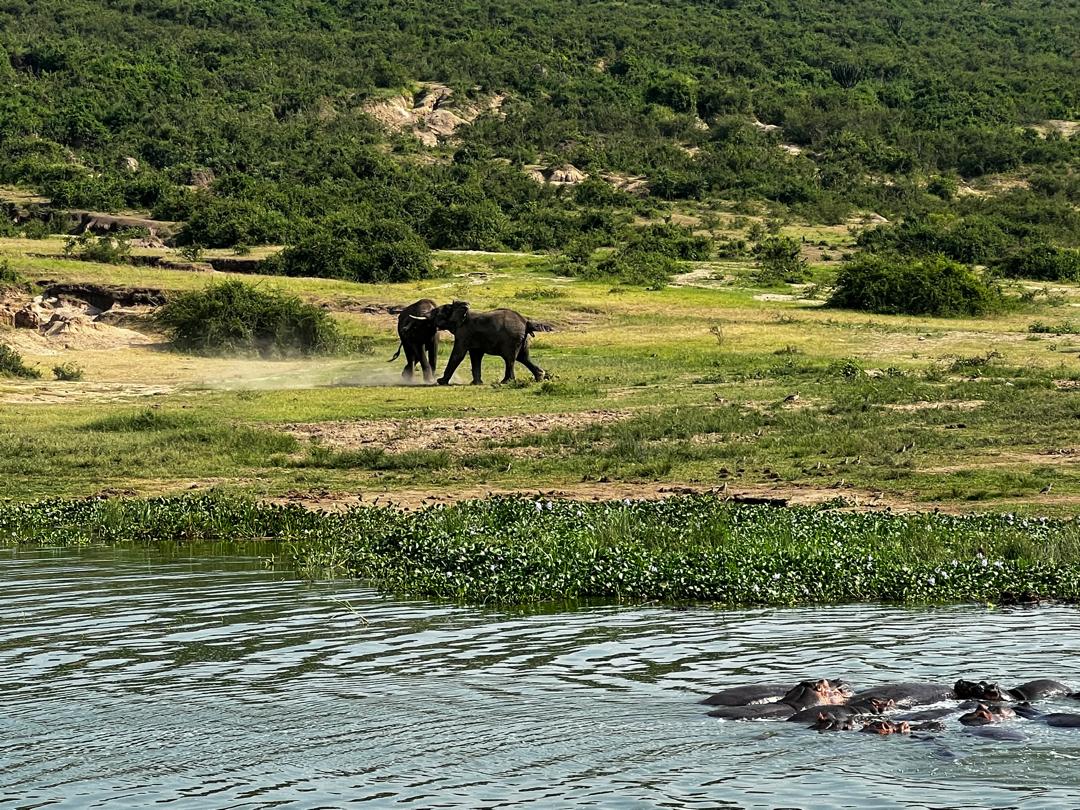
Uganda has one of the highest concentrations of hippopotamus in Africa — with major populations in the Victoria Nile, the Kazinga Channel, and the lakes and rivers of multiple national parks, Uganda offers some of the continent’s finest hippo watching opportunities from boat safaris where you approach within metres of schools of hippos resting in the water, to dramatic Nile crossings at Murchison Falls where hundreds of hippos occupy a single stretch of the river and can be observed from above on guided walks to the top of the falls. Hippo watching is a highlight on any Uganda safari, particularly on the Kazinga Channel boat cruise in Queen Elizabeth National Park.
- Best site for hippos: Kazinga Channel — the 40km channel connecting Lakes George and Edward in Queen Elizabeth NP has some of the highest hippo densities in Africa
- Murchison Falls: hundreds of hippos in the Victoria Nile below the falls; visible from the launch trip and from the cliff above
- Uganda hippo population: approximately 5,000 hippos in Uganda, mostly in the national park rivers and channels
- Safety note: hippos are Africa’s most dangerous large land mammal; all hippo watching must be from boats or vehicles at proper distance
Uganda has one of the highest concentrations of hippopotamus in Africa. With major populations in the Victoria Nile, the Kazinga Channel, and the lakes and rivers of multiple national parks, Uganda offers some of the continent’s finest hippo watching opportunities. These enormous animals — Africa’s third-largest land mammal — are endlessly fascinating to observe: territorial, unpredictable, surprisingly vocal, and genuinely dangerous in 2027.
Hippos are most dramatic at the territorial battles that occur at river channel junctions and lake entrances. Massive males clash with crashing water and thunderous bellowing that can be heard for kilometres. Boat trips at dawn, when territorial behaviour peaks, give the best opportunities for these extraordinary natural spectacles.
Victoria Nile at Murchison Falls: Uganda’s Best Hippo Watching
The Victoria Nile from Murchison Falls downstream to Lake Albert is one of Africa’s most productive hippo watching locations. The afternoon boat trip from Paraa to the base of Murchison Falls passes through water that holds hundreds of hippos. On calm days it is common to see 50 to 100 hippos in a single stretch of river, plus Nile crocodiles, African fish eagles, goliath herons, and many other species.
The hippos at Murchison are habituated to boats and allow very close approach, giving extraordinary photography opportunities. The territorial disputes — where bulls lunge at each other with gaping mouths revealing enormous teeth — are particularly common at the hippo pools near the Nile delta where hippos from different pods meet. Early morning departures at 7am give the best light for photography.
Kazinga Channel: Queen Elizabeth National Park
The Kazinga Channel connecting Lake George and Lake Edward in Queen Elizabeth National Park is another world-class hippo watching location. Twice-daily boat trips from the channel launch give close encounters with hundreds of hippos that haul out on the channel banks. The channel also attracts an exceptional diversity of waterbirds — the goliath heron, African spoonbill, and African skimmer are regular sightings alongside the hippos.
The hippo population of the Kazinga Channel is estimated at over 5,000 individuals — one of the highest densities in Africa. The flat calm water of the channel in the early morning gives excellent conditions for photography and the combination of hippos, waterbirds, and buffalo drinking creates extraordinary wildlife tableaux.
Lake Mburo National Park
Lake Mburo National Park’s lake system holds a significant hippo population that can be observed from guided boat trips. The advantage here is the combination of hippo watching with excellent bird diversity — the African finfoot, papyrus gonolek, and African pygmy goose are all possible at Lake Mburo alongside the hippos. The smaller scale of the lake gives more intimate encounters than the large rivers and channels.
Hippo Behaviour: What to Watch For
Hippos yawn to display their enormous teeth — not out of boredom but as a territorial signal. The gaping display reveals lower canines that can reach 50 centimetres. When two territorial males meet, these displays escalate to violent clashes where the animals slash at each other with their teeth. The wounds inflicted in these battles can be severe — the scarring visible on older bulls is testament to years of fighting.
The “dung spraying” behaviour — where males defecate and use their tail to spray the dung as a territorial marker — is a common sight at water entry points. Calves stay close to their mothers and are vigorously defended. Night is when hippos leave the water to graze on land — early morning boat trips sometimes catch the last animals returning to the water as dawn breaks.
Photography Tips for Hippos
The best hippo photographs combine behaviour with environment — mouths agape during territorial disputes, calves swimming alongside mothers, or the characteristic eyes-and-nostrils view of a submerged hippo. A 300 to 500mm lens is ideal from a boat. The Victoria Nile boat trip at Murchison gives the closest approach — sometimes within 10 metres of hauled-out animals.
Early morning provides the best light and the most active behaviour. The warm orange light of the first hour after sunrise illuminates the pink-grey skin beautifully. Fast shutter speeds of 1/1000s or more are needed to freeze the explosive movements of territorial clashes.
Plan Your 2027 Hippo Safari
The gorilla trekking permit costs $800 in 2027. A Uganda safari combining gorilla trekking at Bwindi with boat trips at Murchison Falls and the Kazinga Channel gives you hippo encounters alongside the full diversity of Uganda’s extraordinary wildlife. Contact us to design your 2027 Uganda itinerary with the best hippo watching Africa has to offer.
Why is the Kazinga Channel the best place for hippo watching in Uganda?
The Kazinga Channel is a 40-kilometre natural channel connecting Lake George and Lake Edward within Queen Elizabeth NP and is arguably the finest hippo watching location in Africa. Why it is exceptional: the channel is narrow enough that boats pass within metres of hippos resting in the shallows; hippos do not need to dive or hide — the boat traffic is normalised and the animals are habituated; schools of 40-80 hippos are common in single views. The boat safari format: 2-hour launches depart from the Mweya Peninsula jetty twice daily (typically morning and afternoon); they travel west into the channel; hippos, elephants, buffalo, and hundreds of bird species are seen from the water. The Kazinga advantage: on a game drive you can see hippos in pools but the boat brings you to their level; the 360-degree views from the channel with animals on both banks make it a different category of wildlife experience.
What is the hippo watching experience at Murchison Falls?
Murchison Falls NP offers a different and equally spectacular hippo encounter. The Nile below the falls: the Victoria Nile below Murchison Falls is one of Africa’s great wildlife corridors; the stretch between the falls and Lake Albert delta is over 70km of river; hippos occupy every accessible stretch; the concentration immediately below the falls is the most dramatic. The launch trip: boats travel from Paraa jetty upstream toward the falls with hippos visible throughout; the trip ends below the base of the falls with views up to the falls itself; the combination of the falls roar, the spray, and the hippos in the pool below is genuinely spectacular. Watching from the top: the walk to the top of Murchison Falls from the boat landing gives aerial views of hippos in the Nile; the gorge below the falls has hippos resting on the rock shelves; this perspective from above is completely different from the boat view.
How do hippos behave and what are the best observation tips?
Understanding hippo behaviour makes the observation much richer. Daily rhythm: hippos spend daylight hours submerged or resting in water to avoid sunburn — their skin is extremely sensitive to UV; the pink secretion on their skin is a natural sunscreen called blood sweat (it is neither blood nor sweat but a skin secretion with antibacterial and UV-filtering properties); they emerge to feed on land at night. The yawning display: when a hippo opens its mouth in a wide gape it is a threat display not a yawn; the enormous canine teeth displayed this way are the weapons used in male territorial fights; a yawning hippo near your boat is communicating aggression and the guide will manoeuvre appropriately. Underwater behaviour: hippos can walk along the bottom of rivers; they surface to breathe every 3-5 minutes; the nostril position allows breathing with only a small part of the head above water. Best light for photography: the afternoon light on the Kazinga Channel boat safari illuminates the hippos from the west as you travel east; morning boats have different light angles.
Are there other places to see hippos in Uganda beyond the main parks?
Hippos in Uganda are found beyond the main parks in several accessible locations. Lake Victoria shores: hippos live along the Lake Victoria shoreline including near Entebbe; they are primarily active at night on the lake shore and less visible than park hippos; attacks on fishermen do occasionally occur at night. Jinja and the Nile: the Nile at Jinja has hippo populations; white water rafting operators navigate around hippo areas with safety procedures; the river cruise at Jinja provides hippo viewing. Lake Mburo NP: Uganda’s closest national park to Kampala has hippos in the lake; the boat ride on Lake Mburo is a good short hippo experience for visitors with limited time; Lake Mburo is 3.5 hours from Kampala. Lake Albert: the shores of Lake Albert in Murchison Falls NP have hippos; the delta area at the Nile mouth is particularly good; accessible by the launch trip to the delta.
What is the hippo’s conservation status and what threatens Uganda’s hippo population?
Uganda’s hippos are doing better than in many African countries but face real pressures. Current status: the common hippopotamus (Hippopotamus amphibius) is classified as Vulnerable by the IUCN; the global population is estimated at 115,000-130,000 individuals; Uganda holds approximately 5,000 of these. The Queen Elizabeth recovery: hippos in Queen Elizabeth NP were massively reduced during the Amin era; the park’s hippo population has substantially recovered with better protection since the 1980s. Current threats: poaching for meat and ivory (hippo canine teeth are traded as ivory substitute); habitat loss as wetlands near parks are drained for agriculture; human-wildlife conflict as hippos leave parks at night and damage crops. Community programmes: Uganda Wildlife Authority compensation schemes for crop damage by hippos and other wildlife help reduce retaliatory killing by communities near park boundaries.
- Best Wildlife Watching Spots in Uganda: Ranked by Species Richness
- Best Photography Spots in Uganda: Safari Photographers Guide
- Best Wildlife Encounters on Earth: Why Gorilla Trekking Makes Every List
- Uganda’s Butterflies: 1240 Species and the Best Spots to Find Them
- Hippos and Nile crocodiles on Uganda’s waterways: wildlife beyond the forest
- Gorilla families with the best reputation for close encounters in Bwindi
- Best places to see hippos in Uganda
- Best Waterfalls Near Bwindi Forest to Visit on Your Gorilla Safari
- Best Time for Gorilla Trekking in Uganda – Monthly Guide to 2025 Seasons
- The Best Time to Climb or Hike Mount Rwenzori










