Uganda’s lakes, rivers, and papyrus swamps host two of Africa’s most formidable large animals — the Nile hippopotamus (Hippopotamus amphibius), Africa’s third-largest land animal and statistically its most dangerous to humans, and the Nile crocodile (Crocodylus niloticus), the world’s largest freshwater reptile at up to 6 metres and 900 kilograms — and both are encountered in extraordinary proximity and numbers on Uganda’s waterway safari experiences, particularly the Kazinga Channel boat cruise in Queen Elizabeth National Park and the Murchison Falls Nile boat to the base of the falls. For visitors combining these experiences with gorilla trekking at Bwindi, a Queen Elizabeth extension adds both species reliably. See Uganda safari packages combining Bwindi and Queen Elizabeth.
- Best hippo location: Kazinga Channel (Queen Elizabeth NP) — very high densities; Albert Nile (Murchison Falls NP)
- Best crocodile location: Murchison Falls base — where the Nile narrows through the falls, crocodiles congregate in exceptional numbers
- Hippo facts: males up to 3,500kg; responsible for more human deaths in Africa than lions or leopards
- Nile crocodile facts: largest freshwater reptile globally; up to 6m and 900kg; responsible for hundreds of human deaths annually in Africa
- Best time to see hippos: any time on the Kazinga Channel boat; early morning when hippos are in water before returning to land grazing areas
Uganda’s wildlife extends far beyond the mountain forests that harbour mountain gorillas and chimpanzees. The country’s lakes, rivers, and papyrus swamps host two of Africa’s most formidable aquatic predators and grazers: the Nile hippo and the Nile crocodile. Both species are present in substantial numbers in Uganda, particularly in and around Lake Edward, Lake George, the Kazinga Channel, and the lower reaches of the Victoria Nile. For visitors combining a gorilla trek at Bwindi with a broader Uganda safari, encounters with hippos and crocodiles on boat cruises and walking trails provide a dramatic contrast to the forest experience and complete the picture of Uganda’s extraordinary wildlife diversity.
The Kazinga Channel: Africa’s most accessible hippo and crocodile habitat
The Kazinga Channel
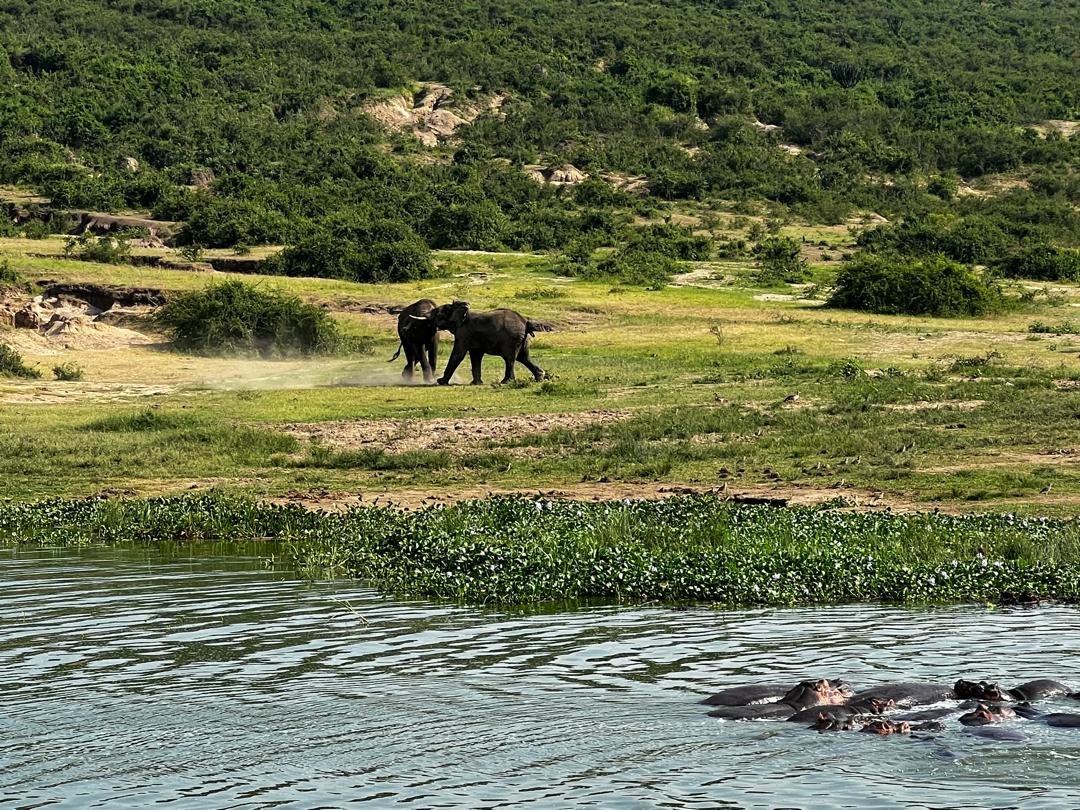
The Kazinga Channel connects Lake George to Lake Edward in Queen Elizabeth National Park, creating a thirty-kilometre waterway that concentrates hippos and crocodiles at densities that are among the highest anywhere in Africa. Afternoon boat cruises on the Kazinga Channel are one of Uganda’s most popular wildlife activities, and with good reason: the two- to three-hour cruise regularly produces sightings of multiple hippo pods, large crocodiles basking on riverbanks, buffalo herds drinking at the water’s edge, and a spectacular diversity of waterbirds including African fish eagles, goliath herons, and pied kingfishers.
Hippo pods in the Kazinga typically number between ten and forty individuals, though larger aggregations occur. The animals spend their days largely submerged, emerging periodically to breathe with the distinctive snort and head-shake that announces their presence. Their underwater social dynamics — complex hierarchies maintained through sound, touch, and occasionally violent confrontation — are largely invisible from the boat’s surface, but the density of animals in the channel means that almost any section of water near the banks will contain submerged hippos within a few metres.
Crocodiles reach impressive sizes in the Kazinga Channel, with large males exceeding four metres in length. They bask in aggregations on sandbanks and mudflats, their mouths occasionally open to regulate body temperature in a behaviour that gives them a permanently threatening appearance regardless of their actual level of alertness. Boat captains with long experience on the channel know the locations of favourite basking sites and position their vessels for optimal photography while maintaining safe distances from animals that can move with startling speed when disturbed.
Hippo biology and behaviour: understanding the world’s third-largest land animal
Common hippos (Hippopotamus amphibius) are the third-largest land animal on earth after elephants and rhinoceroses, with adult males weighing between 1,500 and 3,000 kilograms. Despite their bulk, they are surprisingly fast on land — capable of reaching 30 kilometres per hour over short distances — and genuinely dangerous to humans who inadvertently come between them and water. In Uganda, hippo attacks on fishing communities are a recurring source of human-wildlife conflict, particularly in areas where agricultural land abuts hippo grazing habitat.
Hippos are primarily grazers, emerging from water at night to feed on short grasses in areas up to several kilometres from their daytime refuge. They consume between 40 and 60 kilograms of grass per night, and their grazing pressure has significant effects on the grassland ecosystems they inhabit, maintaining short grass swards that other grazing species exploit. In the dry season, when water sources contract, hippos may travel considerable distances between water and grazing areas, creating well-worn hippo paths that are visible throughout savannah habitats near permanent water.
The pink skin secretions that hippos produce, sometimes described as “blood sweat” in popular accounts, are actually a natural sunscreen and antimicrobial agent rather than either blood or sweat. These secretions help protect hippos’ sensitive skin from solar radiation during their daytime surface exposure and appear to have antibiotic properties that assist wound healing — useful in animals that inflict severe bite wounds on each other during territorial confrontations.
Nile crocodile: Africa’s largest reptile
The Nile crocodile (Crocodylus niloticus) is Africa’s largest reptile and one of the world’s most powerful ambush predators. Adults can exceed five metres in length and weigh over 700 kilograms, though individuals of this size are rare and represent the extreme end of a long-lived, slow-growing species. Crocodiles in Uganda’s protected waterways can live to sixty years or more, growing steadily throughout their lives in a pattern that contrasts with the fixed adult size of most mammals.
Nile crocodiles are opportunistic predators that take prey ranging from fish and waterfowl to mammals as large as buffalo and hippo calves. Their hunting technique relies on patient ambush at water’s edge, where they lie motionless until prey comes within strike range, then explode into action with a speed and power that is genuinely shocking given their apparently static resting posture. The characteristic death roll — used to dismember large prey and exhaust struggling animals — is executed with the full rotational force of the animal’s body and powerful tail.
The Murchison Falls area on the Victoria Nile hosts one of the largest Nile crocodile populations in Africa. The base of Murchison Falls, where the Nile squeezes through a seven-metre rock cleft and crashes into a pool below, concentrates fish and attracts crocodiles in numbers that visitors on the river launch below the falls regularly describe as extraordinary. Crocodiles of all sizes from juveniles to massive adults share the banks and shallows in a scene that conveys the prehistoric quality of these animals with particular vividness.
Lake Edward and the Uganda-DRC border wildlife
Lake Edward, shared between Uganda and the Democratic Republic of Congo, supports substantial hippo and crocodile populations on both shores. On the Ugandan side, Queen Elizabeth National Park’s lake frontage provides protected habitat that sustains some of the country’s highest hippo densities. Fishing communities on Lake Edward have historically maintained an uneasy coexistence with both species, suffering periodic livestock and human losses while also benefiting from the ecosystem services that healthy hippo and crocodile populations provide to the lake’s fish stocks through nutrient cycling.
The complex relationship between local communities and large predators or potentially dangerous megafauna like hippos is a microcosm of the broader human-wildlife conflict challenge that conservationists face across Africa. Simple narratives about conservation preventing human suffering or development destroying wildlife both fail to capture the nuanced trade-offs that communities living alongside dangerous animals navigate daily. Uganda Wildlife Authority’s community engagement work around Lake Edward attempts to address these trade-offs through compensation schemes, conflict mitigation measures, and the community revenue benefits that give local people a stake in conserving the animals that also create risks for them.
Including aquatic wildlife in a Uganda itinerary
Most Uganda gorilla trekking itineraries are routed through Queen Elizabeth National Park as either a transit or a destination, making the Kazinga Channel boat cruise a natural addition to any trip. The four- to five-hour drive between Bwindi and the Queen Elizabeth park headquarters at Mweya passes through spectacular scenery including the Ishasha sector where tree-climbing lions are found, and the Kazinga cruise provides a complementary wildlife experience that broadens the trip’s ecological scope considerably beyond the mountain forest context.
For visitors with more time, the Murchison Falls circuit in northern Uganda combines Nile crocodile and hippo sightings on the river launch with the famous falls themselves, savannah game drives producing lions, elephants, giraffes, and buffalos, and excellent bird watching that includes shoebill storks in the delta area. A complete Uganda wildlife itinerary combining Bwindi gorilla trekking with Kibale chimpanzee tracking, Queen Elizabeth aquatic wildlife, and Murchison Falls savannah game produces one of the most diverse wildlife experiences available anywhere in Africa within a single trip of ten to fourteen days.
The contrast between the intimate hour spent with gorillas in Bwindi’s green cathedral forest and the open-water spectacle of the Kazinga Channel with its hippo pods and cruising crocodiles captures something fundamental about Uganda’s wildlife character: this is a country where entirely different ecosystems and entirely different scales of wildlife encounter sit within a day’s drive of each other, and where the diversity of experiences available to a single visitor in a single week is unmatched by any other destination in the region.
Where is the best place to see hippos in Uganda?
The Kazinga Channel in Queen Elizabeth National Park holds one of Africa’s most accessible and concentrated hippo populations. The channel is a 32km natural waterway connecting Lake George and Lake Edward, and its shallow, protected waters support large hippo pods that spend the day wallowing in or near the water. The two-hour boat cruise on the Kazinga Channel — one of Uganda’s most popular safari experiences — brings visitors within 10-20 metres of hippo pods containing dozens of individuals. The Albert Nile in Murchison Falls National Park is the other major Uganda location: the boat cruise from Paraa to the base of Murchison Falls passes through dense hippo concentrations along the Nile’s banks. Lake Victoria’s Mabamba Bay also has hippos, and Lake Bunyonyi near Bwindi holds a small hippo population in some areas.
Where is the best place to see Nile crocodiles in Uganda?
Murchison Falls National Park provides Uganda’s most spectacular Nile crocodile experience. The boat cruise from Paraa to the base of Murchison Falls passes through the Nile where crocodiles bask on sandbanks and rocks in large numbers — at the base of the falls itself, where the Nile exits a 7-metre wide gorge, crocodiles gather in exceptional concentrations to take fish stunned by the turbulence. Seeing dozens of large Nile crocodiles on a single bank here is one of Uganda’s most memorable single wildlife views. The Kazinga Channel boat also yields crocodile sightings, though in smaller numbers than Murchison. Lake Victoria’s shores have crocodiles throughout, though these are largely invisible to visitors and represent a genuine hazard for swimming or boat capsize in the lake.
Are hippos really more dangerous than lions in Uganda?
Hippos are responsible for more recorded human deaths in Africa than any other large mammal — more than lions, leopards, buffalo, or crocodiles in most annual assessments. This statistic reflects not that hippos are aggressive by nature but that humans and hippos frequently share the same resources. Hippos graze on land at night and return to water at dawn — human-hippo conflict most commonly occurs when people encounter hippos on land at night in communities near lakes and rivers. In Uganda, fishermen on Lake Victoria and the Albert Nile face genuine hippo hazard. From the safety of a safari boat on the Kazinga Channel or Albert Nile, hippos present no danger — but entering the water in hippo territory, or approaching a hippo on land, is extremely dangerous.
What makes the Nile crocodile at Murchison Falls so exceptional to see?
The specific ecology of Murchison Falls concentrates crocodiles in a way that is unusual even by East African standards. The White Nile at Murchison forces through a 7-metre gap in the rift rock — creating one of Africa’s most powerful waterfall sequences. Fish are stunned and disorientated by the turbulence at the base of the falls and are easy prey for crocodiles waiting in the calmer pools downstream. This concentration of food attracts exceptionally large individuals — crocodiles that have grown to 5-6 metres over decades of feeding at this site. The boat approaches to within viewing distance of the falls and the sandbanks where these animals bask, creating close encounters with some of the largest wild Nile crocodiles accessible to tourists in East Africa.
Can I combine Queen Elizabeth and Bwindi on the same Uganda safari?
Yes — this is one of Uganda’s most popular itinerary combinations and the two parks are geographically close (the Ishasha sector of Queen Elizabeth is approximately 60km from Bwindi’s Buhoma sector). A typical combined itinerary spends 2-3 nights at Queen Elizabeth (Kazinga Channel boat cruise, game drives in Mweya and Ishasha sectors, tree-climbing lions in Ishasha), then drives south to Bwindi for 2-3 nights including the gorilla trek. This combination delivers: hippos and crocodiles on the Kazinga Channel, tree-climbing lions, chimpanzee tracking in Kibale Forest (a possible addition en route), and mountain gorillas at Bwindi — four of Uganda’s most iconic wildlife experiences in a single circuit of 8-10 days from Entebbe.
- Are There Other Animals on the Gorilla Trek in Bwindi? Forest Wildlife Beyond the Gorillas
- What a 3-Day Uganda Wildlife and Cycling Safari Did to My Family Was Beyond Anything We Expected
- Murchison Falls Uganda Wildlife Safari — 4-Days: Where the Nile Breaks and the Wild Roars
- Safaris That Offer Unique Wildlife Experiences in Uganda: Beyond the Ordinary
- World Wildlife Day 2026: Protect Medicinal and Aromatic Plants – Conserving Health, Heritage and Livelihoods in Uganda’s Gorilla Forests
- Uganda Chimpanzee Trekking: Kibale Forest and Beyond
- Kibale Forest Animals: Beyond Chimps the Full Species Guide
- Photography composition for wildlife: framing gorillas and forest animals
- Uganda’s wetlands and papyrus swamps: ecological treasures beyond the gorilla forest
- Post-processing gorilla photos: editing techniques for forest wildlife images