Most visitors who drive past the tea plantations on the road to Bwindi Impenetrable National Park see them as scenery — the neat rows of waist-high tea bushes covering hillsides in a bright green grid, the occasional figure moving between the rows with a picking basket, the corrugated iron roofs of processing buildings visible at lower elevations. They do not stop. They are en route to the gorillas, and tea is not part of the itinerary.
This is understandable. But the tea operations visible on the approach to Bwindi are, in their own way, as significant a story of conservation, community economics, and women’s empowerment as anything happening inside the park boundaries. The women who pick and process this tea are the same women whose cooperation makes gorilla conservation possible. Understanding their relationship with the landscape — including the part of it inside the park — requires understanding the tea economy that structures their daily lives.
Tea in the Kigezi Highlands
Tea was introduced to the Kigezi highlands by the British colonial administration in the 1950s as part of a broader strategy to develop commercial agriculture in a region whose terrain and climate made export crop production challenging. The cool temperatures, high rainfall, and well-drained volcanic soils of the Kigezi highlands turned out to be excellent for tea production — conditions similar to those that made tea a viable crop in the highlands of Kenya, Rwanda, and Burundi.
The tea plantations established in the colonial period have been expanded and reorganised over subsequent decades, with large estate operations coexisting with smallholder outgrower schemes that allow individual farming families to grow tea on their own land and sell the green leaf to centralised processing factories. The outgrower model has brought significant numbers of small-scale farming households into the formal commercial economy while retaining the flexibility of smallholder agriculture.
The Kanungu District Factories
The processing factories that serve the Bwindi area — in Kanungu district, on the northern and eastern approaches to the park — handle green leaf from both estate and outgrower sources. The factories are not the gleaming modern facilities of Kenya’s large tea estates; they are older buildings, partially mechanised, operating with a mixture of industrial equipment and labour-intensive processing in ways that reflect the operational realities of remote highland Uganda.
Inside a tea factory during processing, the smell is extraordinary — the grassy, slightly astringent aroma of freshly wilted tea leaf, the darker notes of fermenting leaf, the warm tea-like scent of the final firing stage. The process of turning green leaf into black tea involves withering, rolling, oxidation, and drying in a sequence that has been refined over 150 years of industrial tea production but still depends on sensory judgement at critical stages. The experienced factory workers who manage the oxidation process — determining when the leaf has reached the right colour, smell, and moisture content for drying — are exercising the same kind of embodied expertise as the rangers who track gorillas through Bwindi.
The Women Pickers
Tea picking is overwhelmingly women’s work in the Kigezi highlands, as it is across most of Africa’s tea-producing regions. The picking basket, the stooped posture between the rows, the precise two-leaves-and-a-bud standard that determines picking quality — these are skills that women develop and refine over years of practice, passing them on to daughters who join the picking workforce in adolescence.
The reasons tea picking became women’s work are partly historical — colonial labour organisation assigned different categories of work to men and women in ways that have persisted long after the original reasons were forgotten — and partly practical. Tea picking is piece-rate work: you earn in direct proportion to what you pick. Women who are also managing household and childcare responsibilities often prefer piece-rate work that can be fitted around other obligations, even if the total hours and the earnings are substantial.
Earnings and Empowerment
The economics of tea picking in the Kigezi highlands have improved considerably as tea prices on world markets have remained relatively strong and as competition for labour — partly driven by the employment opportunities created by gorilla tourism — has pushed wages upward. Women tea pickers who work full seasons and pick efficiently earn incomes that are significant in the local economy, providing financial independence that previous generations of rural women did not have access to.
This income has had measurable effects on household decision-making, children’s education (particularly daughters’ education, which women tea earners consistently prioritise), and women’s participation in community governance. The same women who pick tea on the slopes adjacent to Bwindi are often active members of the savings groups, community-based organisations, and park revenue-sharing governance structures that shape conservation outcomes in the area. The economic independence that tea income provides supports the civic participation that makes community conservation work.
The Conservation Connection
The relationship between tea cultivation and gorilla conservation around Bwindi is complex and not always comfortable. Tea plantations on the park boundary create a specific kind of agricultural pressure — the fields are permanent, the investment in establishment is significant, and the economic return depends on maintaining the plantation in production. Farmers who have invested in tea on slopes adjacent to the park have less flexibility to change land use if conservation needs evolve.
On the other hand, the conversion of former subsistence agricultural land to tea production has in some cases reduced pressure on the park boundary by providing income that reduces the economic incentive for encroachment into the forest edge. Tea farmers who earn reliable income from their planted land have less reason to clear additional land than subsistence farmers whose income depends on expanding the cultivated area.
Gorilla-Tea Conflicts
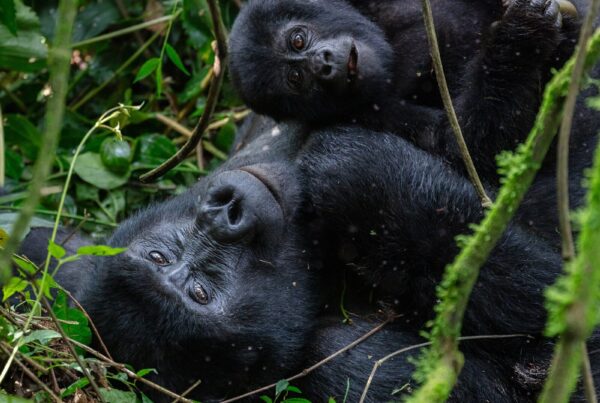
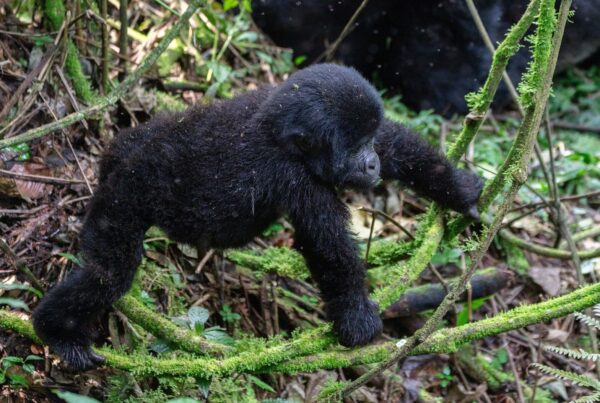
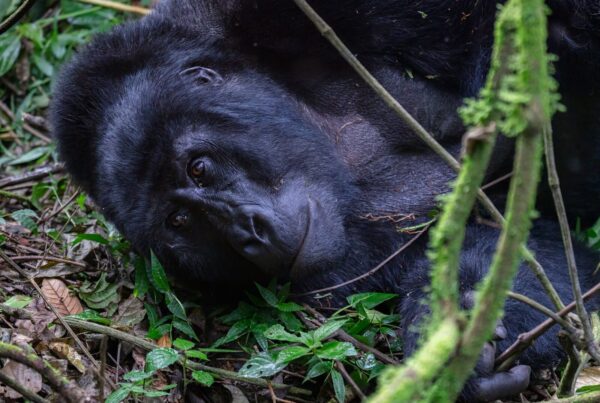
Mountain gorillas crossing the park boundary to raid agricultural land typically target food crops — bananas, maize, vegetables — rather than tea. Tea leaves contain compounds that are unpalatable to gorillas, making tea plots a form of natural buffer between the park and the food crops that gorillas actually want. Several communities around Bwindi have used this characteristic deliberately, planting tea as a boundary crop between the park edge and food crop fields to reduce crop raiding incidents.
The Uganda Wildlife Authority and conservation NGOs working in the Bwindi landscape have supported the expansion of these tea buffer plantings in some areas, recognising that the crop performs a conservation function — deterring gorilla boundary crossings — simultaneously with its commercial function. It is an example of the kind of multiple-benefit land use that makes conservation economically viable in human-dominated landscapes.
Buying Bwindi Tea
Tea produced in the Kanungu district near Bwindi is not currently branded or marketed with its conservation connection in ways that would allow tourists to consciously choose it. Most of the processed tea leaves the region in bulk for blending at larger facilities, losing its geographical identity in the process. Several small enterprises have begun exploring direct marketing of highland Uganda tea to the international specialty market, drawing on the increasingly lucrative “single-origin” premium that has transformed the coffee trade and is beginning to affect tea as well.
For visitors arriving for gorilla trekking at $800 per permit, the tea visible on the approach roads to Bwindi represents a different kind of Uganda story — not wildlife, but the agricultural economy that coexists with the wildlife, the women whose labour sustains it, and the complex relationship between the fields and the forest that defines what conservation actually looks like when it is embedded in a real landscape with real people making real economic choices. The tea and the gorillas share the same hills. Understanding both is to understand Bwindi more completely.
Frequently Asked Questions
Uganda is home to the mountain gorilla (Gorilla beringei beringei), one of two subspecies of eastern gorilla. They live exclusively in the Virunga volcanic highlands (Uganda/Rwanda/DRC) and Bwindi Impenetrable Forest (Uganda only). Mountain gorillas are the only gorilla subspecies that cannot survive in captivity — every individual you can trek is a wild animal.
The standard gorilla trekking permit gives you exactly 1 hour with the gorilla family. This time begins when you make first contact with the family — the ranger signals the start. The Gorilla Habituation Experience gives 4 hours with a semi-wild family. The walk to find the gorillas can take 30 minutes to 5 hours depending on where the family has moved.
Stay calm, crouch down slowly, avoid direct eye contact, and remain quiet. Do not run — running triggers a chase response. Rangers accompanying your group manage close approaches. Habituated gorillas are accustomed to humans and almost never make contact, but a charging silverback is managed by staying still and following ranger instructions immediately.
A maximum of 8 visitors per habituated gorilla family per day for standard trekking. The Gorilla Habituation Experience has a maximum of 4 visitors per family per day. These limits are set by UWA to minimise stress on the gorilla families and maintain the quality of the experience.
Uganda is home to the mountain gorilla (Gorilla beringei beringei), one of two subspecies of eastern gorilla. They live exclusively in the Virunga volcanic highlands (Uganda/Rwanda/DRC) and Bwindi Impenetrable Forest (Uganda only). Mountain gorillas are the only gorilla subspecies that cannot survive in captivity — every individual you can trek is a wild animal.