Updated
There are gorillas in zoos on every inhabited continent. Western lowland gorillas live in managed habitats in major institutions from London to San Diego. Sanctuaries in Congo, Cameroon, and Gabon house orphaned great apes and sometimes allow limited visitor access. In theory, it should be possible to see gorillas without going to Uganda. In practice, there is no comparison between zoo or sanctuary gorilla observation and gorilla trekking in wild Uganda. This post explains specifically why — not to disparage zoos, which have important conservation roles, but to articulate the qualities of the wild encounter that no managed environment can replicate.
The Environment: Wild vs Managed
A zoo gorilla habitat is, by definition, designed for observation. The viewing points are managed. The sight lines are clear. The gorillas are habituated to barriers, to the smell of concrete and people, to feeding schedules rather than natural foraging. The environment communicates “managed” at every level — fences, viewing glass, interpretive signage, the sounds of other zoo animals. The gorillas are present. The wild is absent.
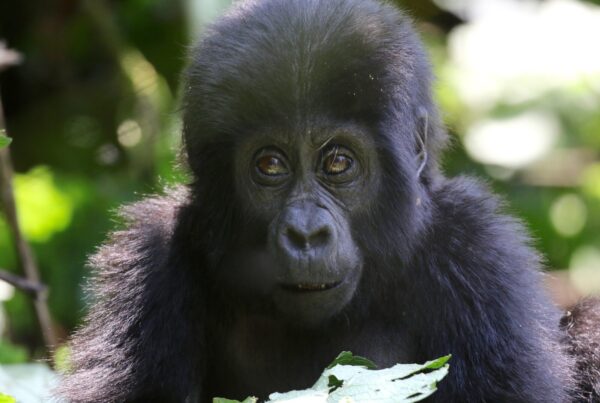
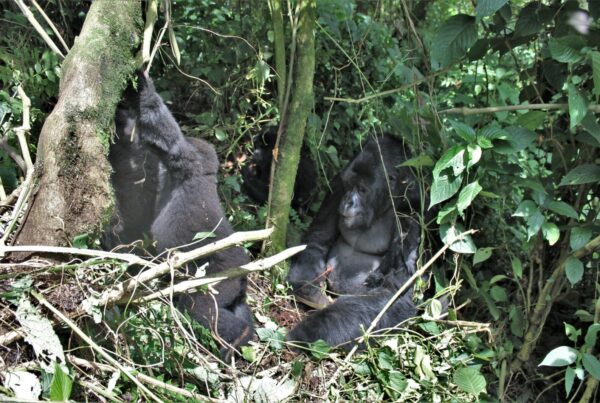
In Bwindi, the environment itself is part of the experience. The ancient forest — 320 square kilometres of montane tropical forest that has existed continuously since the last ice age — surrounds the encounter on every side. The gorillas move through it as they choose; their location is found by trackers rather than assumed. The trees, the sounds, the smells, the altitude, the moisture — all of these are not backdrop to the gorilla encounter. They are the gorilla encounter. Remove the wild forest and you have not just a diminished gorilla experience. You have a fundamentally different kind of interaction with a gorilla.
The Gorillas: Wild vs Captive Behaviour
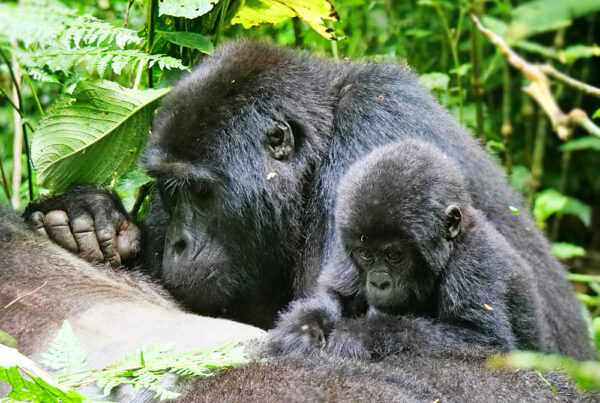
Wild gorillas in Bwindi behave as gorillas in a wild ecosystem. They forage over large territories, interact in the social context of their natural family structure, and encounter each other according to gorilla social logic rather than managed feeding and space allocation. When a silverback displays in Bwindi, it is a genuine expression of wild male dominance behaviour directed at the social realities of his family. When a gorilla in a zoo display-walks, it is occurring in a context that has no ecological meaning — the triggers and social dynamics are different.
Habituated wild gorillas in Bwindi are not tame. They are wild animals that have been acclimatised to human presence within strict distance protocols. They retain their full behavioural repertoire. They interact with each other as wild gorillas interact. The human observers are a tolerated presence in their world, not a managed feature of their environment. This distinction — wild gorillas tolerating human observers versus captive gorillas observed by humans in a human-controlled environment — is the core of what gorilla trekking offers that no zoo can replicate.
The Quality of Recognition
The Quality of Recognition
The emotional impact of the wild gorilla encounter is significantly shaped by the context of mutual recognition: you are in the gorilla’s world, on the gorilla’s terms, within protocols designed to ensure the gorilla’s welfare rather than the visitor’s comfort. The gorilla that looks at you in Bwindi is looking at an unexpected feature of its natural environment — making an assessment, deciding how to respond, choosing its behaviour freely. The gorilla that looks at you in a zoo enclosure is looking at something at the boundary of its managed habitat. Both are gorillas looking at you. Only one of them is a wild animal in a wild world making a free choice about what to do with you. That distinction changes everything about the emotional quality of the encounter.
In 2027, zoos play important roles in ex-situ conservation, research, and public education. They are not poor substitutes for the wild encounter — they are different things entirely. The wild gorilla encounter cannot be approximated in a managed setting. Contact us to plan your 2027 trek to the only place on earth where you can experience what gorilla trekking in wild Uganda actually is.
The zoo comparison for gorilla encounters is addressed by virtually every visitor who completes a Bwindi trek in their post-trip reflections, because the encounter activates exactly the comparison the zoo encounter does not: wild gorillas, in their own habitat, moving on their own schedule, within close enough proximity to make physical similarities unmistakable. The zoo gorilla’s behaviour is adapted to captivity in ways that are subtle enough to be invisible to most visitors but become apparent when the wild encounter establishes the baseline for what normal gorilla behaviour looks like. Post-trek visitors who have previously seen gorillas in captivity consistently describe the wild encounter as correcting a previous misunderstanding of the species.