Standing seven metres from a silverback mountain gorilla produces a specific quality of experience that I have been trying to describe accurately since it happened. The difficulty is that most of the language available for wildlife encounters defaults either to the dramatic — danger, awe, primal fear — or to the sentimental — connection, recognition, spiritual moment. Neither of these captures what actually happens when you stand in the presence of a healthy, habituated silverback in his own forest. What actually happens is more interesting, and more useful, than either of those framings suggest.
The Physical Fact of a Silverback
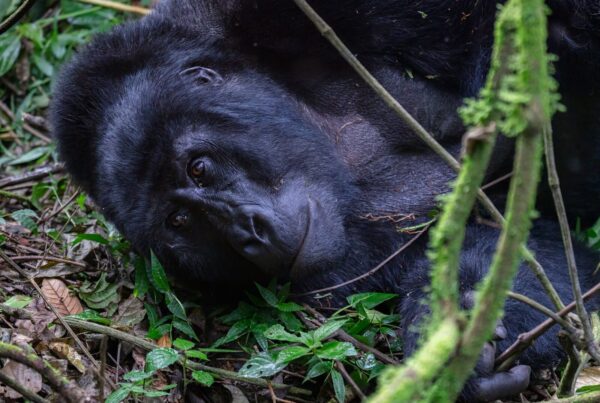
A mature male mountain gorilla weighs between 140 and 220 kilograms. He stands approximately 1.7 metres tall when upright but habitually moves on all fours, which changes the spatial experience of his presence significantly — he is wide rather than tall, low rather than upright, and the physical mass is distributed differently from what you might imagine. The arms are enormously long. The hands are large enough that, if he chose to grip you, you would have no useful response to this. He does not choose to grip you. He chooses to eat leaves and occasionally to look at you with an expression that falls somewhere between assessment and indifference.
The gorilla permit costs $800 USD and is issued by Uganda Wildlife Authority. It allows you to be in the presence of this animal for one hour at a minimum distance of seven metres. In practice, the gorillas often come closer than seven metres — habituated gorillas do not maintain minimum distances; humans do. The experience of being within arm’s reach of a silverback’s family while maintaining the required distance is one of the more specifically paradoxical experiences available in wildlife tourism. You are required to stay back. They are free to come forward. They occasionally do.
The Initial Response
The initial response is, almost universally, the fear response. Not panic — habituated gorilla trekking does not typically produce panic. But the involuntary response to the physical presence of a large, powerful animal is real and automatic and does not require the gorilla to behave aggressively to be triggered. Your nervous system registers the animal before your cortex has finished processing what it is. This is the correct response — evolution built it for good reasons.
The fear response typically lasts between thirty seconds and three minutes. It is replaced, in most people, by something more complex — a combination of heightened alertness, physical stillness, and a quality of attention that is unlike ordinary observational attention. You are watching the gorilla with a completeness of focus that is difficult to achieve in ordinary life and that the situation produces automatically rather than by effort.
What the Silverback Actually Does
The silverback I observed — a dominant male in the Mubare group at Buhoma sector — was resting against a large tree when we arrived. He turned to look at our group briefly, in a movement so economical and so clearly untroubled that the fear response, which was still present in me, lost most of its charge immediately. He had assessed us and found us unremarkable. This assessment, from an animal of this size and this authority, is one of the more specifically reassuring things I have experienced.
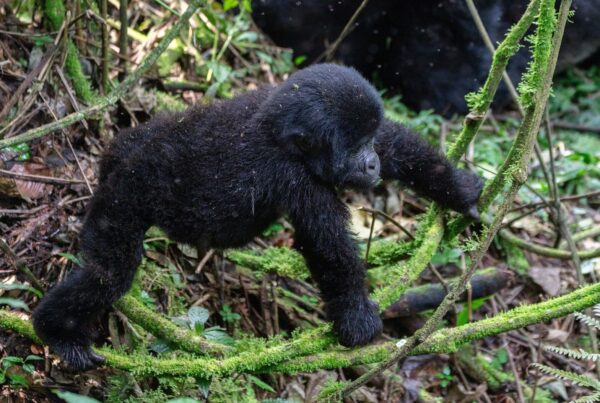
He then resumed resting. His family — his females, his juveniles, his infants — moved around him in the patterns of a social group that has established roles and comfortable relationships. He monitored this movement with a quality of attention that was intermittent and peripheral — he knew where everyone was without appearing to watch for it. Occasional sounds from the periphery of the group produced a brief orientation of his head and then a return to rest. His authority over the group was visible not in any assertion of it but in the way the group organised itself around him as a natural centre of gravity.
The Perspective
The specific perspective that standing in the presence of a silverback produces is not about smallness, though smallness is part of it. It is about a particular kind of competence — the competence of an animal that knows exactly what it is and what it needs and is simply doing that, without any of the anxiety or performance or self-consciousness that characterises most human activity. The silverback is not trying to be anything. He is the thing he is, completely and without apparent effort.
This is not a quality unique to gorillas — it is visible in many wild animals in their natural habitat. But the combination of the silverback’s size, his obvious intelligence, his social complexity, and the specific closeness of the encounter makes it more available as a perspective-producing experience than most wildlife encounters provide. You are close enough to see the grey hairs in his silverback, the specific texture of his knuckles on the forest floor, the quality of his gaze when he looks at you. The distance between abstract knowledge about gorillas and concrete experience of them is covered completely.
I came away from the encounter with a recalibrated relationship to the question of what authority looks like and what competence requires. The silverback exerted both without visible effort. This is, in the context of most professional and social environments I inhabit, unusual enough to be instructive. The $800 permit bought me this instruction. It was adequately priced.