I have known, intellectually, that humans are animals since I was taught it in school. Homo sapiens, primate, mammal, animal. The taxonomy is clear and uncontroversial. What I had never actually felt — viscerally, physically, concretely — was what this fact means for how I understand myself and my species. Gorilla trekking in Uganda produced that feeling in a way that no amount of reading or reasoning had managed. This is a reflection on what changed when the intellectual knowledge became experiential knowledge.
The Distance Between Knowing and Feeling
Human beings are very good at maintaining the distinction between themselves and other animals. We have language, technology, culture, abstract thought. These things are real distinctions and they matter. What they do not do, accurately, is make us a different category of thing from other animals. We are a remarkable and unusual kind of animal. We are not something other than animal. This sounds obvious when stated as a proposition. It is not obvious when you are living inside the human bubble of language, technology, culture, and abstract thought. Everything in that bubble confirms the separateness. Almost nothing in ordinary life confirms the membership.
Arriving at the Gorillas
The gorilla trekking permit costs $800 USD per person, issued by Uganda Wildlife Authority. I booked through a licensed operator and flew into Entebbe, chartered to Kihihi airstrip, and drove to the Buhoma sector lodge. The pre-trek briefing covered the rules: seven-metre minimum distance, no flash photography, no eating during the encounter, do not make direct eye contact with the silverback for extended periods. These are rules about how to behave in the presence of another primate species. The fact that the rules were necessary — that our behaviour required management to avoid communicating threat to a close relative — was itself a form of the knowledge I was about to receive.
The Encounter
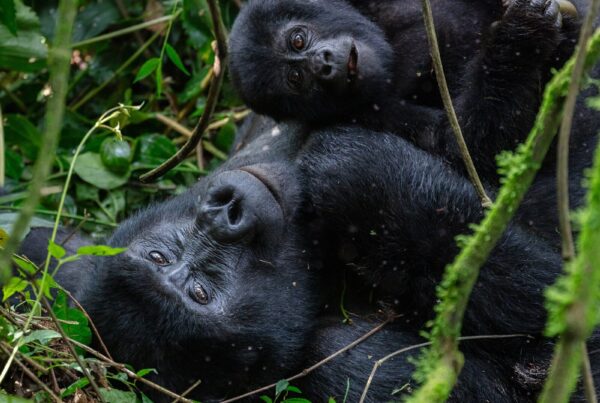
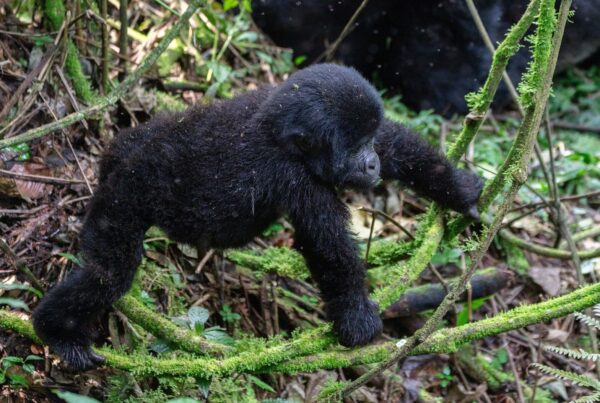
We found the Rushegura family after two and a half hours of walking. The guide moved us to a position from which we could observe without disturbing. The family was in the middle of its morning activity — some feeding, some resting, the younger animals playing with the specific energetic purposelessness of young mammals everywhere. There were two infants, perhaps six months old, who were doing what six-month-old mammals do: clinging to their mothers, attempting mobility, falling over, being retrieved. The mothers’ responses to the falling-over and the being-retrieved were recognisable. Not because I was projecting human emotion onto gorilla behaviour, but because the behaviour itself — the automatic reach, the settling, the resumption of the infant’s exploration — is mammalian in a way that precedes the human-animal distinction entirely.
The Recognition
The recognition happened gradually over the sixty minutes of the encounter. Not as a dramatic revelation but as an accumulation of specific observations that collectively made the human-animal distinction feel increasingly artificial. The social structure of the family — the dominance hierarchy, the affiliative bonds, the coalitions and the dependencies — mapped recognisably onto human social structures in ways that were not coincidental. We share a common ancestor with mountain gorillas approximately eight million years ago. Eight million years is a long time. It is, apparently, not long enough to make the family structure unrecognisable.
The silverback groomed a female for approximately ten minutes of our observation time. The grooming was attentive and specific — he worked through her coat with his fingers in a way that was clearly pleasurable for her, judging by her relaxed posture and her occasional vocalisations. This is social bonding. Primates bond through physical contact. Humans bond through physical contact. The behaviour is the same. The species are different. The underlying animal is the same animal.
What This Means
I am not drawing the conclusion that because gorillas and humans are both animals, the human capacity for language, culture, and abstract thought is unimportant or illusory. These things are real and they matter enormously. What I am saying is that the human-animal distinction, as usually maintained in the human bubble of modern life, is artificially sharp in ways that cost us something. It costs us appropriate humility about our place in the living world. It costs us the specific quality of empathy that comes from recognising another animal’s suffering as suffering of the same category as your own. It costs us, perhaps, some portion of the motivation to protect the living world that we belong to rather than merely inhabit.
Gorilla trekking in Uganda made me feel like an animal. This is an unusual and underrated thing to feel. The permit is $800. The feeling is not available by other means that I have found.