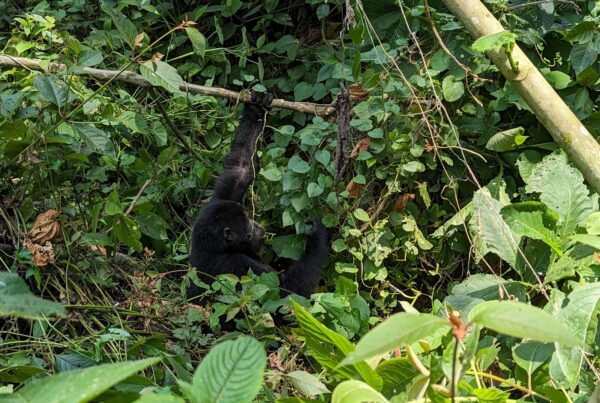
The Two Gorilla Species Compared
The western lowland gorilla is the gorilla subspecies that most people have seen — or think they have seen. These are the animals in zoo exhibits worldwide, the subjects of long-running captive studies, and the gorillas featured in most documentary footage that does not specifically focus on mountain gorillas. Yet western lowland gorillas and mountain gorillas, while sharing a genus and a common evolutionary heritage, are genuinely different animals: different species, different habitats, different sizes, different diets, and different conservation situations.
Taxonomy: Different Species
Western lowland gorillas (Gorilla gorilla gorilla) and mountain gorillas (Gorilla beringei beringei) belong to different species. The two gorilla species — western gorilla (Gorilla gorilla) and eastern gorilla (Gorilla beringei) — diverged approximately 2 to 3 million years ago, separating into distinct evolutionary lineages that have not naturally interbred since. Western lowland gorillas belong to the western species alongside Cross River gorillas; mountain gorillas belong to the eastern species alongside eastern lowland (Grauer’s) gorillas.
This species-level distinction has conservation significance: western and eastern gorillas cannot produce viable hybrid offspring, meaning the conservation of each species must be managed separately. Population management that treats them as interchangeable — as was sometimes done in early zoo breeding programmes before genetic testing became standard — conflates animals that are as different from each other as horses and donkeys.
Physical Differences
The physical differences between western lowland and mountain gorillas are significant and immediately apparent to experienced observers. Mountain gorillas have considerably longer, thicker, darker fur — their defining cold-climate adaptation. Western lowland gorillas have shorter, sparser, brownish-grey fur adapted to the warmer, more humid conditions of the Congo Basin and West African forests they inhabit.
Western lowland gorillas are slightly smaller than mountain gorillas in average body mass: adult male silverbacks typically weigh 140 to 180 kilograms, compared to the 160 to 200 kilogram range of mountain gorilla silverbacks. Their faces are more elongated with wider, more prominent nostrils, and their overall build is slightly less heavily muscled. Western lowland gorillas have more pronounced brow ridges and a different cranial shape that reflects both the skull differences used in subspecies identification and functional differences in dietary mechanics.
The Reddish Forehead Patch
One of the most visible diagnostic differences between western gorilla subspecies and eastern gorilla subspecies is the colouration of the forehead. Many western lowland gorillas show a reddish or brownish-auburn patch on the forehead that is absent in mountain gorillas. The function and basis of this colouration is not fully understood, but it provides a reliable visual identification character that distinguishes the subspecies at a glance.
Habitat and Range
Western lowland gorillas inhabit tropical lowland forest across a range spanning six countries: Cameroon, Central African Republic, Democratic Republic of Congo, Equatorial Guinea, Gabon, and Republic of Congo. Their habitat is lowland tropical forest — warm, humid, and seasonally fruiting — that is dramatically different from the cold, misty montane forest of mountain gorilla habitat in Uganda, Rwanda, and DRC’s highlands.
The elevation difference is stark: western lowland gorillas inhabit forests typically below 1,500 metres, often at elevations below 500 metres, while mountain gorillas live at 1,500 to 4,000 metres. This altitude difference drives most of the other ecological differences between the subspecies, including temperature, vegetation type, dietary composition, and physiological adaptations.
Dietary Differences
The dietary ecology of western lowland gorillas differs substantially from mountain gorillas in its greater dependence on fruit. Fruit constitutes approximately 25 to 30% of the western lowland gorilla diet when available — considerably higher than the typical mountain gorilla diet where fruit is a minor supplement to a primarily foliage-based diet. This higher fruit consumption reflects the greater fruit availability and diversity in lowland tropical forest compared to the montane forest environment.
Western lowland gorillas also consume aquatic vegetation in some habitats — in the swampy bai (forest clearing) habitats of Central Africa, they wade into shallow water to reach aquatic herbs — a behaviour essentially absent in mountain gorillas. This dietary flexibility reflects the different ecological opportunities of lowland forest and demonstrates that the western gorilla has a somewhat broader dietary niche than its highland cousin.
Population and Conservation Status
Western lowland gorillas are by far the most numerous gorilla subspecies, with estimated populations of 95,000 to 200,000 individuals — a massive contrast with the 1,063 mountain gorillas. Despite these larger numbers, western lowland gorillas are classified as Critically Endangered by the IUCN, reflecting high rates of hunting, habitat loss, and disease (particularly Ebola, which has killed tens of thousands of western lowland gorillas in Central Africa).
The conservation approaches for western lowland gorillas differ from mountain gorilla conservation partly because of the scale involved — 100,000+ animals across six countries requires a different management approach than 1,063 in two well-defined protected areas. Anti-poaching, habitat protection, and Ebola response are the priority interventions for western lowland gorillas.
Final Thoughts
Western lowland and mountain gorillas are profoundly different animals sharing a superficial appearance and a common evolutionary heritage. The mountain gorilla’s cold-climate adaptations, concentrated range, and intensive conservation management make it a unique case in the gorilla conservation landscape. Understanding these differences enriches appreciation for both subspecies and provides context for the specific features of the mountain gorilla experience that distinguish it from any other encounter with great apes.