Updated
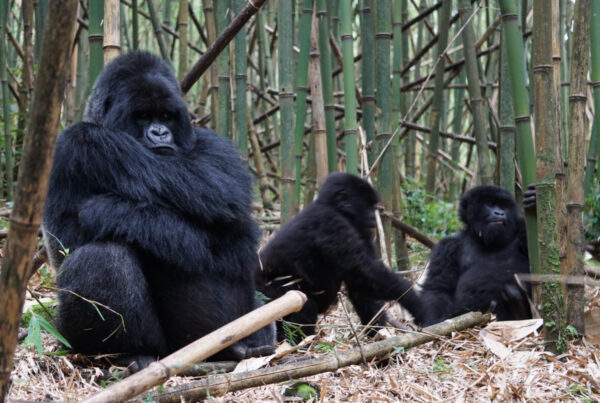
gorilla tool use tourist photo Bwindi Uganda research is a subject central to Uganda’s wildlife tourism, where mountain gorilla conservation and responsible visitor experiences go hand in hand. Gorilla trekking in Uganda generates an enormous volume of wildlife photography. Every year thousands of visitors with high-quality cameras spend their permitted hour photographing the habituated families of Bwindi, and the resulting images — distributed across social media, travel publications, and photography competitions — constitute one of the largest documentary records of mountain gorilla behaviour available outside of professional research photography. Occasionally an image captures something that the guides themselves have rarely or never seen — a behaviour that is theoretically known from research but has not been documented photographically in a tourist context. The photograph taken by a visitor at Buhoma sector in 2021 is one such case.
The Gorilla Caught on a Tourist’s Camera Doing Something Extraordinary
The Behaviour
The photograph shows a silverback from the Rushegura group using a branch as a tool. The image captures the silverback holding a straight section of fallen branch approximately sixty centimetres long, using it to probe a section of decomposing log — a behaviour consistent with tool use for foraging, specifically the extraction of insects from rotting wood. Tool use in gorillas is documented but considered rarer than in chimpanzees — gorillas are generally described as having less elaborate tool behaviour than their more tool-proficient relatives, and photographic documentation of gorilla tool use in wild, non-research contexts is limited.
The visitor who took the photograph did not initially recognise what she had captured. She posted the image on a wildlife photography forum with a description of her trek. A wildlife researcher who saw the post recognised the behaviour and contacted her directly. The image was subsequently submitted to UWA and to a research team studying Bwindi gorilla behaviour, where it was assessed as the clearest photographic documentation of tool-assisted foraging in a habituated Bwindi gorilla to date.
The Research Context
Tool use in mountain gorillas has been previously documented primarily in captive animals and in the Bwindi population through direct field observation rather than photographic record. The most discussed documented case involves gorillas using sticks to gauge water depth before crossing — a form of environmental probing that implies a capacity for planning and tool selection. The 2021 foraging behaviour adds a second category: the use of a physical implement to access food resources in a way that simple manipulations with the hands would not achieve.
The researcher who contacted the photographer published a brief note in a primatology journal documenting the observation. The photographer is credited in the paper. The silverback is identified by individual markings in the photograph and is still a living member of the Rushegura group.
What This Illustrates About Tourist Photography
The scientific literature on mountain gorilla behaviour has been enriched by images taken by gorilla trekking tourists on at least a dozen documented occasions in the last decade. The combination of large numbers of observers, high-quality consumer cameras, and the habituated gorillas’ tolerance of prolonged proximity means that tourist photography captures behaviours that researcher observation — necessarily more limited in time and observer numbers — can miss. The citizen science contribution of gorilla trekking visitors to the understanding of the species they observe is real and ongoing.
The gorilla permit costs $800. Bring a good camera. You may photograph something that ends up in a journal.
Frequently Asked Questions
A versatile zoom lens in the 24–200mm range (or equivalent on crop sensor) works for most forest conditions. A fast lens (f/2.8) handles the low light under the forest canopy. Mirrorless cameras with fast autofocus track gorilla movement well. Flash is strictly prohibited. Bring a rain cover — the forest is damp year-round.
Set: Shutter priority at minimum 1/250s (to freeze movement), Auto ISO with a ceiling of 6400, continuous autofocus, burst mode. Shoot in RAW for post-processing flexibility. In the dense understorey, light is limited — prioritise shutter speed over aperture. Wide-angle shots require patience as gorillas occasionally approach very close.
UWA guidelines require a minimum 7-metre distance from gorillas at all times. In practice, gorillas regularly approach the human group on their own — rangers manage this by repositioning the group when needed. Most trekkers end up photographing gorillas at 3–10 metres. Infant gorillas sometimes approach even closer, which rangers discourage gently.
Yes — video cameras and smartphone video are permitted. Flash is the only restriction. A monopod is useful for steadier video in low light. If you plan serious video work (wildlife documentary standard), consider the Gorilla Habituation Experience ($1,800) which gives 4 hours to film natural behaviour in a smaller group of just 4 visitors.
Uganda is home to the mountain gorilla (Gorilla beringei beringei), one of two subspecies of eastern gorilla. They live exclusively in the Virunga volcanic highlands (Uganda/Rwanda/DRC) and Bwindi Impenetrable Forest (Uganda only). Mountain gorillas are the only gorilla subspecies that cannot survive in captivity — every individual you can trek is a wild animal.