Updated
Gorilla Mating Behaviour: How Mountain Gorillas Reproduce
Reproduction in the Gorilla Family Group
Gorilla Mating Behaviour: How Mountain Gorillas Reproduce Reproduction in the Gorilla Family Group Mountain gorilla reproduction is governed by the social structure of the family group, with the dominant silverback exercising primary reproductive control over the females in his group. Mountain gorilla reproduction is governed by the social structure of the family group, with the dominant silverback exercising primary reproductive control over the females in his group. The mating system of mountain gorillas — polygynous, with one or occasionally a few males fathering most offspring in a group — has shaped both the species’ social structure and its genetic organisation. Understanding how mountain gorillas mate contextualises the silverback’s role, the female’s reproductive choices, and the competitive dynamics that drive male behaviour.
The Silverback’s Reproductive Role
In a typical single-silverback mountain gorilla group, the resident silverback fathers virtually all offspring born to the group’s females. His reproductive monopoly is maintained through both competitive exclusion (the silverback’s dominance prevents other males from mating with group females) and female choice (females in a group generally prefer to mate with the silverback who provides protection, resources, and stable group leadership).
Paternity certainty — the high confidence a silverback has that infants in his group are his own offspring — drives his protective investment in those infants. A silverback who has fathered an infant has strong evolutionary incentives to protect that infant against threats, including the risk of infanticide from incoming males who did not father the infant. This paternal investment is expressed through the silverback’s vigilance over mother-infant pairs, his intervention when infants are threatened, and his general management of group safety.
Female Oestrus and Mate Selection
Female mountain gorillas do not display the obvious external oestrus signals seen in some other primates. Unlike female chimpanzees and baboons whose perineal swellings visibly signal ovulation, female gorillas show subtle behavioural changes — increased proximity to the silverback, specific vocalisations, and postural signals — that communicate reproductive receptivity without a visible anatomical signal. This cryptic oestrus is thought to reduce male conflict over access to females by making precise ovulation timing less readily identifiable to competing males.
Female gorillas have reproductive cycles of approximately 28 to 33 days, closely comparable to the human menstrual cycle. Ovulation occurs at cycle midpoint, and the receptive period around ovulation is when mating most commonly occurs. Females show active mate preference, approaching the silverback or specific males, presenting behaviourally, and refusing approaches from males they do not choose to mate with — demonstrating that female gorillas are not passive in reproduction but exercise active choice.
In multi-male groups, females sometimes mate with subordinate males, particularly when the dominant silverback is not immediately present. These extra-dominant matings are typically brief and opportunistic, and the dominant silverback tolerates them within limits that vary between individuals. Genetic analysis of paternity in multi-male groups confirms that dominant silverbacks father the majority of offspring even in groups where subordinate males mate occasionally.
Mating Behaviour
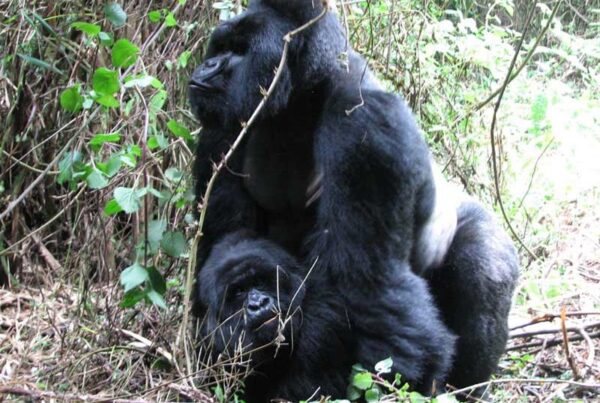
Mountain gorilla mating is typically brief and occurs with minimal ceremony compared to the extended courtship sequences of some other primate species. Copulation may be initiated by the female (who approaches and presents to the male) or by the male (who approaches and mounts). The act itself lasts approximately 1 to 2 minutes. Multiple matings between the same pair over the receptive period are common, and the same female may mate with the silverback several times during her receptive period.
Social context influences mating: the presence of other group members, the current state of inter-individual relationships, and the silverback’s assessment of competition risks all affect when and how mating occurs. In large groups or high-tension social contexts, mating may occur more furtively or with the silverback actively preventing subordinate males from being present during his own matings.
Inter-Group Mating and Female Transfer
Female mountain gorillas sometimes transfer between groups, leaving their birth group or current group to join a different silverback’s group or a lone silverback establishing a new group. These transfers are a primary mechanism for mating outside the natal group — females who transfer mate with silverbacks they were not born associated with, reducing inbreeding risk.
Female transfer decisions appear to be influenced by the quality of available silverbacks (size, age, group stability, demonstrated protective ability) and the social conditions within the current group (conflict with other females, silverback health decline, or the death of the current silverback). Females assessing transfer options may make extended comparisons between their current silverback and potential alternative males, sometimes spending time in proximity to alternative groups before making a transfer decision.
Infanticide and Reproductive Competition
When a new silverback takes over a gorilla group — following the death or displacement of the resident male — the incoming silverback may commit infanticide, killing infants fathered by the previous silverback. This behaviour, observed in mountain gorillas and confirmed through paternity analysis, is explained by the evolutionary benefit to the incoming male: nursing females do not return to reproductive condition, so killing their infants (not his own genetic offspring) shortens the time before the female is receptive and can produce his offspring. Infanticide in the context of group takeovers is one of the documented sources of infant mortality in mountain gorilla populations.
Final Thoughts
Mountain gorilla mating behaviour reflects the intersection of individual reproductive strategies with the social structure of the family group. The silverback’s reproductive dominance, female cryptic oestrus and active mate choice, female transfer as a mechanism of genetic diversity, and the grim calculus of infanticide during group takeovers are all components of a reproductive biology shaped by millions of years of competition and cooperation within a specific social system. Understanding this biology transforms the social dynamics observed during trekking encounters from inexplicable animal behaviour into comprehensible expressions of evolutionary logic.