We almost cancelled our gorilla trek due to fear — fear of the physical demands, fear of Uganda’s reputation in Western media, fear of spending $800 each on permits for an experience that might not live up to the expectation. What we found instead, in Bwindi Impenetrable Forest on a Tuesday morning in October, was something neither of us has been able to stop talking about since.
The Fear Was Real
My partner Sarah and I are not experienced wildlife travellers. We had done a beach holiday in Thailand and a city break in Tokyo. Africa had always felt aspirational and slightly out of reach — not because of the cost, specifically, but because of a vague sense that it required a kind of toughness we were not sure we possessed.
When we started researching Uganda gorilla trekking after watching a documentary, the initial response was excitement. The secondary response, arriving the way secondary responses always do, was anxiety. What if the trek was too hard? What if something went wrong? What if we spent this money and then regretted it?
We had three separate conversations about cancelling. Each time, one of us managed to talk the other out of it. I still do not entirely understand why we kept going forward. Something about the gorillas themselves — the intelligence visible even through a screen, the idea that there were fewer than 1,000 of them left on Earth — kept pulling us back.
The Week Before the Trek
The week before we flew, Sarah developed a cough and became convinced she would not pass the health screening at the park entrance. (You are not allowed to trek if you have flu-like symptoms, to protect the gorillas from human diseases.) The cough cleared up two days before we left.
I spent an evening researching worst-case scenarios online, which is never a useful way to spend an evening. I found one account of a silverback charging a trekking group, read it twice, then went to bed and did not sleep well.
We packed, flew to Entebbe, drove to Bwindi, and arrived at our lodge without incident. The drive was beautiful in a way that made both of us quiet with attention. The lodge was perched above the forest. Below the veranda, the trees stretched away into mist. We ate dinner listening to the forest and something in both of us settled slightly.
The Morning of the Trek
Briefing at 7:30. Our ranger, Jackson, was a compact man in his forties who had been guiding gorilla treks for eighteen years. He delivered the safety instructions with efficiency and then said something that has stayed with me: “The gorillas are habituated to people, but they are still wild animals. You are entering their home. If you bring respect, you will be safe.”
The First Hour of Walking
We were assigned to the Bitukura family, located on a ridge about ninety minutes’ walk from the trailhead. The first section of the path was manageable — wide, slightly inclined, through an area where the forest was not yet fully dense. Sarah and I walked behind two Australian men who moved fast and quietly and seemed to be enjoying themselves.
The second section was steeper. The path narrowed to a single track through vegetation that closed over our heads. The ground was wet. I slipped twice. Jackson helped me both times without comment.
By the time the tracker radioed that the family had been located, we had been walking for two hours and I was tired in a way that felt good — the kind of tired that means you have earned something.
Finding the Bitukura Family
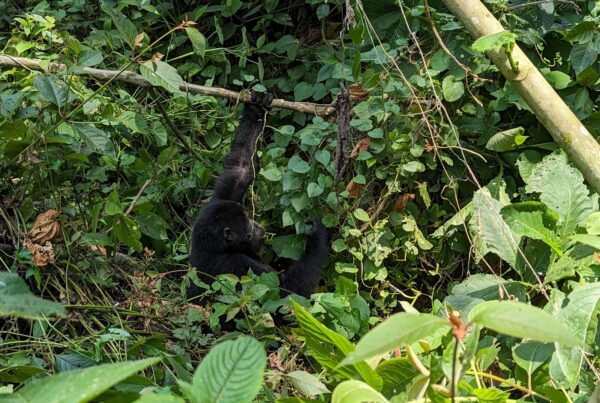
The gorillas were in a valley, partly visible through a stand of bamboo. We heard them before we saw them clearly — low sounds, the movement of large bodies through vegetation, a bark from one of the juveniles that made Sarah grab my arm.
The First View
A female gorilla stepped into a patch of open ground and sat down to eat. She was perhaps four metres away. She looked at us with the expression of someone tolerating something mildly inconvenient and returned to her food.
All the anxiety that had accumulated over the previous weeks simply — left. It did not diminish gradually. It went at once, replaced by a quality of attention I rarely experience: total presence, no background noise, nothing mattering except what was directly in front of me.
The Silverback
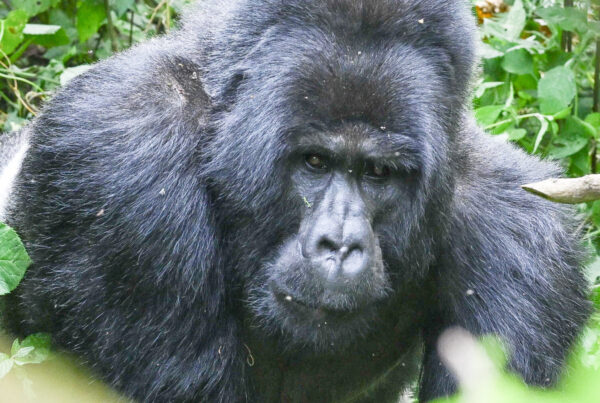
Karamuzi, the Bitukura silverback, was visible to our left, sitting at the base of a large tree. He was eating bamboo shoots with a focused intensity that reminded me, ridiculously, of someone eating lunch at their desk. He was enormous. His silver saddle caught the light that came through the canopy. His arms, even at rest, looked like they could relocate a car without particular effort.
He looked at our group once, with the mild interest of someone who has more important things to think about, and looked away.
An Hour That Felt Like Ten Minutes
We watched the family for sixty minutes. In that hour: an infant fell out of a tree and scrambled back up without apparent embarrassment. Two females groomed each other for twenty minutes without stopping. Karamuzi rose, moved to a new feeding spot, and passed within two metres of our group without acknowledging us.
Sarah was crying for the last fifteen minutes. She had not noticed she was crying until one of the Australian men quietly offered her his spare handkerchief. “Thank you,” she said. “I don’t know why this is happening.” He said: “Same happened to me the first time I saw whales. Some things are just too big not to cry at.”
When Jackson said “time,” we both looked at our watches and could not account for where sixty minutes had gone.
What We Were Afraid of Versus What We Found
The Physical Demands
The trek was hard. Not impossible, not dangerous — hard. With moderate fitness and a willingness to move slowly on the steeper sections, it is absolutely manageable. We would both have benefited from hiring porters, and would strongly recommend this to anyone.
Uganda Itself
We had been vaguely afraid of Uganda in a way that, in retrospect, was rooted in ignorance and outdated media representations. What we found was a country that was hospitable, safe, and extraordinary. Kampala is alive and chaotic and full of food. The countryside is some of the most beautiful we have ever seen. The people — and this is not a platitude — were genuinely kind.
The Permit Cost
We spent $800 each on gorilla permits. This remains the most worthwhile money I have ever spent on any experience. Not just because of what we saw, but because a significant portion of that money goes directly to the conservation programs that keep the gorillas alive.
We Are Going Back
We booked our return trip three weeks after coming home from the first. Next time, we are adding Kibale Forest for chimpanzee trekking and a few nights at Murchison Falls. The fear, the three conversations about cancelling, the sleepless night reading about silverback charges — all of it has resolved into a simple proposition: we should have booked sooner.
If you are in the conversation-about-cancelling stage, or if fear is the thing standing between you and this experience, I hope this story is useful. The gorillas are worth it. Uganda is worth it. Whatever you are afraid of is almost certainly smaller than what you will find.
Contact Uganda Gorilla Trekking to start planning your trek. Do not cancel.