Updated
what gorilla smells like up close Bwindi trekking is a subject central to Uganda’s wildlife tourism, where mountain gorilla conservation and responsible visitor experiences go hand in hand. What a gorilla smells like up close is something nobody talks about, which is strange because it is one of the most vivid and immediate aspects of the whole encounter. You can see gorillas in documentaries. You can hear their vocalisations on recordings. But the smell — earthy, musky, warm, distinctly animal and distinctly familiar at the same time — is something that hits you the moment you enter the family group’s territory and does not leave you for the rest of the day.
What a Gorilla Smells Like Up Close: Nobody Talks About This
The Sensory Experience Nobody Prepares You For
The briefings before gorilla trekking cover a great deal of useful information: how to behave around the silverback, how close you can stand, what to do if a gorilla approaches you, the signs that an animal is stressed or displaying aggression. They do not, in my experience, cover the smell.
I think this is an oversight. Not because the smell is unpleasant — it is not, exactly — but because it is one of the first signals your body receives that this is real, that you are in the actual physical presence of a large primate, that this is not a screen or a zoo but an encounter with a wild creature in its own environment.
The smell is the first proof that the gorillas are there before you see them clearly.
What It Actually Smells Like
This is, admittedly, difficult to convey in words. People who have been on gorilla treks describe it variously as: musky, earthy, woody, animal, “like the zoo but wilder,” “like wet dog but much more complex,” “like the forest floor but with something alive in it.”
My own description: imagine the smell of a forest after rain, dense with the layered decay and growth of an ecosystem that has been running for millions of years. Add to that the specific quality of a large warm-blooded animal — not the sanitised version you get in a zoo, but the full version, including diet, activity, and the closeness of a group of social animals in a relatively small space. Then add something sweeter underneath — not unpleasant, but distinctly there. That is approximately what gorillas smell like up close.
It is, I should say clearly, not a bad smell. It is a powerful smell. A real smell. The smell of something genuinely wild.
The First Time I Noticed It
Our guide, a man named David who had been working with the Mubare family for nine years, was leading us down a slope toward the valley where the family had been located. We had been walking for about two hours. The forest had become denser, the undergrowth taller, the tree canopy closing over us.
About five minutes before we saw the first gorilla, I noticed the smell. I looked at the trekker beside me — a woman from Australia named Carol — and she looked at me at the same moment. Neither of us said anything. We both knew, without any guidance from David, that we were very close.
David Confirmed It
When I mentioned the smell to David afterward, he smiled in the way of someone who has been waiting for a specific observation to arrive. “You notice that?” he said. “Good. That means you were paying attention. The smell is always the first sign. Even before the trackers radio, even before you hear them — if the wind is right, you smell them first.”
He said that experienced rangers can distinguish family groups by smell, to some extent, though he was careful to add that this was general professional knowledge rather than a specific boast. Each family group has a slightly different smell profile, depending on diet, range, and the specific mix of individuals.
The Smell and the Evolutionary Connection
Gorillas share 98.3% of their DNA with humans. This fact appears repeatedly in gorilla trekking literature, and with good reason — it is one of the most extraordinary facts in natural history. When you are standing three metres from a mountain gorilla, the smell is one of the ways that fact becomes tangible rather than statistical.
Human beings have a well-developed olfactory sense for detecting other humans — we respond to the pheromones of people we find attractive, we recognise family members by scent, we have emotional responses to smells in ways that are not fully mediated by conscious thought. Standing near a gorilla, something in the olfactory system registers “large primate” with a familiarity that bypasses intellectual analysis.
This is not to say gorillas smell like people. They do not. But there is something in the smell of a gorilla that registers as belonging to the same broad category of experience as proximity to a large primate — which is exactly what it is.
Other Sensory Surprises Nobody Mentions
The Sound of Movement
The sound of gorilla movement through vegetation is distinctive and surprisingly audible at close range. A silverback moving through undergrowth sounds like something large and purposeful — the crack of branches, the soft percussion of knuckles on soil, the rustle of leaves at a height that indicates size. You hear it before you always see it clearly, and the sound carries information about the animal’s mood (calm movement sounds different from agitated movement) that experienced guides can read instantly.
The Vocalisations Up Close
Gorilla vocalisations recorded and played back through speakers do not prepare you for what they sound like when you are standing nearby. The deep rumbling that habituated gorillas sometimes make while feeding — a contentment sound, guides describe it — is a low vibration more felt in the chest than heard with the ears. When a silverback makes a longer vocalisation, the physical quality of it at close range is something entirely different from anything a recording can convey.
The Size at Real Distance
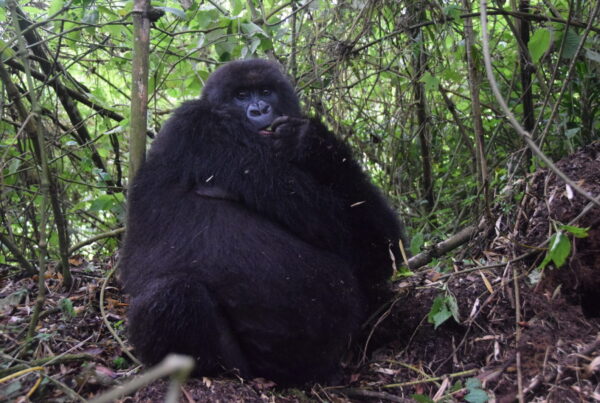
You know, intellectually, how large mountain gorillas are. Adult males can weigh 200 kilograms. The silverback’s arm span is wider than most humans are tall. But “knowing” this and being three metres away from it are very different experiences. People consistently describe the silverback as larger than they expected, despite having prepared extensively for the experience. The expectation is set by photographs and screens; the reality is set by the animal itself, and the reality wins every time.
After the Encounter: The Smell That Stays
When we walked back to the trailhead after our hour with the Mubare family, I was aware that I could still smell the gorillas even after we had been walking for thirty minutes away from them. Whether this was actual scent on my clothing or a sensory memory, I genuinely could not say.
Several other trekkers in the group mentioned the same thing over lunch. One woman said she could still smell the gorillas when she changed her clothes at the lodge, though she acknowledged this was probably psychological rather than physical. I think the distinction is less important than she imagined — the smell had become associated with the experience so strongly that it had been encoded alongside the visual memories, and triggered together with them.
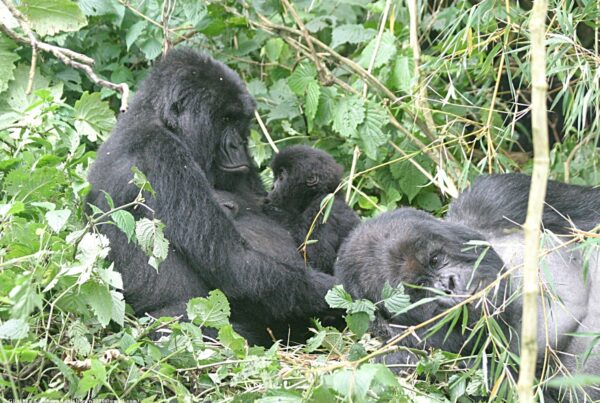
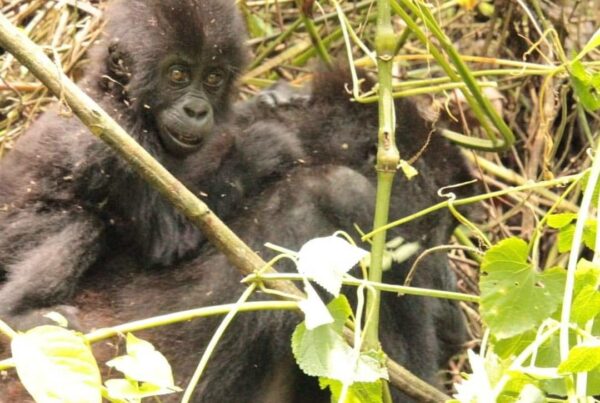
This happens with powerful experiences. Your brain files them under multiple sensory headings simultaneously. The gorilla smell was filed next to the juvenile who approached us, next to the silverback’s gaze, next to the sound of the forest, next to the specific quality of light through the Bwindi canopy at ten in the morning. They are, in memory, inseparable.
The Case for Full Sensory Immersion
All of this is an argument, indirectly, for why gorilla trekking is an experience that cannot be replicated by any form of mediated viewing. A documentary is extraordinary, but it cannot give you the smell of a gorilla family in their habitat. A zoo is educational, but it cannot give you the sound of knuckles on wet earth three metres away. A photograph is valuable, but it cannot give you the felt vibration of a deep rumble from a silverback.
The full experience — what all your senses receive when you are standing in Bwindi Forest with the Mubare family — is available only there. And the smell, which nobody talks about, is part of what makes it irreplaceable.
Planning Your Visit
Uganda gorilla trekking permits cost $800 per person. The experience includes up to one hour with a habituated gorilla family in Bwindi Impenetrable National Park. Treks range from one to six hours depending on where the family has moved. All fitness levels are catered for, and porters are available for the steeper sections.
Contact Uganda Gorilla Trekking to check availability and book your permit. Bring good hiking boots, a camera, and — now you know — whatever associations you have with the particular smell of something genuinely wild encountered genuinely close.
Frequently Asked Questions
Uganda is home to the mountain gorilla (Gorilla beringei beringei), one of two subspecies of eastern gorilla. They live exclusively in the Virunga volcanic highlands (Uganda/Rwanda/DRC) and Bwindi Impenetrable Forest (Uganda only). Mountain gorillas are the only gorilla subspecies that cannot survive in captivity — every individual you can trek is a wild animal.
The standard gorilla trekking permit gives you exactly 1 hour with the gorilla family. This time begins when you make first contact with the family — the ranger signals the start. The Gorilla Habituation Experience gives 4 hours with a semi-wild family. The walk to find the gorillas can take 30 minutes to 5 hours depending on where the family has moved.
Stay calm, crouch down slowly, avoid direct eye contact, and remain quiet. Do not run — running triggers a chase response. Rangers accompanying your group manage close approaches. Habituated gorillas are accustomed to humans and almost never make contact, but a charging silverback is managed by staying still and following ranger instructions immediately.
A maximum of 8 visitors per habituated gorilla family per day for standard trekking. The Gorilla Habituation Experience has a maximum of 4 visitors per family per day. These limits are set by UWA to minimise stress on the gorilla families and maintain the quality of the experience.
Uganda is home to the mountain gorilla (Gorilla beringei beringei), one of two subspecies of eastern gorilla. They live exclusively in the Virunga volcanic highlands (Uganda/Rwanda/DRC) and Bwindi Impenetrable Forest (Uganda only). Mountain gorillas are the only gorilla subspecies that cannot survive in captivity — every individual you can trek is a wild animal.