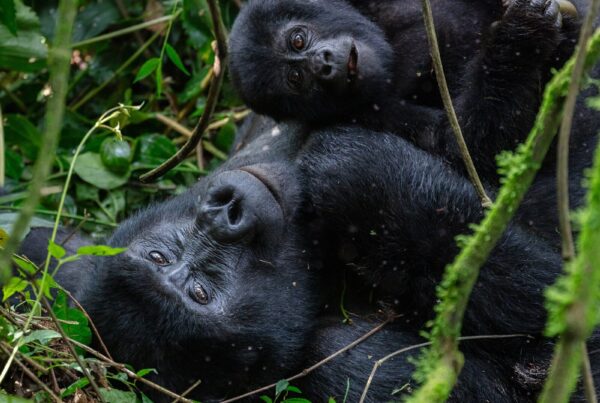
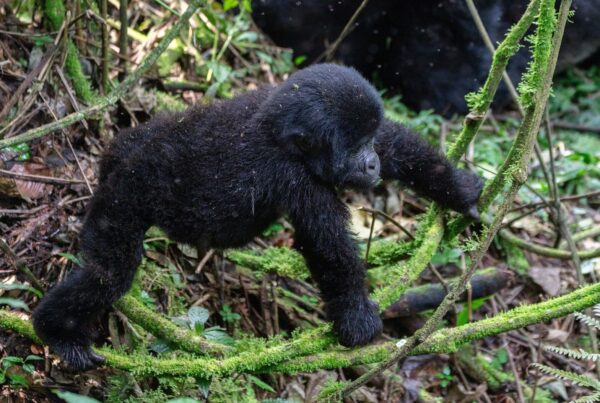
The first week of a mountain gorilla’s life is its most vulnerable. The infant is born at approximately 1.8 kg, with eyes open but entirely dependent on its mother for warmth, nutrition, and protection. In the first days the mother rarely sets the infant down and the bond between them is the primary determinant of the infant’s survival. When that bond is disrupted — by a difficult birth, by maternal illness, or by unusual social circumstances — the infant’s chances decrease rapidly. The story of the Bweza group infant born in 2020 illustrates how close the margin can be, and what the intervention of the Gorilla Doctors team made possible.
A Difficult Birth
The birth was observed — unusually — by the monitoring ranger team, who had been tracking the Bweza group closely because the pregnant female had been showing signs of imminent labour. The birth occurred in the morning and was protracted — taking over four hours, which is longer than typical gorilla births. The infant was born alive but the female, visibly exhausted, did not immediately begin the cleaning and stimulation of the infant that normally follows delivery.
The Gorilla Doctors team was notified immediately. Their initial assessment found an infant that was cold, wet, and not nursing — the three warning signs that, together, indicate a neonate at serious risk. The female was alert but not engaging with the infant in the normal post-birth bonding behaviour.
The First Twenty-Four Hours
The team made the decision not to intervene physically in the first instance — removing the infant for veterinary care carries the risk of severing the maternal bond permanently, which would condemn the infant to a life of hand-rearing without the social integration that wild gorilla groups provide. Instead, the team maintained close monitoring and waited to see whether the female would begin to engage with the infant.
By early afternoon — approximately six hours after the birth — the female had begun to hold the infant more closely. By evening she was nursing. The Gorilla Doctors team observed the nursing and confirmed milk transfer. The infant’s core temperature, assessed indirectly through its behaviour, appeared to stabilise. The decision not to intervene had been correct, but it had required accepting several hours of uncertainty during which the outcome was genuinely unclear.
The Monitoring Regime That Followed
The team maintained elevated monitoring of the Bweza group for the following two weeks. Daily observations confirmed that the infant was nursing, maintaining normal weight gain, and achieving the developmental milestones expected in the first weeks of life. At the two-week assessment the Gorilla Doctors team classified the infant as stable and reduced monitoring to the standard protocol.
The infant — a male — is now a healthy juvenile member of the Bweza group. Trekkers who visit the group at Buhoma sector in 2027 may observe him: one of the more active and curious juveniles in the group, identifiable to guides by specific markings noted at birth. His survival required the monitoring infrastructure to detect the problem within hours of birth, the veterinary expertise to make the right decision about when to wait rather than intervene, and the habituation of his family that allowed close enough observation for that decision to be informed.
What Survived
The gorilla permit costs $800. The monitoring, the veterinary team, the rangers, the anti-poaching infrastructure — these are what that permit maintains. The Bweza juvenile who almost did not survive his first week is alive because these systems worked. He will, if he lives to adulthood, become part of the mountain gorilla population that has grown from 254 individuals to over 1,060. One birth at a time.