Updated
Gorilla infants separated from their family groups are among the most critical situations in mountain gorilla conservation. An infant alone in the forest is vulnerable to predators, to exposure, to starvation, and to the psychological distress that separation from its mother causes. The cases documented by Uganda Wildlife Authority and Gorilla Doctors of infant rescues in Bwindi — where a separated baby has been located, stabilised, and reunited with its family — are detailed accounts of rapid-response conservation in practice, and they illustrate the infrastructure that makes such interventions possible.
How Separations Happen
Infant gorillas under two years of age do not separate from their mothers voluntarily. The documented separation cases in Bwindi have occurred in specific circumstances: during rapid group movement through difficult terrain when the mother has fallen behind the main group; during confrontational events when the group disperses quickly; and in one documented case, during a predator encounter that caused brief panic in the group and resulted in a mother and infant being separated in the ensuing movement.
In each case the critical factor was detection speed. A separated infant that is not located within hours faces declining survival odds as night temperature drops at Bwindi’s altitude and predator activity increases after dark. The monitoring systems that track habituated groups — daily ranger patrols, tracker networks, radio communication infrastructure — are designed in part to enable the rapid detection that makes successful reunification possible.
The Rescue
The infant in this account was found by trackers monitoring the Rushegura group at Buhoma sector. The morning check found the group with an unusual level of vocalisation — alarm calls, agitated movement — and a count of individuals that came up one short. The missing individual was identified as a fourteen-month-old male, born to a mid-ranking female in the group.
Rangers backtracked the group’s movement from the previous afternoon and found the infant in the mid-morning, approximately 600 metres from the group’s current location, in dense undergrowth near a stream. He was cold and stressed but uninjured. The ranger team’s response was to warm him, assess him, and then begin the process of moving him toward the main group.
The Reunification
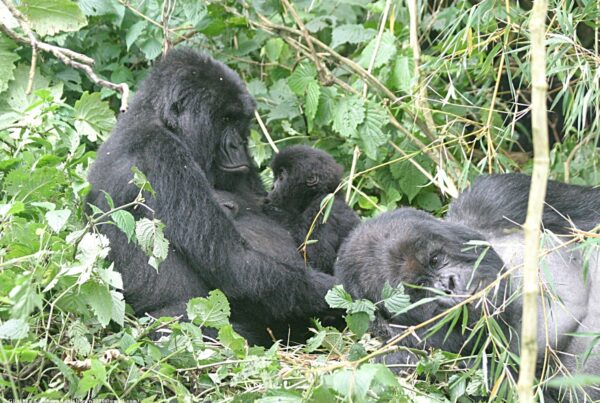
Reunification of a separated infant with its family group requires care. The rangers’ approach was to carry the infant to within hearing distance of the group and then set him down in a position where his vocalisations could be heard by his mother. Infants in distress produce calls that adult females, particularly mothers, respond to urgently. The infant’s mother broke from the group within minutes of hearing him. The reunion, documented by the rangers, was immediate and complete — the infant clung to his mother, who checked him thoroughly and then moved with him away from the rangers.
The Gorilla Doctors team assessed the infant from observation distance the following day and found him nursing normally and showing no signs of lasting distress. The separation had lasted approximately fifteen hours. He was located in time because the monitoring system worked.
What This Requires to Be Possible
This outcome required daily monitoring, experienced trackers who could detect an individual missing from a thirty-gorilla group, communication infrastructure allowing rapid ranger deployment, and the habituation of the Rushegura family that allowed rangers to approach and handle the infant without causing additional panic. All of this is funded by gorilla tourism. The permit costs $800. The infrastructure it maintains is the difference between a rescued infant and a story with a different ending.
Ranger-led gorilla rescue operations at Bwindi combine veterinary skill with field craft in a way that demonstrates the depth of expertise accumulated in the park’s habituated family programme. A baby gorilla separated from its family — whether by predator disturbance, human encounter at the forest edge, or family movement during the infant’s developmental stage when it might be left briefly — must be returned to the family before the separation becomes permanent. Rangers trained in both the individual family members’ identities and the gorilla’s developmental behaviour can sometimes facilitate reunion without veterinary intervention; more complex separations require a Gorilla Doctors assessment and, in the most serious cases, temporary holding followed by a managed reintroduction to the family group.
Ranger rescue operations for separated gorilla infants typically involve a ground team that follows the infant’s movement by sound and footprint, minimises direct contact to avoid habituation to individual human handlers, and works to bring the infant within range of the family group rather than extracting it from the forest environment. The constraint of maintaining minimal human contact while still providing sufficient support for the infant’s survival makes these operations among the most operationally complex that the monitoring teams undertake — a balance between the infant’s immediate safety needs and the long-term imperative to keep it functionally integrated with the gorilla social environment it needs to develop normally.