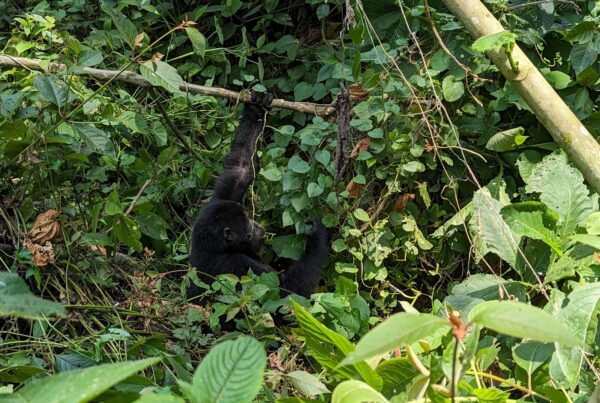
Africa has many iconic animals. The lion, the elephant, the leopard, the rhino, and the buffalo — the “big five” of safari tradition — are globally recognised symbols of the continent’s wildlife. The cheetah, the giraffe, the zebra, and the hippopotamus are equally familiar. But among all of Africa’s remarkable animals, the mountain gorilla has acquired a specific significance in the conservation narrative that exceeds even these more famous species. Understanding why requires examining not just the gorilla’s biology and rarity but the story of its recovery and what that recovery represents for conservation as a discipline.
The Rarity That Defines It
There are approximately 1,100 mountain gorillas alive on earth. This is the entire global population of a species — not a regional subspecies count, not a national estimate. Every mountain gorilla that has ever lived on earth has lived in a narrow strip of forest straddling Uganda, Rwanda, and the DRC. The species exists nowhere else: not in captivity, not in any other country, not at any other time in recorded history. This absolute constraint — that the gorilla’s survival is entirely dependent on the continued integrity of a few hundred square kilometres of Albertine Rift forest — gives it a specificity that more widely distributed species do not have.
When people say that protecting Bwindi is protecting the mountain gorilla, they are making a literal claim. The forest is the species. There is no backup population, no captive reserve, no alternative habitat. If Bwindi’s gorillas are lost, the mountain gorilla is gone from the world. That is not true of lions, or elephants, or even most other endangered species that have populations distributed across multiple regions.
The Recovery That Proves Conservation Works
In 1981, at the depth of the mountain gorilla’s crisis, wildlife biologists estimated the population at fewer than 250 individuals in the Virunga Massif alone. The prognosis was bleak. By the early 1990s, when Uganda gazetted Bwindi as a national park and systematic census data became available across both populations, the total was estimated at approximately 620. By 2010 it was over 880. Today it is over 1,100 and growing.
This trajectory — from near-extinction to documented, sustained recovery — is the rarest outcome in conservation. Most critically endangered species follow the opposite arc: initial concern, conservation effort, stabilisation or continued decline, and ultimately extinction or permanent listing as a conservation-dependent survivor. The mountain gorilla’s genuine recovery, in a landscape of intense human pressure and with the most modest financial resources relative to the challenge, demonstrates that even the most imperilled species can be brought back from the edge when the right combination of protection, economic incentive, and community engagement is sustained.
The Human Mirror
Mountain gorillas share 98% of human DNA. Their social structures — the hierarchical family groups, the protective silverback, the close bonds between mothers and infants, the play behaviour of juveniles, the grief responses documented when family members die — are recognisably familiar to human observers in a way that most other animals’ behaviours are not. This familiarity creates an empathic connection that has driven conservation support for gorillas in ways that biologically more distant species have not generated.
The conservation movement for mountain gorillas has always benefited from public engagement that transcends the purely ecological argument. People who have no particular interest in forest ecology or biodiversity science can feel a direct emotional connection to a species that nurses its infants, mourns its dead, and demonstrates social intelligence that any human observer can recognise. This emotional accessibility has made the gorilla a uniquely effective conservation symbol — capable of engaging audiences that the technical language of biodiversity conservation cannot reach.
The Umbrella Species Effect
In conservation biology, an umbrella species is one whose protection automatically protects many other species because it requires a large, intact habitat. Mountain gorillas are the quintessential umbrella species for the Albertine Rift forests. Protecting Bwindi for the gorillas means protecting the forest that contains hundreds of endemic plant species, 347 bird species, 120 mammal species, and countless invertebrates that share the same ecosystem. The gorilla’s symbolic importance drives the funding and political will that protects all of this — species that would never attract the same level of conservation attention or tourism revenue on their own merits.
What Trekking Means in This Context
The gorilla trekking permit at $800 USD for international visitors in 2027 is many things simultaneously: a ticket to an extraordinary wildlife encounter, a contribution to ranger salaries and patrol operations, a payment into the community revenue-sharing programme that gives Bwindi’s neighbours a stake in its survival, and a vote for the conservation model that has produced the mountain gorilla’s recovery. In paying the permit and making the trek, a visitor participates directly in the story that the gorilla represents: that endangered species can recover, that conservation investment works, and that the presence of human visitors in the right conditions and the right numbers is not a threat to wild animals but part of the system that keeps them alive.
The gorilla is Africa’s most important conservation symbol because it is both the most dramatic proof that conservation works and the most compelling argument for why it must continue. Every living mountain gorilla is evidence of what becomes possible when protection is sustained. Every trekker who pays the permit is part of sustaining it.
Frequently Asked Questions
The global mountain gorilla population is approximately 1,100 individuals — one of the smallest populations of any great ape. They exist in two separate populations: one in the Virunga Massif spanning Uganda, Rwanda, and DRC; and one in Bwindi Impenetrable Forest (Uganda only). The population has grown from approximately 620 in the 1980s, largely due to tourism-funded conservation.
Uganda Wildlife Authority directs 20% of every gorilla permit fee to communities adjacent to Bwindi and Mgahinga. These funds pay for school construction, healthcare programmes, borehole maintenance, and community microfinance. Permit revenue also funds ranger salaries, anti-poaching patrols, and the research teams that monitor gorilla health daily.
The Batwa (also called Twa) are an indigenous forest people who lived inside Bwindi for thousands of years until it was gazetted as a national park in 1991. Conservation displaced them from their ancestral forest. Gorilla tourism revenue now funds Batwa cultural programmes and livelihoods. The Batwa Cultural Trail at Buhoma sector is run by the Batwa community and is one of the most authentic cultural experiences near Bwindi.
Mountain gorillas are classified as Endangered on the IUCN Red List — one step down from Critically Endangered, which they held until 2018. Their population has grown consistently since the 1980s, making them one of the few great ape populations increasing in number. This recovery is directly attributed to the conservation funding generated by gorilla tourism.
Uganda is home to the mountain gorilla (Gorilla beringei beringei), one of two subspecies of eastern gorilla. They live exclusively in the Virunga volcanic highlands (Uganda/Rwanda/DRC) and Bwindi Impenetrable Forest (Uganda only). Mountain gorillas are the only gorilla subspecies that cannot survive in captivity — every individual you can trek is a wild animal.