Updated
The Complete Visual Guide to Mountain Gorilla Body Language
Mountain gorilla body language guide for trekkers and wildlife observers
A mountain gorilla body language guide is one of the most practically useful pieces of information that any gorilla trekking visitor can have before entering Bwindi Impenetrable Forest. Understanding what a gorilla’s posture, movement, and facial expression communicate allows trekking visitors to interpret what is happening in front of them during the encounter with an accuracy and depth that significantly enriches the experience. More practically, understanding gorilla body language allows trekkers to recognise when their own behaviour needs to change — when the silverback is becoming alert to something unusual, when a particular stance requires the group to lower their posture, and when the calm, disengaged movement of the family indicates a completely relaxed encounter. This guide covers the key elements of mountain gorilla body language from the most important to the most subtle.
The silverback’s body language: the most important signals to read
The silverback’s body language is the primary information source for every trekking group entering a gorilla family’s territory. His posture, movement, and vocalisation set the tone for the encounter, and reading his signals correctly is the ranger’s primary responsibility and the trekking group’s most important skill.
Relaxed posture: the baseline
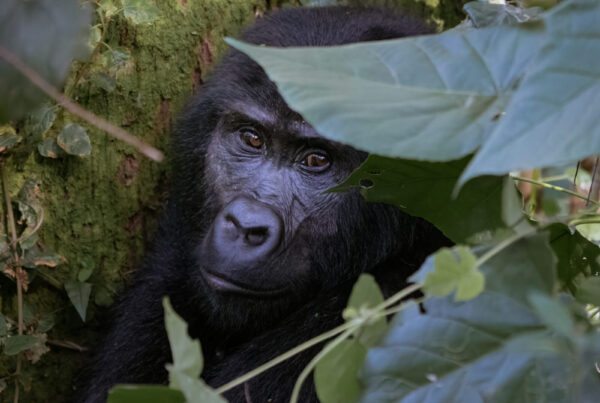
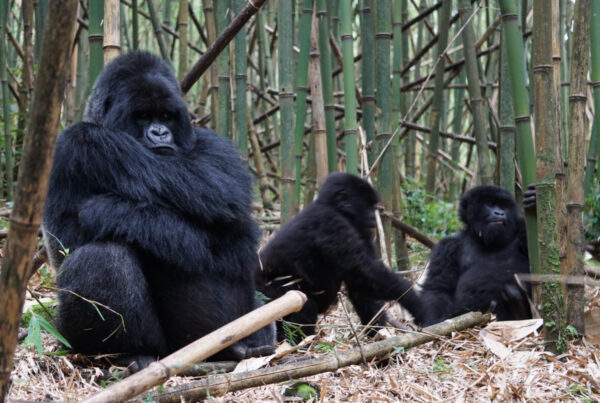
A relaxed silverback is either resting — lying on his side or sitting upright with his weight distributed comfortably — or feeding. His movement, when he is moving, is deliberate and unhurried. His attention is divided between the forest environment, his family members, and the trekking group, without being fixed on any of them for extended periods. His facial expression is composed: mouth closed, brow unfurrowed, eyes moving regularly but without urgency. This is the baseline from which deviations indicate a change in his internal state, and it is the state that most trekking encounters involve for the majority of the permitted hour.
Alert posture: something has caught his attention
When the silverback moves into alert posture, the change is immediately visible even to observers who have never seen it before. He sits upright if he was resting, or stops moving if he was travelling. His head turns towards the source of his attention. His eyes focus and fix. His breathing slows. Rangers who observe this transition know immediately to manage the trekking group: if the silverback has been alerted by the behaviour of a trekking visitor — a sudden movement, an unexpected noise, a camera shutter at the wrong moment — the appropriate response is stillness and lowered posture. If the silverback has been alerted by something else — a sound from elsewhere in the forest, the approach of a neighbouring group’s silverback, an unusual event within his own family — the ranger observes carefully before deciding how to respond.
Display behaviour: establishing dominance
When a silverback performs a display — rising to his full height, beating his chest with cupped palms, vocalising with deep hoots or alarm barks, and sometimes charging towards the perceived challenge before stopping short — every trekking guide present responds with the same instructions to the group: crouch, lower your eyes, stay still. The display is a communication, not an attack, and the appropriate response is one that conveys deference and non-challenge. Trekkers who crouch and avoid eye contact in response to a silverback display are communicating exactly the right message: we acknowledge your dominance, we are not a threat. The silverback, having received this response, typically ends the display and returns to his normal activity.
Female gorilla body language: reading the family’s social dynamics
Female mountain gorillas — particularly the dominant or “lead” female in the group, who occupies the highest social rank among the females — communicate the social state of the group through body language that experienced observers learn to read as fluently as the silverback’s signals.
Proximity to the silverback as a status signal
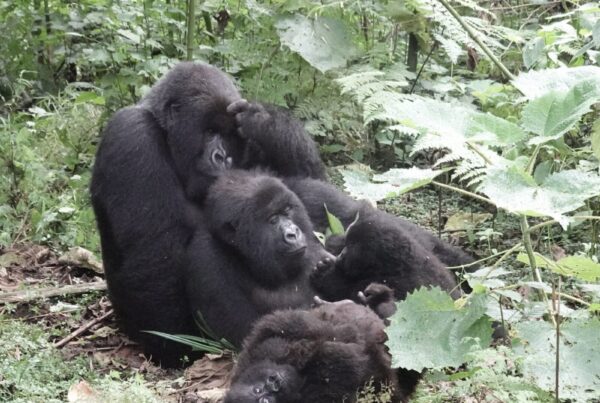
The physical positioning of females relative to the silverback communicates social rank and relationship quality in real time. High-ranking females rest and feed in close proximity to the silverback; lower-ranking females maintain more distance. When the silverback moves, the female who moves with him most promptly, and who positions herself closest to him after the movement, is typically the highest-ranking female in the group. This spatial information — readable in a few minutes of observation — provides the foundation for understanding the social structure of the family you are observing.
The piloerection signal
Piloerection — the raising of the hair on the body and arms — is a reliable indicator of an agitated or alarmed gorilla. In mountain gorillas, piloerection can be seen most clearly on the arms and shoulders, where the longer outer guard hairs rise to create a visually larger, more imposing profile. The signal functions both as a display to other group members (communicating the individual’s agitated state) and potentially as a genuine attempt to appear larger and more threatening. Rangers observing piloerection in multiple family members simultaneously recognise it as a signal that the group is collectively uneasy and adjust the trekking group’s behaviour accordingly.
Infant body language: play, fear, and exploration
Gorilla infants have a more limited but equally readable repertoire of body language signals. Play face — the open-mouth expression produced during play, functionally equivalent to a human smile — is the easiest infant signal to identify and the one most reliably produced during encounters with trekking groups. Fear behaviour — clinging to the mother, hiding behind the mother’s body, attempting to reach the mother from a distance — is also unmistakable and occurs when infants are startled or when the encounter involves closer approach than the infant is accustomed to.
The contact grunt
Gorilla infants separated from their mothers by even a short distance produce a specific vocalisation — a brief, quiet grunt — that functions as a contact call. The mother’s response is usually equally brief: a soft answering vocalisation or a movement to close the distance between them. This exchange, repeated throughout the day as the infant begins to explore its environment independently, is one of the most clearly observable communication sequences in mountain gorilla social life and one that resonates immediately with human parents familiar with the anxiety of a young child at the edge of their comfort distance.
Reading body language in real time: the ranger’s skill
The skill of gorilla trekking rangers lies partly in their ability to read all of these signals simultaneously and to manage the trekking group’s behaviour in response. A ranger who notices the silverback shifting from relaxed to alert posture before the trekkers have registered any change will quietly stop the group and wait, watching the silverback’s signals and managing the group’s positioning to ensure that nothing in the visitors’ behaviour escalates whatever has caught the silverback’s attention. This continuous, expert monitoring — invisible to most trekking visitors because the ranger makes it look effortless — is the infrastructure on which the entire gorilla trekking experience rests.
Understanding gorilla body language transforms the experience of a gorilla trek from a passive wildlife viewing event into an active, engaged observation of complex social behaviour. The more you can read of what you are watching, the more you will see — and the more you will understand of the family dynamics, social relationships, and individual personalities that make mountain gorilla society one of the most fascinating subjects in primatology.