Updated
gorilla play wrestling juvenile development social behaviour is a subject central to Uganda’s wildlife tourism, where mountain gorilla conservation and responsible visitor experiences go hand in hand. Gorillas play and wrestle, and the play of juvenile mountain gorillas in Bwindi Forest is one of the most immediately engaging things a trekking visitor will observe — partly because it is genuinely entertaining, and partly because it is recognisable in a way that other gorilla behaviours are not. A juvenile gorilla chasing another through the undergrowth, wrestling with the specific focus of an animal that has important things to learn, tumbling off a branch and scrambling back up with no apparent embarrassment — these are behaviours that every person who has watched children at play will recognise immediately. That recognition is not coincidental. It reflects shared evolutionary roots in play as a mechanism of social and cognitive development.
Gorillas Play and Wrestle: Juvenile Social Development Explained
What Gorilla Play Is
Play in gorillas, as in most social mammals, is defined by a set of characteristics: it is voluntary, intrinsically motivated (not driven by immediate need), exaggerated in its movements, often role-reversed (the larger animal might pretend to be dominated), and typically involves signals that communicate “this is play, not aggression.” In gorillas, the primary play signal is a specific vocalisation — a breathy, rhythmic call that functions like laughter in its social role, telling the play partner that the physical contact occurring is playful rather than antagonistic.
Gorilla play occurs most frequently in juveniles (ages 3-8) and sub-adults (8-12), though adults occasionally engage in play with juveniles, particularly the dominant silverback with young group members. The frequency and intensity of play peaks in the juvenile period and decreases as animals approach adulthood and the stakes of physical interactions increase.
The Developmental Functions of Play
Play is not recreational. It is developmental work done in a recreational mode — the specific qualities of play (the lowered stakes, the safety signals, the reversibility of outcomes) create conditions in which young animals can practise skills and test social dynamics without the costs that would attach to the same activities in serious contexts.
Physical Development
The wrestling, chasing, and climbing of juvenile gorilla play develops coordination, strength, and the specific physical skills that will be needed for adult life — including, for males, the fighting skills that will determine social rank. Play fighting between juvenile males has the specific quality of genuine fighting practice: the techniques used, the body positions adopted, and the sequences of moves and counters reflect the techniques that adult males use in serious conflicts.
Social Learning
Play provides a context for learning the social rules of the group. Juvenile gorillas that play with a range of partners — other juveniles, sub-adults, occasionally adults — experience a range of social dynamics, learn how different animals respond to different interactions, and begin to develop the social knowledge that will be essential for managing their position in the adult hierarchy. The specifically social learning function of play is one of the reasons that play frequency decreases when juveniles are isolated from peers — the information that play provides is social information, and social information requires social partners.
Cognitive Development
The flexibility of play — the role reversals, the novel combinations, the voluntary rule-making and rule-breaking — exercises cognitive flexibility in ways that more stereotyped behaviours do not. Animals that have more diverse play histories tend to be more behaviourally flexible as adults, more capable of adapting their responses to novel situations. This flexibility is one of the most consistent findings across species in play research.
Male and Female Play Differences
Juvenile male and female gorillas play differently, and the differences reflect their different adult roles. Juvenile males engage in more rough-and-tumble wrestling, spend more time in play fighting, and more frequently test the dominance dynamics of play interactions. Juvenile females engage in more social play — closer physical proximity, more grooming-adjacent interactions, more play that involves mother-infant simulation (carrying and caring for younger animals).
These differences are not absolute — female juveniles also wrestle and male juveniles also engage in gentle social play — but they are consistent enough to be documented across multiple study populations. They are generally interpreted as early rehearsal of adult role behaviours: males are practising for the competitive, physically demanding life of adult males; females are practising for the caregiving, social-management life of adult females.
Play With the Silverback
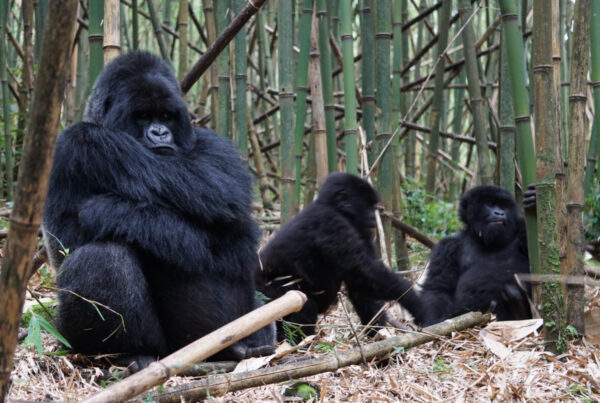
One of the most affecting things to observe during a gorilla trek is play between a silverback and young group members. The dominant male — the most powerful animal in the family group, capable of displacing any other member at will — engages in play with juveniles and infants with a visible modulation of his physical capability. He allows animals that are a fraction of his size to “dominate” him in play, holds back his strength, and participates in interactions that serve no competitive purpose for him at all.
This tolerant play behaviour has functional significance: it maintains social bonds between the silverback and young group members, socialises juveniles to the silverback’s presence and thereby reduces their anxiety about proximity to him, and may play a role in the silverback’s assessment of the group’s young males as they develop. But its quality, observed from outside, looks very much like affection — the large animal choosing to play gently with the small ones because doing so has value that is not reducible to utility.
Watching Play During a Trek
The juvenile play activity is usually the most immediately engaging thing for trekking visitors, particularly those who find the feeding behaviour of adults less intuitively interesting. It is also the part of the hour most likely to produce spontaneous laughter from the visitor group — the pratfalls, the comical reversals, the specific absurdity of a young gorilla that has tried something ambitious and found it beyond current capability are universally funny in a way that crosses every species boundary.
Your guide can explain what specific play sequences mean and what the juveniles are learning from them. The information adds depth to what is already an immediately accessible observation.
Uganda gorilla trekking permits are $800 per person. Contact Uganda Gorilla Trekking to book your permit. The juveniles are playing. Come and watch.