Mountain gorilla facts that surprise even experienced wildlife enthusiasts
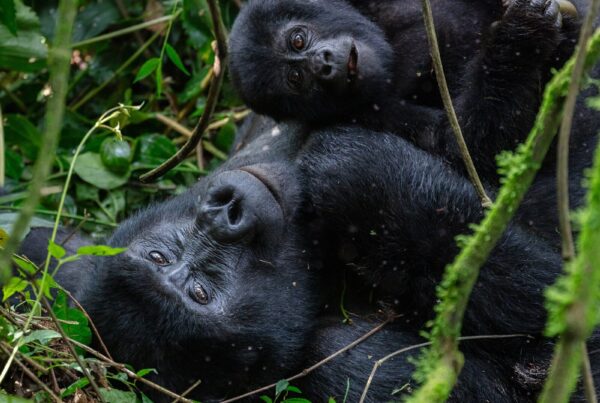
Mountain gorilla facts are frequently misrepresented, simplified, or simply unknown to the general public — even among people who have a strong interest in wildlife and conservation. The combination of the gorillas’ relative inaccessibility (living in remote mountain rainforests in central Africa), the limited number of researchers who have worked directly with them, and the tendency of popular media to focus on a few well-known facts at the expense of the genuinely surprising detail means that most people’s knowledge of mountain gorillas contains significant gaps. This illustrated guide covers 25 facts about mountain gorillas that most visitors to Bwindi learn for the first time during their trekking experience.
1. There are only two populations of mountain gorillas in the world
Mountain gorillas live in exactly two locations: Bwindi Impenetrable Forest in Uganda, and the Virunga Massif — a chain of six volcanoes straddling the borders of Uganda, Rwanda, and the Democratic Republic of Congo. These two populations are not connected — the gorillas cannot move between them — and together they contain the entire world population of approximately 1,063 individuals as of the most recent census.
2. Mountain gorillas cannot survive in captivity
Unlike western lowland gorillas — which are kept in zoos worldwide and have been bred in captivity for decades — mountain gorillas have never successfully survived in captivity. Every attempt to keep a mountain gorilla in a zoo has failed, and the species is considered unkeepable outside its natural habitat. This means that unlike many endangered animals, mountain gorillas cannot be protected through a captive breeding programme. Their survival depends entirely on protecting the wild populations in Bwindi and the Virungas.
3. They eat up to 34 kilograms of vegetation per day
A large silverback gorilla can consume up to 34 kilograms of vegetation daily — the equivalent of roughly 34 average-sized cabbages. This extraordinary food intake is necessary to fuel a body that can weigh over 200 kilograms and to support the energy demands of moving through steep, dense forest for several hours each day. Mountain gorillas are primarily folivores — leaf eaters — and their diet includes over 200 plant species found in their forest habitat.
4. A silverback’s silver is permanent
The silver coloration that gives silverback gorillas their name is not a seasonal or temporary change — it is permanent, developing when a male reaches sexual maturity at around 11 to 13 years of age and remaining for the rest of his life. The silver saddle is a visual signal of sexual maturity and social status that is immediately recognised by other gorillas. A young adult male without silver coloration is called a blackback — distinguishable from a silverback by the uniform black of his coat.
5. Gorillas have blood types
Mountain gorillas have ABO blood types, just like humans — although the distribution of blood types in gorilla populations differs from that in humans. This shared blood group system is one of many physiological similarities between gorillas and humans that reflect their close evolutionary relationship. The shared blood group system also has practical conservation implications: it affects the disease susceptibility of gorillas and the protocols that need to be followed to prevent disease transmission from human visitors.
6. They laugh
Gorillas produce a vocalisation during play that researchers describe as functionally equivalent to laughter — a rapid, panting exhalation produced during tickling, chasing, and wrestling games. The sound is distinct from the other vocalisations in the gorilla repertoire, is produced reliably in play contexts, and has been documented across multiple gorilla populations. It is one of the behaviours that most powerfully illustrates the emotional continuity between gorillas and humans.
7. Infant gorillas are born with white tails
Mountain gorilla infants are born with a small tuft of white hair on their rump — a marker that disappears as the infant grows. The function of this white marking is not fully understood, but researchers have noted that adults in the group show increased interest in and tolerance of infants that display the marking, suggesting it may serve as a signal of vulnerability that triggers protective behaviour in older group members.
8. Gorillas have individual personalities
Long-term research on mountain gorilla populations has documented clear individual personality differences — some gorillas are consistently more bold, more playful, more aggressive, or more affiliative than others, regardless of social rank or family position. These personality differences are stable over time and influence the individual gorilla’s social relationships and behaviour in predictable ways. Rangers who have worked with habituated families for many years describe individual gorilla personalities with the same specificity that you would expect from descriptions of human individuals.
9. A silverback leads a family for his entire adult life
When a silverback becomes the dominant male of a family group — either by inheriting leadership from his father or by forming a new group — he typically leads that group for the rest of his life. Silverback leadership is not challenged from within the group in the way that some other animal social structures involve regular challenges and replacements. A silverback is replaced only when he dies or becomes too old and infirm to defend his family, at which point a younger male — often one of his own sons — takes over leadership.
10. They have home ranges but not fixed territories
Mountain gorilla family groups have home ranges — areas of forest that they use regularly and that overlap with the ranges of neighbouring groups — but they do not defend these ranges as fixed territories in the way that many other animals do. Encounters between different family groups are relatively rare and usually resolved without serious violence, through display and withdrawal. The flexibility of this arrangement allows gorilla families to shift their ranges in response to seasonal changes in food availability without the costs of territorial defence.
11-25: Additional facts for the curious
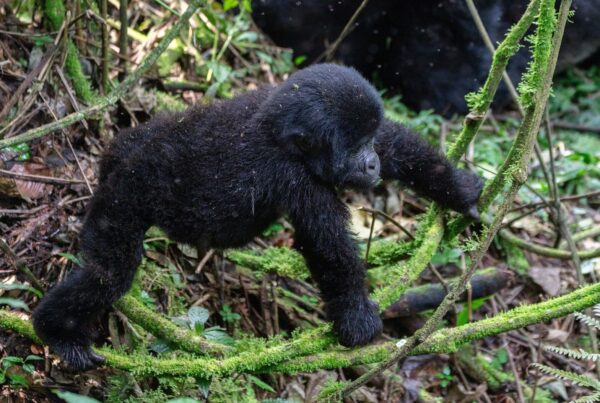
Beyond these ten, the list of surprising mountain gorilla facts extends considerably. Gorillas do not swim and avoid crossing deep water whenever possible. They have individual vocalisation signatures that researchers use to identify individuals at distance, in the same way that humans can often recognise a specific person’s voice. They produce a specific vocalisation — a series of belch rumbles — that functions as a social contact call, keeping family members in auditory contact in dense forest where visual contact is limited. Their fur is longer and thicker than that of lowland gorillas, an adaptation to the cooler temperatures of their high-altitude forest habitat. They build a new sleeping nest every night — a fresh platform of bent vegetation that is used for one night and then abandoned. Mountain gorilla infants are completely dependent on their mothers for the first three years of life and remain with their birth family until sexual maturity at around eight to ten years of age.
The full complexity of mountain gorilla biology, behaviour, and social life is accessible to visitors who spend an hour with a habituated family in Bwindi and who ask their ranger the questions that the encounter provokes. The gorilla trekking experience is, among its many other qualities, one of the most effective wildlife education programmes in the world — and the facts you learn during your hour in the forest tend to stay with you in a way that information from a book or documentary simply cannot match.