Mountain gorillas share 98.3% of human DNA, and this number appears in every gorilla trekking briefing, every conservation article, and every documentary about these animals. But what does it actually mean? The statistic is real, the science behind it is solid, and the implications of it extend well beyond the headline number in ways that are genuinely interesting — and that change how you experience an hour with a gorilla family in a way that abstract knowledge about DNA cannot.
What DNA Comparison Actually Measures
When scientists say that gorillas and humans share 98.3% of their DNA, they are measuring the similarity between the sequences of base pairs that make up the genomes of both species. The human genome contains approximately 3.2 billion base pairs. A 1.7% difference between two genomes of that size translates to approximately 54 million base pair variations — which is both a small percentage and an enormous absolute number.
The comparison is not between the number of genes (both humans and gorillas have roughly 20,000 to 25,000 protein-coding genes) but between the specific sequences of DNA bases — the adenine, thymine, cytosine, and guanine that spell out genetic information in every cell of every living creature. The 98.3% figure reflects how similar those spellings are between the two species.
Why 1.7% Can Mean So Much
A 1.7% difference sounds small until you consider what that 1.7% has produced over the approximately 10 million years since the human and gorilla lineages diverged from a common ancestor. Those differences encode changes in brain development, hand anatomy, facial structure, laryngeal anatomy (the physical basis of human speech), immune system function, and dozens of other systems. Small percentages of a 3.2 billion base pair genome have large consequences when they accumulate in the right places over millions of years.
The 98.3% similarity, conversely, reflects the shared architecture: the cellular machinery, the metabolic systems, the basic developmental processes, the immune system foundations, the broad structural plan of the primate body. This is the deep shared heritage that becomes tangible when you stand in Bwindi Forest with a gorilla family three metres away.
What the Similarity Looks Like in Practice
The 98.3% shows up in ways that are immediately visible during a gorilla trek.
The Hands
Gorilla hands are visually almost identical to human hands — the same finger count, similar proportions, fingerprints that can identify individuals the way human fingerprints can. The hands are more muscular and the grip more powerful (gorilla grip strength is approximately ten times human grip strength), but the basic architecture is the same. Watching a gorilla pick up food, groom another animal, or grip a branch, you are watching the same hand anatomy that is on the ends of your own arms, operating with greater force.
The Face
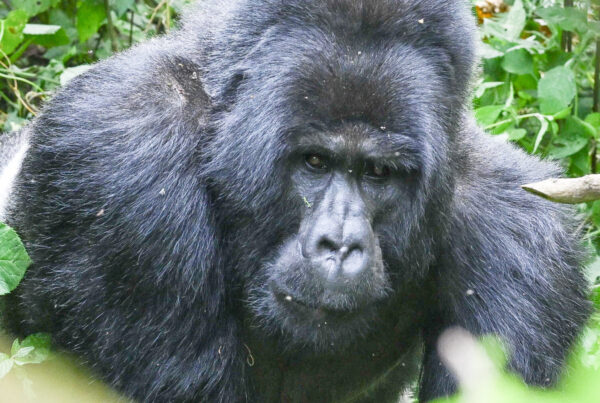
Gorilla facial expressions are legible to humans in ways that the expressions of more distantly related animals are not. The eyes register attention, curiosity, and discomfort in ways that humans instinctively read. The social facial signals — the expressions that accompany threat, appeasement, contentment — map onto human emotional reading systems with enough fidelity that experienced guides can interpret a gorilla’s emotional state in real time and adjust trekking group positioning accordingly.
The Social Structure
Gorilla social life — family groups with long-term pair bonds, extended parental investment, complex social hierarchies, play behaviour in young, conflict and reconciliation — is recognisable in outline from human social life, though the specific forms differ. The 98.3% shared genetic foundation produces a recognisable social architecture even at 10 million years of separation.
What the 1.7% Has Produced
The differences are as interesting as the similarities.
Language
Gorillas cannot produce human speech because their larynx is positioned differently than the human larynx. They can, however, learn and use sign language with genuine communicative intent — a fact demonstrated most famously by Koko, a western lowland gorilla who learned American Sign Language. The capacity for symbolic communication exists in both species; the physical apparatus for spoken language is unique to humans.
Bipedalism
Gorillas are primarily knuckle-walkers rather than bipeds. They can walk upright for short distances but are not built for it. The skeletal differences that make humans obligate bipeds — pelvic structure, leg length, foot anatomy — are encoded in that 1.7% divergence. The fossil record shows that bipedalism evolved in the human lineage after the divergence from gorillas, approximately 4 to 6 million years ago.
Brain Size and Cognition
Human brains are approximately three times larger than gorilla brains relative to body size. Much of the specific coding that drives this difference is in the 1.7% of the genome that diverged. The cognitive consequences are significant: human abstract reasoning, complex language, cumulative culture, and written record-keeping are not features of gorilla cognition. But the foundations — tool use, problem-solving, social intelligence, emotional complexity — exist in both species. The gorilla brain is not a simpler human brain; it is a related brain that took a different path.
The Conservation Significance of the Number
The 98.3% figure has direct conservation implications. Because gorillas are so closely related to humans, they are highly susceptible to human respiratory viruses — colds, influenza, and other diseases that are minor inconveniences for humans can be fatal for gorilla populations with no acquired immunity.
This is why trekking protocols require visitors to stay at least seven metres from gorillas and to not trek if they have flu-like symptoms. The same DNA that makes the gorilla encounter so profound also makes the gorillas vulnerable to the people who come to see them. The protocols are not arbitrary. They reflect the specific biological reality of the kinship the 98.3% number describes.
Experiencing the Number in Bwindi
The 98.3% is a number until you stand in Bwindi Forest with a gorilla family three metres away. Then it becomes something else — a direct, embodied understanding of what shared ancestry means in practice. The hands, the face, the social dynamics, the eyes that look at you with the specific quality of a mind engaged with another mind — all of it is the 98.3% made visible.
Trekkers who have read the number in advance consistently report that the number changes meaning in the forest. It stops being a statistic and becomes a felt reality. This is, I think, one of the most valuable aspects of the gorilla trekking experience: it makes abstract evolutionary science personally tangible in a way that no classroom or screen can replicate.
Planning Your Trek to See the 98.3% in Person
Uganda gorilla trekking permits are $800 per person and include one hour with a habituated gorilla family in Bwindi Impenetrable National Park. Contact Uganda Gorilla Trekking to book your permit and plan your visit. The 98.3% is waiting to become real for you, in a forest that has been running for millions of years.
Frequently Asked Questions
Uganda is home to the mountain gorilla (Gorilla beringei beringei), one of two subspecies of eastern gorilla. They live exclusively in the Virunga volcanic highlands (Uganda/Rwanda/DRC) and Bwindi Impenetrable Forest (Uganda only). Mountain gorillas are the only gorilla subspecies that cannot survive in captivity — every individual you can trek is a wild animal.
The standard gorilla trekking permit gives you exactly 1 hour with the gorilla family. This time begins when you make first contact with the family — the ranger signals the start. The Gorilla Habituation Experience gives 4 hours with a semi-wild family. The walk to find the gorillas can take 30 minutes to 5 hours depending on where the family has moved.
Stay calm, crouch down slowly, avoid direct eye contact, and remain quiet. Do not run — running triggers a chase response. Rangers accompanying your group manage close approaches. Habituated gorillas are accustomed to humans and almost never make contact, but a charging silverback is managed by staying still and following ranger instructions immediately.
A maximum of 8 visitors per habituated gorilla family per day for standard trekking. The Gorilla Habituation Experience has a maximum of 4 visitors per family per day. These limits are set by UWA to minimise stress on the gorilla families and maintain the quality of the experience.
Uganda is home to the mountain gorilla (Gorilla beringei beringei), one of two subspecies of eastern gorilla. They live exclusively in the Virunga volcanic highlands (Uganda/Rwanda/DRC) and Bwindi Impenetrable Forest (Uganda only). Mountain gorillas are the only gorilla subspecies that cannot survive in captivity — every individual you can trek is a wild animal.