Updated
turning 40 gorilla trekking Uganda Bwindi is one of Africa’s most extraordinary wildlife experiences, connecting travellers with mountain gorillas in their natural forest habitat. I turned 40 in Bwindi Forest surrounded by mountain gorillas. Not on the actual day — the planning did not align that precisely — but close enough that the trek was the centrepiece of a birthday trip that I spent more time planning than any other event of that year, including the birthday celebration my friends organised that I attended politely and found forgettable. The gorillas were not forgettable. This is what I learned from spending my fortieth year in Africa.
I Turned 40 in Bwindi Forest With Gorillas: Why That Mattered
Why the Round Numbers Matter
I know that 40 is a number and that a number does not change anything about the day it arrives. I also know that this is not how human psychology actually works. The round numbers function as forcing functions — moments when the social permission to examine your life is suddenly available in a way it is not during the years between. You are allowed to ask, at 40, what you have done and what you intend to do next. The question hangs in the air and demands something more than your usual evasion of it.
I had been travelling less than I intended for the previous decade. The usual reasons: career, relationship demands, the sense that there would always be more time. The 40 landmark made the falseness of that last assumption suddenly obvious. There would not always be more time. There was this time. The gorilla trekking permit cost $800 USD and I had been earning money for twenty years. The question of whether I could afford it became, at 40, obviously the wrong question.
Planning the Trip
I planned it like a significant event deserves to be planned — carefully, with attention to what I actually wanted rather than what was convenient. I researched sectors. I chose Buhoma for accessibility and for the history of the families there. I booked a lodge that had been specifically recommended for its veranda views of the forest edge. I arranged a charter flight from Entebbe because I was turning 40 and the 6-hour road journey felt like the wrong way to arrive at something I had decided was important. I asked my operator about the guide — specifically about which guides were known for their knowledge of the family’s individuals and their ability to communicate that knowledge during the hour.
The preparation was part of the gift I was giving myself. Caring enough about an experience to plan it well is its own statement about what you value.
Trek Day
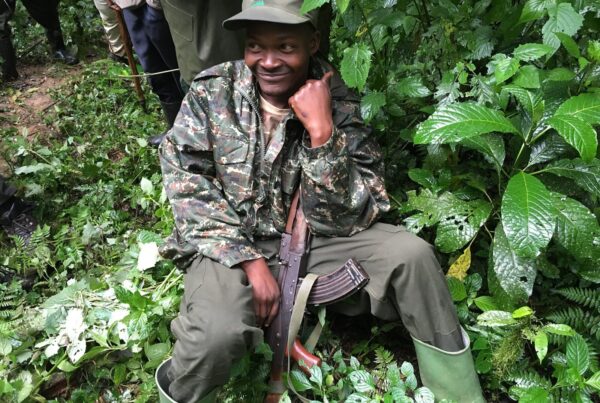
My guide was named Godfrey. He had been guiding at Buhoma for twelve years. He knew the Habinyanja family individually — the dominant silverback, the elder females, the adolescents he had watched grow up over a decade. Walking with someone who has that relationship with a wild animal family creates a different quality of encounter than walking with a guide who leads you to where the GPS coordinates say the animals are. Godfrey narrated the family as we approached — who was who, what to look for, what each individual’s characteristic behaviour was. By the time we found them I felt I was arriving to meet specific animals rather than experiencing an undifferentiated wildlife spectacle.
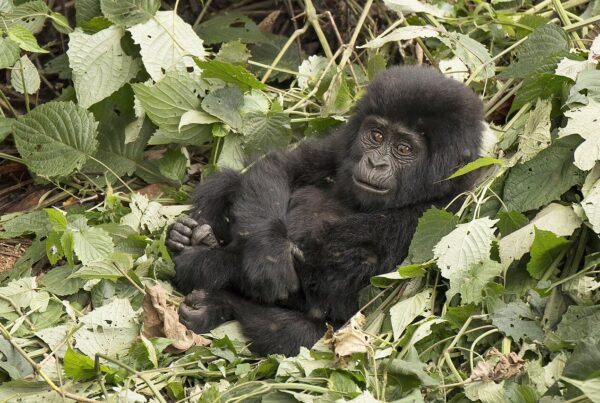
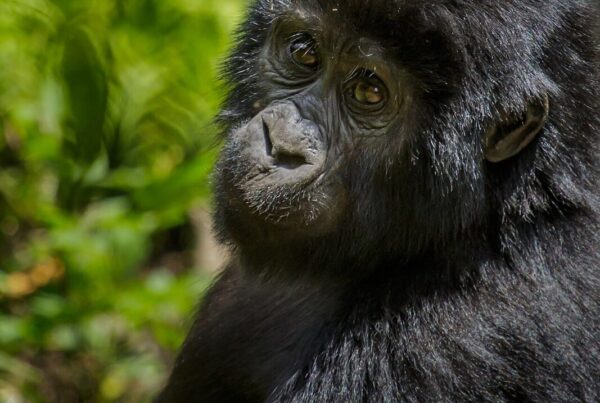
The Habinyanja group was feeding in a section of mid-altitude forest when we arrived. Godfrey pointed out the silverback — a large male he had been observing for nine years. He told me the male’s name. He described a specific personality trait he had observed across those nine years. I will not reproduce those details here because they are Godfrey’s knowledge and his relationship with these animals. But the specificity of it — the sense that I was meeting a named individual with a particular character in a particular place — elevated the experience past anything I had imagined.
What Turning 40 in the Forest Means
I spent my fortieth year asking what I had built and what I was building. The forest gave me a particular answer — not in words but in the quality of presence I felt there. You cannot spend an hour watching a mountain gorilla family and leave with the same priorities you arrived with. Not because the experience moralises at you or teaches you lessons. Because it simply is what it is, which is ancient and alive and completely real, and your life in comparison is revealed as the set of choices it is — some of which are worth making and some of which are not.
I came back from Uganda with a list. Not a bucket list — a list of things I had been not doing that I intended to start doing. It was shorter than you might expect. Most of the changes were small. But they were specific, and they were mine, and they came from standing in Bwindi Forest on the wrong side of 40 and understanding that the time for approximations was running out.
The gorilla trekking permit is $800. If you are facing a round number of your own, it is a worthwhile way to spend some of it.
Frequently Asked Questions
Uganda is home to the mountain gorilla (Gorilla beringei beringei), one of two subspecies of eastern gorilla. They live exclusively in the Virunga volcanic highlands (Uganda/Rwanda/DRC) and Bwindi Impenetrable Forest (Uganda only). Mountain gorillas are the only gorilla subspecies that cannot survive in captivity — every individual you can trek is a wild animal.
The standard gorilla trekking permit gives you exactly 1 hour with the gorilla family. This time begins when you make first contact with the family — the ranger signals the start. The Gorilla Habituation Experience gives 4 hours with a semi-wild family. The walk to find the gorillas can take 30 minutes to 5 hours depending on where the family has moved.
Stay calm, crouch down slowly, avoid direct eye contact, and remain quiet. Do not run — running triggers a chase response. Rangers accompanying your group manage close approaches. Habituated gorillas are accustomed to humans and almost never make contact, but a charging silverback is managed by staying still and following ranger instructions immediately.
A maximum of 8 visitors per habituated gorilla family per day for standard trekking. The Gorilla Habituation Experience has a maximum of 4 visitors per family per day. These limits are set by UWA to minimise stress on the gorilla families and maintain the quality of the experience.
Uganda is home to the mountain gorilla (Gorilla beringei beringei), one of two subspecies of eastern gorilla. They live exclusively in the Virunga volcanic highlands (Uganda/Rwanda/DRC) and Bwindi Impenetrable Forest (Uganda only). Mountain gorillas are the only gorilla subspecies that cannot survive in captivity — every individual you can trek is a wild animal.