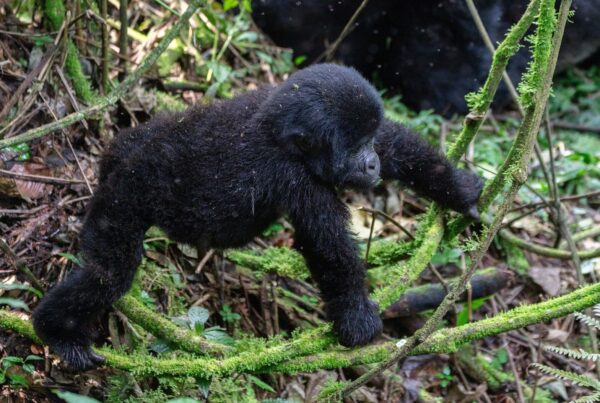
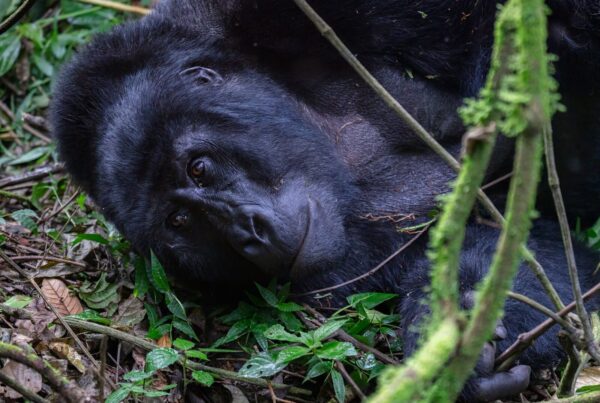
The dominant silverback of a mountain gorilla group is not simply its largest member — he is its social nucleus, the organising presence around which the group’s structure, movement, safety decisions, and reproduction are centred. When he dies, what happens next depends on whether the group has other adult males and whether the females have sufficient reason to stay together. In single-silverback groups, the social unit can disintegrate within days. In multi-male groups, the transition follows a different logic. Gorilla Doctors and the research teams in Bwindi document every silverback death and track the subsequent changes in group composition. See the gorilla families and their current composition, and the Bwindi conservation framework.
- Single-male groups: most vulnerable — often disintegrate when the silverback dies; females disperse to other groups
- Multi-male groups: more stable — subordinate males compete to inherit dominant position; group often holds together
- Infanticide risk: males who take over or absorb a group may kill infants sired by the previous silverback
- Female choice: females with infants often transfer to new groups to protect their young from infanticide
- Conservation significance: silverback deaths in small habituated populations require rapid response — group disintegration loses the investment of years of habituation
The death of a dominant silverback is the most disruptive event in the life of a mountain gorilla family. The silverback is not simply the group’s physical protector — he is its social nucleus, the organising presence around which the group’s structure, movement patterns, and collective behaviour are oriented. When that presence is removed, the family faces a fundamental reorganisation that determines whether it survives as a unit or disperses. The documented cases of silverback deaths in habituated groups in Bwindi provide some of the most detailed records of gorilla social resilience available in the research literature.
The Role of the Silverback in Group Structure
Understanding what is lost when a silverback dies requires understanding what he provides. He is the group’s navigator — decisions about where to travel, where to feed, and where to nest are initiated by the silverback and followed by the group. He is the group’s defender — confrontations with other groups, with solitary males seeking to steal females, and with predators are his responsibility. He is the social regulator — disputes between females are often resolved by his presence rather than direct intervention. And he is, for the females in the group, the reason they remain together: female gorillas’ primary social bond is with the silverback rather than with each other.
This last point is crucial for understanding what happens after a silverback’s death. Without the social attractor that has held the group together, individual females face a choice: remain with the group if a successor male is present, or transfer to another group or to a solitary male. The outcome depends almost entirely on whether there is a viable successor within the group.
The Nshongi Silverback’s Death and Its Aftermath
The original Nshongi silverback — the dominant male who led the group through its period of peak size at thirty-six individuals — died in 2014 at an estimated age of thirty-five. His death was not sudden; researchers had observed declining health and reduced dominance behaviour over several months, and his eventual death was documented by the monitoring team. The group at the time of his death numbered twenty-four individuals, having already begun the fission process that would accelerate following his death.
Within the group there were two maturing silverbacks — males who had grown up in the group and were approaching the age and size to potentially take the dominant role. The succession contest between them was documented over approximately three months following the dominant male’s death. It was resolved without serious physical injury — the larger of the two males achieved dominance through display rather than direct fighting, and his rival accepted subordinate status rather than departing.
Female Responses
Despite the succession, four adult females transferred out of the Nshongi group in the twelve months following the dominant silverback’s death. Two transferred to established neighbouring groups. Two joined a solitary male who was actively recruiting. This level of female transfer — approximately thirty percent of the adult female cohort — is consistent with documented patterns following silverback deaths in other habituated groups. It represents a significant demographic disruption but not a fatal one.
The Nshongi group stabilised under its new dominant male and has subsequently grown to its current size of approximately twenty-five individuals. The females who transferred also reproduced successfully in their new groups. In evolutionary terms, the system worked as it was designed to — the silverback’s death produced disruption, reorganisation, and ultimately continuation.
What Trekkers Observe
Every habituated gorilla group in Bwindi exists within this history of births, deaths, succession contests, and female transfers. The family you observe during a gorilla trek in Uganda in 2027 is a current chapter in a longer story. The permit costs $800. The research infrastructure that documents and understands these events is part of what that permit supports — and the families you visit are more knowable, and their futures more securable, because of it.
What happens to a gorilla group when the dominant silverback dies?
The outcome depends on group composition. In single-silverback groups, the death of the dominant male removes the only animal capable of protecting the group and coordinating its movements. Females — particularly those with dependent infants — face an immediate decision about their safety and that of their young. Many disperse to join established groups, often led by males who were already known to them from range overlap or previous encounters. The original group structure collapses, and if juveniles have not yet joined other groups, they may face elevated predation risk during the transition period.
What is infanticide in mountain gorillas and when does it happen?
Infanticide is the killing of infants sired by a different male — typically by a new dominant male who takes over a group or absorbs females from a disbanded group. It has been documented extensively in mountain gorillas since Dian Fossey’s observations in the 1970s. The mechanism is evolutionary: by killing infants not his own, a male accelerates the females’ return to reproductive cycle, allowing them to conceive his offspring sooner. Females with dependent infants are aware of this risk — they often transfer to groups led by males unlikely to commit infanticide, including groups with an established relationship with their offspring’s father.
Do gorillas grieve when a group member dies?
Research observations document behaviours consistent with grief responses in mountain gorillas after the death of group members. Groups spend extended periods near the body of a recently deceased animal, exhibiting reduced activity, reduced feeding, and increased inter-individual grooming — which serves as comfort behaviour in gorilla social life. Mothers have been documented carrying deceased infants for days before finally leaving them. These behaviours are not definitively grief in the human psychological sense, but they are measurably distinct from the group’s behaviour at other times and appear to function similarly to human mourning.
How do Gorilla Doctors respond when a silverback dies?
Gorilla Doctors conduct a post-mortem examination on every silverback death to determine cause of death and collect biological samples. Knowing whether the death was from natural disease, injury, or human-caused illness informs both the immediate veterinary response (are other group members at risk?) and the long-term epidemiological record. After the death, Gorilla Doctors and park rangers increase monitoring of the affected group to track family stability, female movements, and any signs of aggression toward infants. This close monitoring in the days and weeks following a silverback death is part of what has allowed conservationists to respond rapidly to infanticide risks in specific cases.
Can a habituated gorilla group lose its habituation after a silverback dies?
In principle, yes — if a group disintegrates and females join wild, unhabituated groups, the years of investment in that family’s habituation are lost. This is why conservationists and park authorities prioritise rapid monitoring and sometimes careful ranger management of group transitions after a dominant male death. In multi-male groups where a subordinate male takes over leadership, the habituation usually transfers — the new dominant male was already part of the habituated group and accustomed to human presence. It is the disintegration scenarios, where females join entirely unfamiliar groups, that risk losing habituation investment.
- What Happens to a Community When a Silverback Dies: A Cultural Story
- Mountain gorilla silverback succession: what happens when the dominant male dies
- Watching a Silverback Discipline His Family: Raw Power and Love Together
- What Happens When You Stand in the Presence of a Silverback: Perspective
- The Silverback Who Lost His Family and Started Again: A True Story
- What Happens When a New Silverback Takes Over a Gorilla Group
- How a Silverback Protected His Family From a Buffalo Encounter
- Understanding mountain gorilla social behaviour: silverbacks, females, and family life
- The psychology of encountering a silverback: what happens when you meet the world’s largest primate
- Silverback gorillas: leadership, family protection, and what makes them remarkable