Updated
gorilla trekking Uganda sense of wonder is one of Africa’s most extraordinary wildlife experiences, connecting travellers with mountain gorillas in their natural forest habitat. I had become someone who was not surprised by things. I am not sure exactly when this happened — somewhere in the progression from child to adult, from student to professional, from someone who looked forward to things to someone who managed them. Gorilla trekking in Uganda did not make me a child again. It did something more sustainable: it reminded me that wonder is a response available to adults, that it is not the exclusive property of people with fewer responsibilities and more ignorance, and that there are still things in the world that produce it reliably, if you go far enough to find them.
How Gorilla Trekking Gave Me Back My Sense of Wonder
What Losing the Sense of Wonder Actually Costs
I want to make the case for this before I tell the story, because I think the loss of wonder is often treated as a minor and inevitable consequence of adult life rather than what it actually is — a significant impoverishment. Wonder is not a luxury. It is the mechanism by which human beings remain genuinely engaged with their own existence. When it goes, what replaces it is competence — which is valuable — and habit — which is necessary — but neither of which provides the quality of engagement that makes life feel worth the effort of living it.
I was competent and habitual. I was doing my job well, maintaining my relationships adequately, managing my health responsibly. I was not, in any meaningful sense, surprised by my life. The gorilla trekking trip was, in part, a deliberate attempt to go somewhere that competence and habit could not protect me from the experience.
The First Moment
The first moment was not the gorilla. It was the charter flight from Entebbe to Kihihi airstrip, and specifically the moment when the aircraft turned over the Rift Valley and the scale of what was below became suddenly clear. I am not describing this well. The Rift Valley from a small aircraft at altitude is a specific spatial experience that produces vertigo of the productive kind — the sense of scale that makes your ordinary sense of the world’s dimensions inadequate. I pressed my face to the window like a child and did not remove it until we landed. I had not done anything like that in years.
The Forest
Bwindi Impenetrable National Park is old in a way that is difficult to describe to someone who has not stood in it. The forest is over 25,000 years old, continuously forested through ice ages and geological events that erased most comparable ecosystems. Walking in it produces a response that is partly aesthetic — the beauty is real and substantial — and partly something older than aesthetics. The kind of response that evolution presumably built into human beings for good reasons, during the period when forests were not recreational resources but the primary environment of human existence.
The sounds in the forest before you find the gorilla family are their own category of wonder. The Rwenzori Turaco calling from the canopy. The distant sound of a waterfall. The specific quality of bird calls in enclosed forest — present and directional in a way that open landscape sounds are not. I walked in this environment for three hours before I reached the gorilla family and was, by the time we arrived, already substantially restored to something I had thought I had outgrown.
The Gorillas
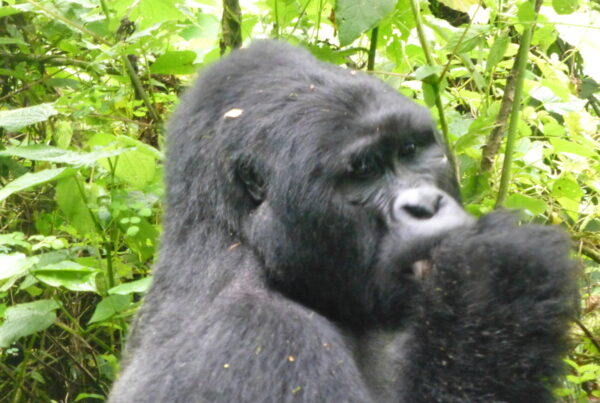
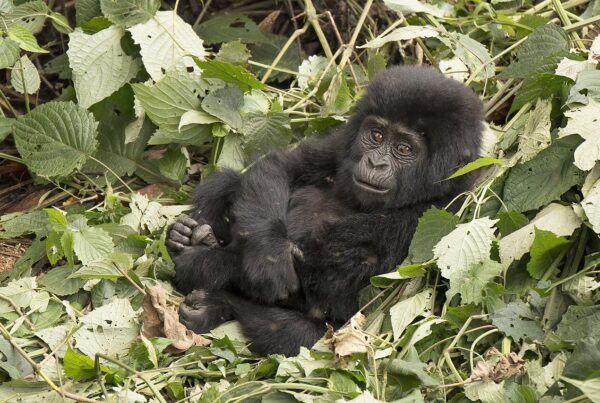
The Mubare group at Buhoma sector was the first habituated gorilla family in Uganda. Habituated in 1991, they have been receiving human visitors longer than almost any other gorilla group in the world. Whatever adjustments to the world the habituated state has produced in them, they are complete — the gorillas I observed were the most settled, least performative wild animals I have encountered anywhere. They were not performing for us. They were not interested in us. They were simply there, in their world, going about the business of being gorillas, and we were temporarily, with permission, in their proximity.
The silverback was the specific focus of my wonder in a way I had not expected. He was not dramatic in the moment I watched him. He was resting, leaning against a large fig tree, watching his family without apparent engagement, in the specific settled state of an authority that has no need to assert itself. He looked at me once. Briefly, without expression, and looked away. In that look and non-look I felt something I can only describe as being assessed and found unremarkable. Which is correct. I am unremarkable. The silverback was not.
What I Brought Home
Wonder is a renewable resource if you know where to find it. I came home from Uganda with a recalibrated sense of what the world contains — not just the gorillas and the forest, but the whole category of experience that requires effort and distance and the willingness to be surprised. I have been more easily surprised since. This is not naivety. It is, I think, a form of health.
The gorilla trekking permit is $800. If your sense of wonder needs renewal, Bwindi is a reliable source. Contact us to plan your 2027 trip.
Frequently Asked Questions
Uganda is home to the mountain gorilla (Gorilla beringei beringei), one of two subspecies of eastern gorilla. They live exclusively in the Virunga volcanic highlands (Uganda/Rwanda/DRC) and Bwindi Impenetrable Forest (Uganda only). Mountain gorillas are the only gorilla subspecies that cannot survive in captivity — every individual you can trek is a wild animal.
The standard gorilla trekking permit gives you exactly 1 hour with the gorilla family. This time begins when you make first contact with the family — the ranger signals the start. The Gorilla Habituation Experience gives 4 hours with a semi-wild family. The walk to find the gorillas can take 30 minutes to 5 hours depending on where the family has moved.
Stay calm, crouch down slowly, avoid direct eye contact, and remain quiet. Do not run — running triggers a chase response. Rangers accompanying your group manage close approaches. Habituated gorillas are accustomed to humans and almost never make contact, but a charging silverback is managed by staying still and following ranger instructions immediately.
A maximum of 8 visitors per habituated gorilla family per day for standard trekking. The Gorilla Habituation Experience has a maximum of 4 visitors per family per day. These limits are set by UWA to minimise stress on the gorilla families and maintain the quality of the experience.
Uganda is home to the mountain gorilla (Gorilla beringei beringei), one of two subspecies of eastern gorilla. They live exclusively in the Virunga volcanic highlands (Uganda/Rwanda/DRC) and Bwindi Impenetrable Forest (Uganda only). Mountain gorillas are the only gorilla subspecies that cannot survive in captivity — every individual you can trek is a wild animal.