Updated
gorilla trekking Uganda conservation personal essay is one of Africa’s most extraordinary wildlife experiences, connecting travellers with mountain gorillas in their natural forest habitat. I was not someone who cared about conservation. I knew the arguments. I accepted their validity. I donated occasionally to the right things. But I did not feel it — the genuine, personal, motivating investment that conservation advocates describe. Gorilla trekking in Uganda in 2027 changed this. I want to explain exactly how, because I think the mechanism is more interesting and more transferable than the simple “I saw something beautiful and now I care” version of this story.
The Experience That Made Me Care About Conservation for the First Time
Before: Why Conservation Felt Abstract
Conservation messaging is primarily about loss. Species are disappearing. Habitats are shrinking. Numbers are declining. This messaging is accurate and important. It is also, for people without a personal relationship with the things being lost, abstract in a way that limits its motivational power. I cared about mountain gorillas in roughly the same way I cared about Arctic ice sheets — intellectually, at a remove, without the emotional investment that produces sustained action.
The problem with caring about something you have never experienced is that the caring is entirely theoretical. You are protecting an idea rather than a reality. Ideas are easier to defer than realities.
The Permit as Conservation Act
The gorilla trekking permit costs $800 USD per person for international tourists. This price is set by Uganda Wildlife Authority and distributed across park management, ranger salaries, anti-poaching operations, community benefit programmes, and conservation research. Before I went, I understood this intellectually. After I went, I understood it in the way that matters for actually caring about something: I understood what I was protecting and why it was worth protecting.
The mountain gorilla population was approximately 254 individuals in 1981. It is over 1,060 in 2027. This recovery happened because tourism revenue made conservation economically viable and locally supported. The permit I paid for is not a charity donation — it is participation in an economic mechanism that has demonstrably worked. Understanding this changed my relationship to what I was spending my money on.
The Ranger Who Changed My Thinking
Our ranger escort was a UWA ranger named Bosco who had been patrolling the Buhoma sector for eight years. During the walk to the gorilla family, I asked him — in the way of someone making conversation rather than expecting a significant answer — what the work was actually like. He described anti-poaching patrols, the tracking of snares, the community relationships that determined whether the park was protected or encroached upon, the specific families he had watched over years, and the particular investment he felt in their continued existence. He was describing his job. It did not sound like a job. It sounded like a vocation.
Understanding that there are specific people — named, present, invested — doing the daily work of keeping these animals alive changed the abstraction into something concrete. Conservation is not a policy or a campaign. It is Bosco walking a patrol route he knows by heart, in a forest he is personally invested in, to protect a gorilla family he has watched for eight years. That is real. That is worth supporting.
The Gorilla Family Itself
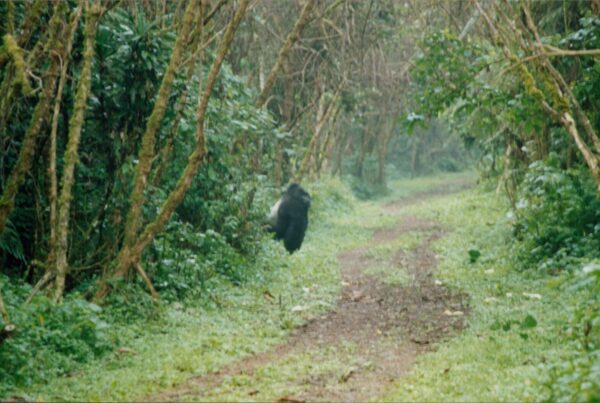
We found the Habinyanja group — thirty-two gorillas — in a clearing created by a fallen tree. The group’s activity on that particular morning was unremarkable by the standards of gorilla behaviour: feeding, resting, socialising. What it was, once I had walked three hours to see it and understood something of what it had taken to keep it alive, was not unremarkable at all. It was the product of decades of human effort, political will, community engagement, and a functioning economic model that made conservation competitive with destruction. The thirty-two gorillas were alive because people had made specific choices over thirty years to keep them alive.
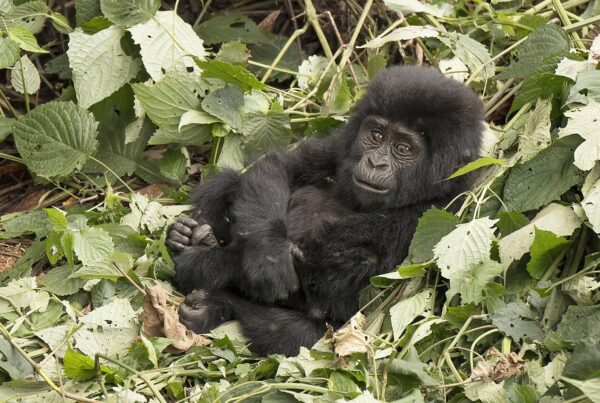
A silverback juvenile — perhaps three years old — came within four metres of our group and sat down. He looked at us with the specific direct curiosity of a young animal investigating something new in a familiar environment. My guide said quietly: “He was born two years after the last census, when the population reached 900. He would not exist if the numbers had gone the other way.” I wrote this down when I got back to the lodge because I did not want to forget it.
What I Did When I Got Home
I set up a regular donation to Gorilla Doctors (the veterinary organisation that provides medical care to habituated mountain gorilla groups across Uganda, Rwanda, and DRC). I joined the conservation newsletter from Uganda Wildlife Authority. I have told this story, approximately in this form, to everyone who has asked about Uganda since I came back. I wrote this piece. None of these are transformative acts. They are the specific, motivated behaviour that comes from caring about something concretely rather than theoretically.
That is what the gorillas gave me. Not the sentiment. The specificity.
Frequently Asked Questions
The global mountain gorilla population is approximately 1,100 individuals — one of the smallest populations of any great ape. They exist in two separate populations: one in the Virunga Massif spanning Uganda, Rwanda, and DRC; and one in Bwindi Impenetrable Forest (Uganda only). The population has grown from approximately 620 in the 1980s, largely due to tourism-funded conservation.
Uganda Wildlife Authority directs 20% of every gorilla permit fee to communities adjacent to Bwindi and Mgahinga. These funds pay for school construction, healthcare programmes, borehole maintenance, and community microfinance. Permit revenue also funds ranger salaries, anti-poaching patrols, and the research teams that monitor gorilla health daily.
The Batwa (also called Twa) are an indigenous forest people who lived inside Bwindi for thousands of years until it was gazetted as a national park in 1991. Conservation displaced them from their ancestral forest. Gorilla tourism revenue now funds Batwa cultural programmes and livelihoods. The Batwa Cultural Trail at Buhoma sector is run by the Batwa community and is one of the most authentic cultural experiences near Bwindi.
Mountain gorillas are classified as Endangered on the IUCN Red List — one step down from Critically Endangered, which they held until 2018. Their population has grown consistently since the 1980s, making them one of the few great ape populations increasing in number. This recovery is directly attributed to the conservation funding generated by gorilla tourism.
Uganda is home to the mountain gorilla (Gorilla beringei beringei), one of two subspecies of eastern gorilla. They live exclusively in the Virunga volcanic highlands (Uganda/Rwanda/DRC) and Bwindi Impenetrable Forest (Uganda only). Mountain gorillas are the only gorilla subspecies that cannot survive in captivity — every individual you can trek is a wild animal.