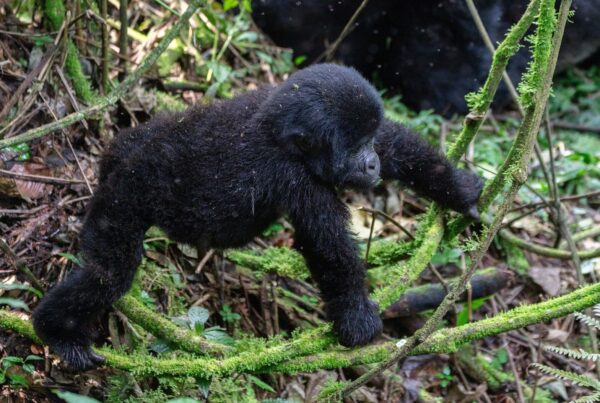
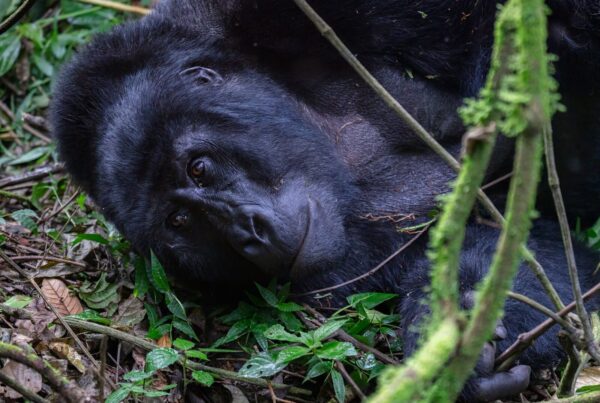
African buffalo share the forest with mountain gorillas in parts of Bwindi Impenetrable National Park, and while direct confrontations between the two species are infrequent, they are documented. Buffalo — among the most dangerous large mammals in Africa, responsible for more human fatalities per year on the continent than lions — are not natural predators of gorillas, but the dense forest terrain can produce unexpected proximity and the resulting interactions test the silverback’s protective role in ways that inter-gorilla contests do not. The documented encounter between a habituated gorilla group and a buffalo at Ruhija sector is one of the most closely observed cross-species confrontations in Bwindi’s monitoring record.
The Setting
Ruhija sector, at the highest altitude of Bwindi’s entry points, receives less tourism traffic than Buhoma or Rushaga, but its gorilla groups are no less closely monitored. The tracker team assigned to the Oruzogo group at Ruhija had been following the group through a section of bamboo forest — a zone where both gorillas and buffalo feed on bamboo shoots during the appropriate season — when the encounter occurred.
The buffalo was a lone male — a common configuration for older male buffalo who have left their herds, and the category most associated with unpredictable behaviour. He emerged from dense bamboo approximately twenty metres from the edge of the gorilla group’s position. The tracker’s account, recorded in the UWA monitoring report, describes the silverback’s response as immediate and unambiguous.
The Silverback’s Response
The silverback — who had been feeding approximately ten metres from the buffalo’s emergence point — moved directly between the buffalo and his family. The chest beat that followed was described by the trackers as the most sustained and powerful they had observed in several years of monitoring the group. The silverback charged toward the buffalo in a short, fast display — not making contact, but closing the distance to approximately five metres and stopping with a final, stationary chest beat.
The buffalo held his ground for approximately thirty seconds. Then he turned and moved back into the bamboo. The silverback stood facing the direction of retreat for several minutes, continuing intermittent chest beats, before returning to his family. The females had moved the juveniles and infants to the far edge of the group’s position during the confrontation — a dispersal pattern that researchers have noted as a coordinated family response to threat, apparently organised without explicit communication from the silverback.
What This Demonstrates
The silverback’s response to the buffalo encounter demonstrates the protective function that is central to his role in the group. His immediate physical positioning between the threat and his family, his sustained display, and the family’s coordinated response all reflect a social system that has evolved specifically for threat management in a complex and potentially dangerous environment. Bwindi is not a peaceful forest — it is an ancient, complex ecosystem in which multiple large animals compete for resources and occasionally interact in ways that require rapid response.
Gorilla trekking in Uganda in 2027 takes visitors into this environment. The silverback you observe in the clearing is not simply a large animal at rest. He is the organising intelligence of a social group that has survived in this environment for generations. The permit costs $800. What you observe in the clearing is the surface of something much deeper.
Frequently Asked Questions
The global mountain gorilla population is approximately 1,100 individuals — one of the smallest populations of any great ape. They exist in two separate populations: one in the Virunga Massif spanning Uganda, Rwanda, and DRC; and one in Bwindi Impenetrable Forest (Uganda only). The population has grown from approximately 620 in the 1980s, largely due to tourism-funded conservation.
Uganda Wildlife Authority directs 20% of every gorilla permit fee to communities adjacent to Bwindi and Mgahinga. These funds pay for school construction, healthcare programmes, borehole maintenance, and community microfinance. Permit revenue also funds ranger salaries, anti-poaching patrols, and the research teams that monitor gorilla health daily.
The Batwa (also called Twa) are an indigenous forest people who lived inside Bwindi for thousands of years until it was gazetted as a national park in 1991. Conservation displaced them from their ancestral forest. Gorilla tourism revenue now funds Batwa cultural programmes and livelihoods. The Batwa Cultural Trail at Buhoma sector is run by the Batwa community and is one of the most authentic cultural experiences near Bwindi.
Mountain gorillas are classified as Endangered on the IUCN Red List — one step down from Critically Endangered, which they held until 2018. Their population has grown consistently since the 1980s, making them one of the few great ape populations increasing in number. This recovery is directly attributed to the conservation funding generated by gorilla tourism.
Uganda is home to the mountain gorilla (Gorilla beringei beringei), one of two subspecies of eastern gorilla. They live exclusively in the Virunga volcanic highlands (Uganda/Rwanda/DRC) and Bwindi Impenetrable Forest (Uganda only). Mountain gorillas are the only gorilla subspecies that cannot survive in captivity — every individual you can trek is a wild animal.