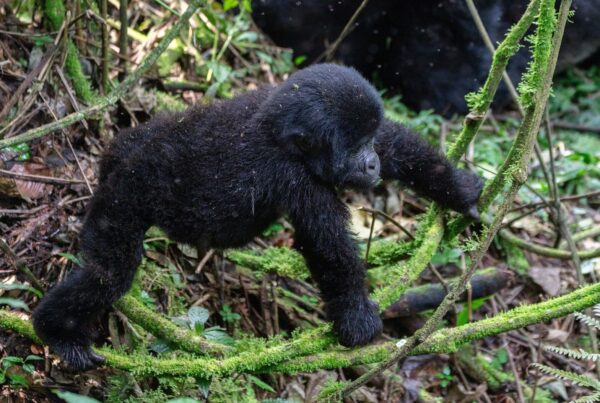
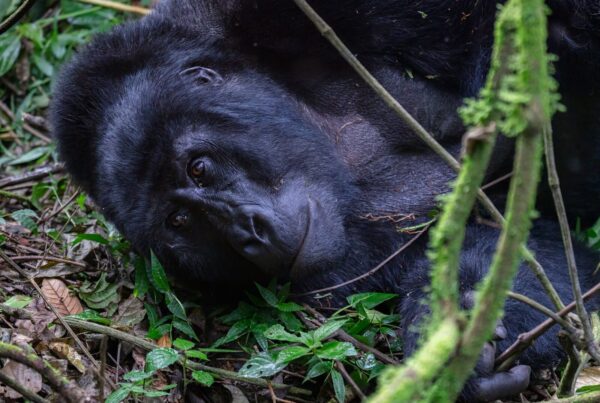
Every guide who has worked at Bwindi for years accumulates moments that fall outside the standard briefing — and the most frequently described category is not a frightening encounter but the opposite: a juvenile gorilla treating a human as if the distinction between species is simply not relevant to its immediate curiosity. Habituated gorillas do not interact with human visitors as a rule — the habituation is to human presence, not to human contact — but juvenile gorillas in particular have not fully internalised the social boundaries that adult gorillas observe. These encounters are brief, managed carefully by rangers, and illustrate something that language cannot quite capture about what gorilla habituation actually means in practice. See the gorilla families and Bwindi’s encounter protocols.
- 7-metre rule: minimum distance required by UWA — but gorillas sometimes approach visitors, not the reverse
- Juvenile curiosity: juvenile gorillas (2–8 years) are the most likely to approach human observers from curiosity
- Protocol when gorillas approach: stay still, crouch down, avoid eye contact, let the animal move away on its own terms
- Do NOT: extend a hand toward a gorilla, make eye contact with silverbacks, or move suddenly
- Disease concern: even brief contact increases transmission risk — rangers manage these situations to minimise contact
Every guide who has worked at Bwindi for long enough has a story. The guides who lead gorilla treks in Uganda accumulate encounters over years — things that happened once or twice or three times in thousands of hours in the forest, events that the normal protocols cover and manage but that remain, for the humans present, genuinely extraordinary. The account of the juvenile gorilla who climbed a guide’s leg at Buhoma sector is one such story, and it illustrates both the protocols that govern gorilla-human contact and the specific quality of gorilla curiosity that makes encounters at Bwindi unlike anything else in wildlife tourism.
The Habituated Family and Juvenile Behaviour
Juvenile mountain gorillas — roughly equivalent in developmental stage to human children between five and ten years — are the most behaviorally unpredictable members of a gorilla group in the context of trekking visits. Adult gorillas, particularly silverbacks, have established patterns of response to trekking groups that experienced guides can read and anticipate. Juveniles have the curiosity of young animals combined with the physical capability to act on it without the caution that older, more experienced animals exercise. They approach, they investigate, and their approach is not always interceptable before physical contact occurs.
The guide in this account had been leading treks at Buhoma for nine years. He was standing at the rear of the trekking group during the hour with the Habinyanja family when a juvenile — approximately four years old, recognisable to him from previous visits — detached from a nearby play group and moved directly toward the group. The juvenile’s approach was fast enough that the guide had insufficient time to move away before the animal reached him.
The Encounter
The juvenile climbed the guide’s leg — gripping the fabric of his trousers, pulling itself up to approximately knee height, and investigating the guide’s boot with apparent interest. The guide remained still. This is the correct response: sudden movement to dislodge the animal would trigger a startled response from the juvenile and potentially a protective response from nearby adults. The correct protocol is to stand still, avoid eye contact with the juvenile, and wait for it to lose interest and return to the group.
The encounter lasted approximately forty seconds. The juvenile investigated the boot, grabbed the guide’s trouser leg with both hands, and looked up at his face. The guide looked away — downward and to the side, the non-threatening gaze direction. The juvenile then released its grip and scrambled back toward the group. The silverback, who had been monitoring the interaction, did not charge or display — his experience of regular trekking visits meant that this type of juvenile investigation was a known quantity.
The Protocol Response
Following the encounter, the guide reported the contact to UWA management. Any physical contact between gorillas and humans — even incidental contact initiated by the gorilla — is logged and reviewed. The review confirmed that the guide’s response was correct and that the contact was gorilla-initiated and could not reasonably have been avoided. No protocol adjustment was required. The guide was cleared to continue leading treks.
The logging of such contacts is part of the monitoring system that tracks gorilla behaviour and human-gorilla interactions over time, contributing to the research record that informs protocol development. Even a forty-second encounter between a juvenile and a guide’s leg is part of the data.
What the Story Illustrates
The gorilla trekking experience in Uganda in 2027 is governed by protocols developed over three decades of managed human-gorilla interaction. Those protocols exist because they work — because the combination of rules, ranger presence, and experienced guides maintains a framework within which the gorillas behave predictably and visitors remain safe. Within that framework, the gorillas make their own decisions. The juvenile who climbed the guide’s leg was not following a script. The permit costs $800. Some of what happens in the forest you simply cannot book.
What should I do if a gorilla approaches me during a trek?
Crouch down to appear smaller, avoid direct eye contact, stay still, and let the gorilla move past or away on its own terms. Do not extend your hand toward it, do not make sudden movements, and do not turn and run. Rangers will be managing the situation simultaneously — follow their low-voiced instructions immediately. Gorillas that approach human visitors are typically curious rather than aggressive; the visitor’s job is to not give the gorilla any reason to escalate from curiosity to alarm. The protocol is the same whether it is a juvenile climbing onto your boot or a silverback passing at two metres: still, crouched, non-threatening, and attentive to ranger instruction.
Why do juvenile gorillas approach human visitors more than adults do?
Juvenile gorillas (roughly 2–8 years old) are in an active learning and play phase of development — curiosity is their primary mode of engaging with the world. They have been raised in a habituated group where human presence is a normal part of their environment, but they have not yet fully absorbed the social norms that adult gorillas observe around human visitors. Adult gorillas — including silverbacks — generally maintain distance and avoid direct interaction. Juveniles have not yet developed the same social inhibitions. A juvenile that touches a human observer’s boot or leg is treating it like any other object of curiosity in its environment.
Is it dangerous if a gorilla touches you?
The danger is disease transmission — not physical injury. A juvenile gorilla touching a visitor’s boot or pack is unlikely to cause physical harm, but the close contact increases the risk of pathogen exchange in both directions. This is why rangers intervene quickly to re-establish distance when gorillas approach visitors too closely. The gorilla health protocols are not about visitor safety from injury; they are about protecting the gorillas from human pathogens. Rangers manage these brief-contact situations calmly because panicking a gorilla by sudden movement would be more dangerous than the quiet moment of close contact.
Have gorillas ever seriously injured gorilla trekking visitors?
Serious injuries to gorilla trekking visitors are extremely rare. The habituated gorilla families in Uganda have been visited by hundreds of thousands of tourists over more than three decades without a pattern of serious incidents. The rare cases that have occurred typically involved visitors who broke protocol — moving toward a silverback, making sudden movements, or not following ranger instructions during a display. Following ranger instructions, maintaining the 7-metre distance, and behaving calmly when gorillas approach are the complete visitor safety protocol. Rangers with decades of experience manage situations that visitors could not manage themselves.
What is the most memorable gorilla encounter a guide can have?
Guides who have worked in Bwindi for years consistently describe encounters that involve unexpected proximity as their most memorable — not because they were dangerous, but because they compressed the felt distance between species to something that language struggles to describe. A juvenile sitting on your boot, a young male grooming your sleeve, a mother holding her infant directly in your line of sight at two metres — these moments are not in the briefing script but they happen, and they are what guides describe when asked what keeps them coming back to work in the forest after a decade.
- 100 Men vs a Gorilla: The Brutal Reality of Nature’s Power
- The True Weight of a Giant: How Much Does a Silverback Gorilla Really Weigh?
- Real Difference Between Mountain Gorillas in the Forest and Gorillas in Zoos
- Uganda Gorilla Trekking on a Budget: The Real Minimum Cost 2026
- Gorilla Trekking for Seniors: What You Really Need to Know
- Uganda Travel Insurance: What Cover Do You Really Need
- Uganda Gorilla Permit at $800: Is It Really Worth It in 2026?
- Why Gorillas Beat Their Chests: The Real Science Explained
- Gorillas Play and Wrestle: Juvenile Social Development Explained
- The 5 Best Gorilla Safari Instagram Accounts You Should Be Following