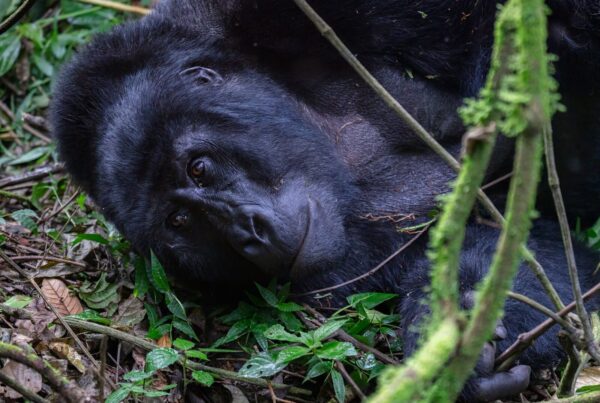
Gorillas can learn sign language, and the story of Koko — the western lowland gorilla who spent over forty years communicating in American Sign Language with researcher Francine Patterson — is one of the most remarkable chapters in the history of animal cognition research. Koko learned over 1,000 signs, used them in combinations to create novel expressions, demonstrated understanding of spoken English far beyond her signed vocabulary, and gave researchers a window into gorilla cognition that challenged fundamental assumptions about the relationship between language and intelligence. Understanding Koko’s story deepens the experience of a gorilla trek in a specific way: you cannot look at a gorilla’s face knowing this history and fail to wonder what it is thinking.
The Beginning: 1971
Francine “Penny” Patterson began teaching American Sign Language to a one-year-old western lowland gorilla named Hanabi-Ko — “Koko” in Japanese — at San Francisco Zoo in 1971. Patterson was a Stanford University graduate student investigating whether great apes could acquire human language. Previous research with chimpanzees had produced promising results; Patterson wanted to investigate whether gorillas, which had a reputation for being less cognitively complex than chimps, were capable of similar linguistic learning.
The early results exceeded expectations. Within months, Koko was using signs to communicate requests and preferences. Within years, she had acquired a vocabulary that dwarfed any previous animal language study. By the time Patterson received her PhD in 1979, Koko had become internationally famous and the research had generated both significant scientific findings and significant controversy.
What Koko Could Do
By adulthood, Koko demonstrated a vocabulary of over 1,000 signs and appeared to understand approximately 2,000 spoken English words. She combined signs in novel sequences that her handlers interpreted as original expressions rather than memorised phrases. She used signs to describe things not present, to refer to past and future events, and to discuss abstract concepts — behaviour that is considered a key marker of genuine language use rather than mere conditioned response.
Novel Combinations
One of the most discussed aspects of Koko’s signing was her apparent creation of new compound expressions for objects she did not have a sign for. She reportedly referred to a ring as a “finger bracelet,” a mask as an “eye hat,” and a cigarette lighter as a “bottle match.” These combinations suggest either creative use of known signs to describe new referents, or — in a more conservative interpretation — well-learned patterns of combination that produce useful outputs without necessarily implying the same generative process as human language production.
Emotional Expression
Patterson documented Koko signing about emotions — expressing sadness after the death of a companion cat, expressing fear during thunderstorms, expressing affection toward the people she was close to. Whether these expressions constituted genuine emotional self-reporting or well-conditioned responses to familiar situations is a question that the research generated extensive debate about, and that has not been fully resolved.
The Scientific Debate
Koko’s story is inseparable from the controversy it generated. Critics of the research argued that what looked like language use could be explained by simpler mechanisms: conditioning, cuing from researchers (the “Clever Hans” effect), selective reporting of successful interactions, and the natural human tendency to interpret animal behaviour in anthropomorphic terms.
The most serious objections concern the methodology of Patterson’s research, which was conducted under conditions that were more naturalistic than controlled, making rigorous analysis difficult. The absence of the double-blind protocols standard in cognitive research means that the published results are harder to evaluate than studies conducted under more controlled conditions.
What the debate has not resolved — because it cannot — is the fundamental question the Koko research raised: where on the continuum from conditioned response to genuine language comprehension does Koko’s behaviour actually fall? Different researchers give different answers, and the honest position is that the evidence, as recorded, does not definitively settle the question.
What the Research Did Establish
Whatever the controversies about Koko’s specific linguistic abilities, the broader research program established several things that are not seriously disputed:
Gorilla Cognitive Complexity
Gorillas are capable of associating arbitrary symbols (signs) with objects and actions in ways that go well beyond simple conditioning. The speed and breadth of Koko’s vocabulary acquisition demonstrates cognitive capacity that places gorillas firmly in the category of highly intelligent, cognitively flexible animals.
Social and Emotional Range
Koko’s documented interactions showed a range of social and emotional behaviours — consistent preferences, relationships, apparent grief, apparent humour (she was documented making what Patterson interpreted as jokes) — that support the picture of gorillas as socially and emotionally complex animals that emerges from field research on wild populations.
The Research Legacy
The Koko research, controversies and all, contributed to a shift in how the scientific community and broader public think about animal cognition. The question “can animals think?” was replaced, gradually, by more nuanced questions about the forms that cognition takes in different species and the evolutionary relationships between different cognitive capacities. Koko was not responsible for this shift alone, but she was part of it.
Mountain Gorillas and Cognition
Koko was a western lowland gorilla (Gorilla gorilla gorilla), not a mountain gorilla (Gorilla beringei beringei). The two subspecies differ in habitat, diet, social structure, and some physical characteristics. Direct extrapolation of Koko’s abilities to mountain gorillas is not scientifically appropriate.
However, the cognitive research on western lowland gorillas — including Koko’s — contributes to the broader understanding of gorilla cognitive capacity as a genus. Mountain gorilla field research, while it cannot use the language-learning paradigm, has documented social complexity, problem-solving behaviour, and social learning that are consistent with significant cognitive capacity.
The intelligence that you observe in a mountain gorilla’s face — the assessment, the curiosity, the social awareness — is not explained by Koko’s story. But Koko’s story is one of the pieces of evidence that makes that intelligence plausible rather than merely projected.
Planning Your Visit
Uganda gorilla trekking permits are $800 per person. Contact Uganda Gorilla Trekking to book your permit and plan your visit to Bwindi. The mountain gorillas you will meet cannot sign. But they are thinking. The evidence for that is both the science of gorilla cognition and the hour you spend watching them, which will convince you more thoroughly than any research paper.
Frequently Asked Questions
Uganda is home to the mountain gorilla (Gorilla beringei beringei), one of two subspecies of eastern gorilla. They live exclusively in the Virunga volcanic highlands (Uganda/Rwanda/DRC) and Bwindi Impenetrable Forest (Uganda only). Mountain gorillas are the only gorilla subspecies that cannot survive in captivity — every individual you can trek is a wild animal.
The standard gorilla trekking permit gives you exactly 1 hour with the gorilla family. This time begins when you make first contact with the family — the ranger signals the start. The Gorilla Habituation Experience gives 4 hours with a semi-wild family. The walk to find the gorillas can take 30 minutes to 5 hours depending on where the family has moved.
Stay calm, crouch down slowly, avoid direct eye contact, and remain quiet. Do not run — running triggers a chase response. Rangers accompanying your group manage close approaches. Habituated gorillas are accustomed to humans and almost never make contact, but a charging silverback is managed by staying still and following ranger instructions immediately.
A maximum of 8 visitors per habituated gorilla family per day for standard trekking. The Gorilla Habituation Experience has a maximum of 4 visitors per family per day. These limits are set by UWA to minimise stress on the gorilla families and maintain the quality of the experience.
Uganda is home to the mountain gorilla (Gorilla beringei beringei), one of two subspecies of eastern gorilla. They live exclusively in the Virunga volcanic highlands (Uganda/Rwanda/DRC) and Bwindi Impenetrable Forest (Uganda only). Mountain gorillas are the only gorilla subspecies that cannot survive in captivity — every individual you can trek is a wild animal.