Updated
Gorilla trekking in Uganda and polar bear viewing in Svalbard or Churchill, Manitoba represent two of the most geographically extreme wildlife experiences available to travellers in 2027. Both require reaching destinations that are remote, logistically challenging, and expensive to access. Both offer encounters with large, charismatic mammals that occupy environments fundamentally hostile to human beings. And both have become emblematic of a particular type of ambitious wildlife travel that is willing to go to the ends of the earth — literally, in the case of Svalbard — for a genuinely extraordinary experience. This comparison examines which experience offers more value, greater reliability, and stronger emotional impact for the serious wildlife traveller.
The Polar Bear Experience: Svalbard vs Churchill
The two main polar bear viewing destinations have different characters. Svalbard (Norwegian Arctic, 78 degrees north) offers summer polar bear viewing from expedition vessels navigating sea ice, combined with spectacular Arctic landscape photography and diverse Arctic wildlife (walrus, Arctic fox, reindeer, seabirds). Churchill in northern Manitoba, Canada, offers autumn bear viewing from specialised tundra vehicles as bears gather on the coast of Hudson Bay waiting for sea ice to form. Churchill encounters tend to be closer and more predictable; Svalbard encounters are more dramatic in setting but more variable in proximity.
Both are expensive: Svalbard expedition voyages cost USD 4,000 to 10,000 per person for 10 to 14 day trips excluding flights to Longyearbyen. Churchill tundra vehicle programmes cost USD 4,000 to 7,000 for 4 to 7 day trips excluding flights to Winnipeg or Churchill. Polar bear viewing is among the most expensive wildlife tourism experiences in the world.
Cost Comparison
Gorilla trekking in Uganda costs USD 700 for the permit plus USD 800 to 1,800 for ground arrangements (transport, accommodation, guide fees) per person — total USD 1,800 to 2,500 per person for a 3-night gorilla trekking trip, excluding intercontinental flights. This is approximately half the cost of a Churchill programme and a fraction of a Svalbard expedition. On a value-for-cost basis, gorilla trekking is significantly more competitive than polar bear viewing.
The Encounter Quality
Polar bear encounters in Churchill, at their best, are extraordinary: a large male investigating the tundra vehicle from two metres, breath visible in -20 degree air, paws the size of a dinner plate on the vehicle’s reinforced window. The physical reality of a polar bear at close range is overwhelming in a way that photographs cannot capture. In Svalbard, bears on ice floes photographed from ship decks are often at greater distances, the experience more cinematic than intimate.
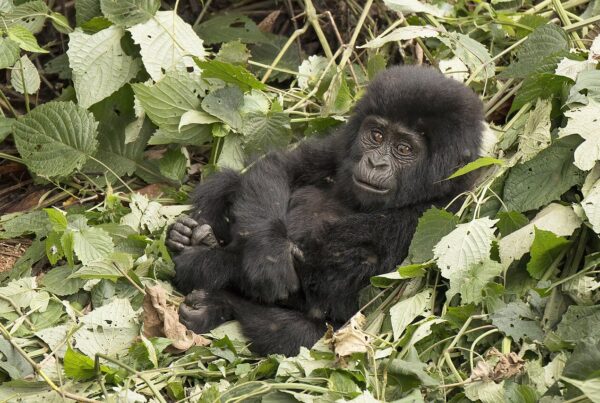
Gorilla encounters are intimate in a different way. The gorilla is a social being, embedded in family relationships that are visible and interpretable during the encounter. A polar bear is a solitary apex predator; its interaction with a viewing vehicle is investigative or indifferent. A gorilla’s interaction with a trekking group includes eye contact, social signalling, and apparent curiosity that creates a sense of mutual recognition that polar bear viewing rarely achieves. The gorilla encounter involves beings that are recognisably like you. The polar bear encounter involves a being that would eat you if given the opportunity and the motivation — thrilling, but not relational in the same way.
Conservation Context
The conservation narratives of the two experiences diverge significantly. Mountain gorilla conservation in Uganda is a success story: populations have tripled in 30 years due to sustained conservation effort funded substantially by tourism revenue. Polar bears in 2027 are in a more complex position: while not immediately endangered, long-term projections for sea ice loss under climate warming scenarios represent a structural threat to their habitat that even excellent conservation management cannot fully address. Visiting polar bears is, for many travellers, visiting an animal whose long-term future is uncertain in ways that gorilla conservation has managed to improve.
The Verdict
Both experiences are extraordinary. Polar bear viewing in Churchill is one of the most viscerally dramatic wildlife encounters available anywhere. But gorilla trekking in Uganda offers a more intimate, more cognitively complex encounter at significantly lower cost, with a clearer and more direct connection between your visit and successful conservation outcomes. For travellers choosing between two remote wildlife experiences, gorilla trekking makes the stronger case. Contact us in 2027 to plan yours.
The comparison between gorilla trekking and polar bear safaris highlights a fundamental distinction in the visitor’s relationship with the subject: the polar bear viewing is conducted from a protected distance with the bear as a distant subject, while the gorilla encounter occurs within the same visual field as the animal, creating a relational quality that the polar bear experience’s distance prevents.