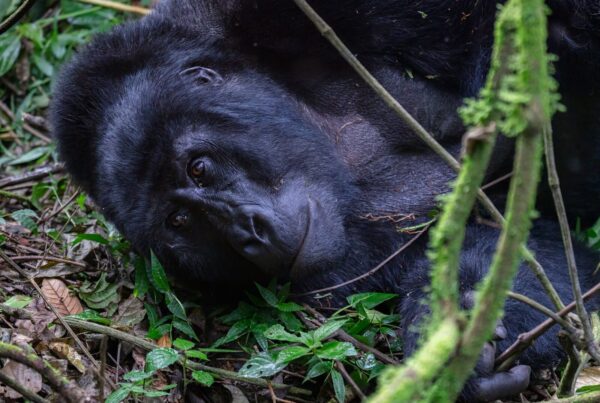
The Northern Lights and gorilla trekking in Uganda occupy similar positions in the bucket list consciousness of serious travellers: both are experiences that require specific conditions to witness, both demand travel to remote destinations, and both produce emotional responses that travellers struggle to describe in proportion to the experience itself. But they are also fundamentally different in the nature of what they offer — one is a meteorological spectacle, the other a biological encounter. This comparison examines which of the two experiences is more likely to stay with you, and what each offers that the other cannot.
The Northern Lights: What the Experience Is
The Northern Lights: What the Experience Is
The Aurora Borealis is a natural light display caused by the interaction of solar wind particles with Earth’s magnetic field and upper atmosphere. The colours — green, purple, pink, white — appear in bands and curtains across the sky, typically between 65 and 72 degrees north latitude, during periods of high solar activity. Witnessing a strong aurora display is one of the most visually overwhelming experiences available to a traveller: the scale (the entire visible sky), the colour, and the movement (auroras shift and pulse in real time) combine into something that photographs cannot adequately represent.
The experience is, however, entirely passive and entirely dependent on conditions. You cannot summon the lights. You can position yourself correctly (northern Norway, Iceland, Finnish Lapland) during the right season (September to March), and then wait. Many travellers wait through multiple nights and see nothing stronger than a faint glow. Some see extraordinary displays on their first night. The unpredictability is part of the experience — but it is also a source of frustration that gorilla trekking, with its guarantee of a gorilla encounter, does not produce.
Gorilla Trekking: The Active Encounter
Gorilla trekking in Uganda is an active experience. You trek through forest, face physical challenge, and arrive at an encounter you worked for. The gorillas are always there — permits guarantee the encounter. The variable is the quality of what the gorillas are doing when you find them and how close they choose to be. The passivity of aurora watching — standing in a field, looking up — is absent from gorilla trekking. You are engaged, physically and emotionally, throughout.
The encounter itself is with individuals. Gorillas have faces, personalities, and relationships that become legible over the course of an hour’s observation. The recognition that something is happening between you and the gorilla — that it is as aware of you as you are of it — is not a feature of aurora watching. The lights are spectacular; they are not aware. The gorillas are not a spectacle. They are a presence.
Cost and Logistics
Northern Lights viewing from northern Norway (Tromso) typically costs USD 200 to 500 per person for guided aurora tours, plus the cost of flights, accommodation, and ground transport — total approximately USD 2,000 to 4,000 per person for a week-long Tromso trip. Iceland is similar. Finnish Lapland is slightly more accessible for European travellers by budget airline.
A Uganda gorilla trekking experience (3 nights, one permit) costs USD 1,800 to 2,500 per person including the USD 700 permit, plus intercontinental flights. The in-country cost of gorilla trekking is broadly comparable to or slightly lower than a quality Northern Lights viewing trip; the flight cost depends on origin point.
Which Stays With You Longer?
Travellers who have experienced both describe the Northern Lights as the more visually arresting experience and gorilla trekking as the more emotionally complex one. The lights are extraordinary but ultimately aesthetic. The gorilla encounter is relational — it involves another being who is aware of you and responds to you, creating the kind of memory that grows richer rather than fading. The encounter with a silverback’s gaze, or a juvenile playing in a clearing, is not a memory of something beautiful witnessed. It is a memory of something experienced in mutual presence.
Our honest answer: both are worth doing. But gorilla trekking has a higher floor — the guarantee of the encounter means you will have something extraordinary regardless of conditions. The Northern Lights have a higher ceiling on a great night but carry the risk of a cloudy sky. For a once-in-a-lifetime experience with the highest probability of transformative impact, gorilla trekking in Uganda in 2027 is the more reliable choice. Contact us to plan your expedition.