Bwindi Impenetrable National Park and the Amazon Basin represent the two most biodiverse terrestrial ecosystems on earth — one in Central Africa, one in South America. Both are threatened. Both are extraordinary. Both draw serious wildlife travellers from across the world. But they offer profoundly different experiences, require different physical and logistical preparations, and deliver different emotional payoffs. This comparison helps you decide whether your next great nature experience should be in the mountains of Uganda or the rivers of Amazonia — or which to do first if you plan to eventually do both.
What Each Experience Offers
The Amazon experience is defined by immersion in a living system of almost incomprehensible complexity. An Amazon river cruise or lodge-based jungle experience delivers: pink river dolphins, caimans at eye level from a canoe, poison dart frogs on riverside vegetation, more species of bird per square kilometre than any other ecosystem on earth, and the constant, layered sound of a forest that is never quiet. No single encounter defines the Amazon experience the way the gorilla encounter defines gorilla trekking. Instead, the Amazon accumulates: each organism, each layer of forest, each dawn and dusk on the river adds to a picture of biological richness that overwhelms gradually.
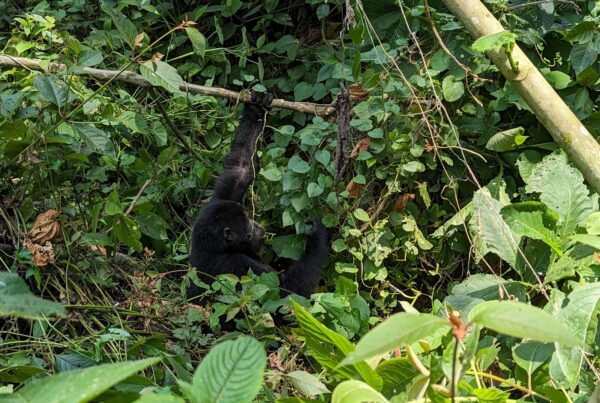
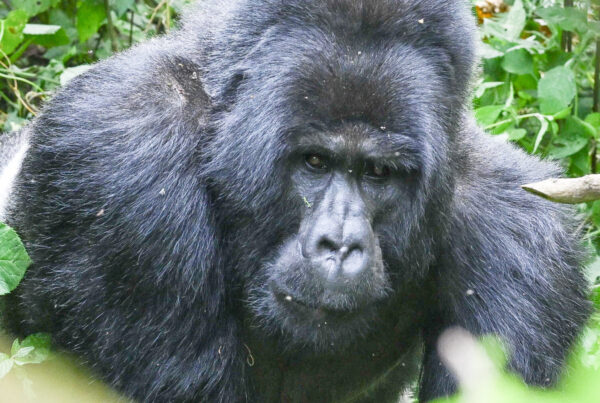
Gorilla trekking in Uganda offers something more focused. The hours of forest walking before you find the gorillas are often extraordinary in their own right — birdsong, primates in the canopy, forest elephant trails. But the experience crystallises around the encounter: one hour with a specific gorilla family, close enough to see individual facial expressions, embedded in a forest whose conservation story is one of the most documented and most successful in conservation history.
Wildlife Encounter Reliability
Amazon wildlife encounters are less predictable than gorilla encounters. The diversity is extraordinary, but sighting large mammals (tapir, giant otter, jaguar) is variable — the Amazon is dense, animals are shy, and the tourist path is well enough travelled that the most sought-after species have learned to avoid it. A quality Amazon lodge in the right location (Peru’s Madre de Dios, Brazil’s Pantanal border) will deliver extraordinary birding and reliable caiman sightings. Giant otter encounters are common in certain areas. Jaguar sightings are genuinely uncertain even on premium-priced wildlife photography tours.
Gorilla trekking guarantees the encounter. The gorillas are known, tracked daily, and within a defined home range. Your hour with them is guaranteed by the permit and by three decades of successful habituation management. No Amazon wildlife experience can offer a similarly reliable encounter with its most sought-after animals.
Conservation Urgency
Both ecosystems face existential pressures in 2027. Amazon deforestation — driven by agricultural expansion, cattle ranching, and illegal mining — continues despite international pressure and domestic conservation legislation. The Brazilian Amazon has lost approximately 17 percent of its original cover, and some areas are approaching the “dieback threshold” beyond which forest may transition irreversibly to savanna. Visiting the Amazon supports ecotourism businesses that provide economic alternatives to deforestation, but the systemic pressures are difficult for tourism alone to address.
Mountain gorilla conservation in Uganda has a more legible and more successful story: populations recovering, community benefit programmes functioning, anti-poaching effective. Your gorilla trekking permit contributes directly and verifiably to this success. The conservation argument for gorilla trekking is stronger than for most Amazon tourism, where the link between tourist spending and forest protection is more diffuse.
Cost and Logistics
Premium Amazon lodge experiences in Peru or Brazil cost USD 3,000 to 8,000 per person for 7 to 10 nights, excluding international flights. Budget Amazon river tours from Iquitos or Manaus are available from USD 500 to 1,500 per person but offer significantly less reliable wildlife access. Gorilla trekking in Uganda costs USD 1,800 to 2,500 for a 3-night experience including the USD 700 permit. The Amazon offers more range in price point; gorilla trekking is more consistent in quality.
The Recommendation
For travellers who want biological immersion in a complex ecosystem over multiple days, the Amazon is arguably the richer experience. For travellers who want a focused, emotionally resonant encounter with a specific, known animal species in a conservation context that is actively working, gorilla trekking is the more direct path to that experience. Do both if you can. Do gorilla trekking first if you must choose — the guarantee of the encounter makes it the safer investment of limited travel time and budget. Contact us to plan your 2027 Uganda expedition.