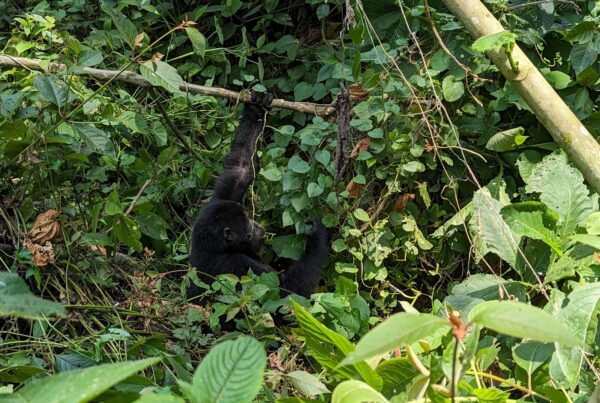
Uganda offers two of the most significant hiking experiences in Africa within a single itinerary: gorilla trekking in Bwindi Impenetrable National Park and mountaineering in the Rwenzori Mountains — the Mountains of the Moon, the source of the Nile’s headwaters, home to glaciers at the equator. For hikers and mountaineers planning East Africa itineraries, combining these two experiences produces a trip of exceptional range — the ancient lowland forest of Bwindi alongside the high-altitude alpine zones of the Rwenzori, two utterly different ecosystems connected by Uganda’s Highland road corridor. This guide addresses gorilla trekking Uganda for hikers.
The Two Experiences
Gorilla trekking at Bwindi is a forest walk at 1,600 to 2,600 metres, lasting two to six hours, through dense equatorial forest to find a habituated mountain gorilla family. The terrain is steep and technically undemanding — no climbing equipment required, no exceptional fitness level prerequisite, though good aerobic capacity helps. The Rwenzori Mountains offer Uganda’s most demanding mountain terrain: multi-day routes to peaks at 4,000 to 5,109 metres (Margherita Peak on Mount Stanley), through a succession of ecosystems from rainforest to heathland to alpine bog to permanent glacier. The full Rwenzori traverse takes seven to ten days.
The gorilla permit is $800. The Rwenzori climbing permits and guide fees add approximately $600-900 for a multi-day route. A combined Uganda hiking itinerary of fourteen to sixteen days — gorilla trekking at Bwindi plus a full Rwenzori route — represents one of the most complete mountain experiences available in Africa and one of the most cost-effective given the quality of both experiences.
Planning the Combined Itinerary
The logical itinerary sequence is Bwindi first, Rwenzori second — gorilla trekking at lower altitude before ascending into the Rwenzori range, allowing acclimatisation to develop progressively. The road from the Bwindi area to Kasese (the gateway to the Rwenzori) takes four to five hours through the Queen Elizabeth National Park corridor, which adds a wildlife viewing dimension to the transfer. Operators that handle both Bwindi permits and Rwenzori guiding can combine both into a single booking.
For serious mountaineers, the Rwenzori in the wet season (March-May, October-November) produces the challenging conditions that technical alpinists seek; the dry season (June-August, December-February) is more accessible but still demanding. Contact us to plan your 2027 gorilla trekking and Rwenzori hiking Uganda trip. The gorilla permit is $800. The Rwenzori permit is additional. The combination is one of the great African adventure itineraries.
Frequently Asked Questions
Minimum: 3 days (arrive, travel to Bwindi, trek, return — very rushed). Recommended: 5–7 days to include proper travel time and a buffer day. If combining with Kibale chimps or a game park, allow 8–12 days. The 8-hour road journey from Kampala to Bwindi means a 3-day trip involves almost no rest.
A popular 7-day itinerary: Day 1 — Arrive Entebbe, transfer to Kampala or Entebbe hotel. Day 2 — Fly or drive to Bwindi. Days 3–4 — Gorilla trekking (one or two treks), forest walks. Day 5 — Return to Entebbe via Kampala or direct charter. Days 6–7 — Optional Entebbe or Kampala city time before departure.
Yes, but they are in different countries. A combined itinerary typically routes Entebbe (Uganda gorillas) → Nairobi or Kilimanjaro (Tanzania/Kenya safari) with a connecting flight between legs. Allow 10–14 days total. Alternatively, Uganda’s own Queen Elizabeth National Park offers excellent big game alongside the gorilla experience without the international connection.
Near Bwindi: Batwa Cultural Experience (indigenous forest walk with the Batwa community), guided birding walks (350+ species), forest nature walks, waterfall hikes, community village visits. Within 2–3 hours of Bwindi: Lake Bunyonyi (canoeing, island walks), Mgahinga (golden monkey trekking, Virunga volcano hiking).
Uganda is home to the mountain gorilla (Gorilla beringei beringei), one of two subspecies of eastern gorilla. They live exclusively in the Virunga volcanic highlands (Uganda/Rwanda/DRC) and Bwindi Impenetrable Forest (Uganda only). Mountain gorillas are the only gorilla subspecies that cannot survive in captivity — every individual you can trek is a wild animal.