Understanding Gorilla Home Ranges
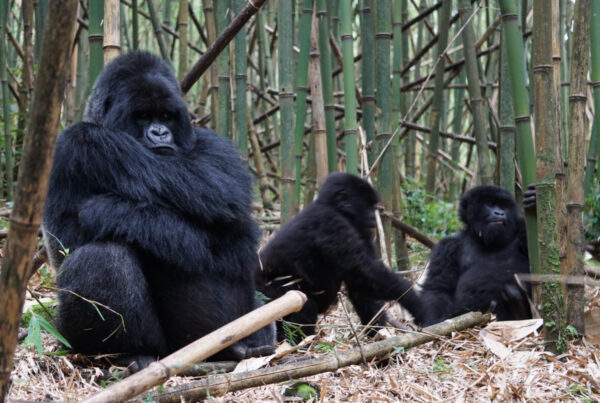
Mountain gorillas are not migratory animals. They do not follow seasonal routes across vast landscapes or travel hundreds of kilometres between food sources. Instead, they maintain relatively stable home ranges — defined areas of forest within which they meet all their daily food, water, and social needs. Understanding the size and character of these home ranges, and how gorillas navigate within them, is fundamental to gorilla ecology and to the conservation planning that protects them.
Home Range Size
Mountain gorilla home ranges vary considerably in size depending on habitat quality, group size, and the availability of preferred food resources. Research on habituated families in Bwindi and the Virungas has documented home ranges ranging from approximately 3 to 35 square kilometres, with most groups falling in the 4 to 15 square kilometre range. Groups with access to high-quality forest containing abundant preferred food species maintain smaller home ranges; groups in more resource-limited areas travel more widely to meet their nutritional requirements.
The Bwindi population, living in relatively nutrient-rich forest with exceptional plant diversity, tends toward the smaller end of home range estimates. Groups in the Virunga volcanoes’ lower slopes, with their bamboo and herbaceous vegetation, may use larger areas. Within Bwindi’s four sectors, gorilla families typically remain within their established home range year-round rather than migrating between sectors.
Daily Travel Distance
Within their home range, mountain gorillas typically travel 0.5 to 2 kilometres per day, with 1 kilometre being a commonly cited average. This is short compared to many large mammals — elephants may cover 20 to 40 kilometres daily — but reflects gorillas’ feeding strategy. As bulk herbivores consuming enormous quantities of low-calorie vegetation, gorillas maximise time spent feeding rather than travelling. Moving long distances between food patches costs energy that must be replaced through food; staying near rich food patches while feeding efficiently minimises this energy expenditure.
Daily travel patterns are strongly influenced by food distribution. When a productive fruiting tree or dense patch of preferred vegetation is located within the home range, the group may spend multiple consecutive days feeding in the same small area before moving on. When preferred foods are dispersed, the group moves more continuously between patches, accumulating greater daily distance.
Seasonal Variation in Movement
Mountain gorilla movement shows some seasonal patterns, though less dramatically than savannah species whose movements are driven by large-scale seasonal water availability. In Bwindi, wet season months offer more distributed food availability as plant growth is stimulated by rainfall, allowing gorillas to feed in smaller areas. During dry periods when certain preferred foods become scarce, gorillas may travel to areas of the home range that retain moisture and food availability longer.
Altitude within the home range is sometimes used seasonally. Some gorilla families in Bwindi use higher portions of their home range during dry months when lower areas have reduced food quality, and descend to lower areas during cooler, wetter months. This altitudinal use adds a vertical dimension to home range ecology that two-dimensional mapping does not capture.
Home Range Overlap
Unlike many territorial mammals, mountain gorillas do not defend rigid exclusive territories. Home ranges of adjacent gorilla families overlap, sometimes substantially. This overlap means that different families occasionally encounter each other in the forest — events that typically involve significant social tension, chest-beating displays, and sometimes brief physical confrontations between silverbacks before the groups separate and move away.
The absence of strict territorial defence is partly explained by the nature of the food resource. Leaves and stems — the gorilla’s primary food — are widely distributed and not easily monopolised. Defending an entire home range against all other gorillas would cost more energy than the resource gain justifies. Fruit patches, which are more concentrated and patchier in distribution, do sometimes attract inter-group competition at the patch level, but not systematic territorial defence at the home range level.
How Gorillas Navigate
Mountain gorillas navigate their home ranges using a combination of spatial memory, sensory perception, and social information. Silverbacks that have occupied the same home range for years develop detailed cognitive maps of resource locations, seasonal availability patterns, and the positions of hazards. Research examining gorilla route efficiency has shown that gorillas travel more directly between known resources than random movement would predict, suggesting active spatial planning rather than purely reactive foraging.
The social transmission of home range knowledge may also be important. Young gorillas raised within their birth group’s home range acquire knowledge of its resources through years of following experienced adults on foraging routes. When females transfer to new groups, as mountain gorillas commonly do, they must acquire new spatial knowledge — a period when the silverback’s guidance of foraging movement is particularly valuable.
Conservation Implications
Home range data from habituated gorilla families informs park management and conservation planning in critical ways. Knowing where families spend most of their time identifies core use areas that require maximum protection from disturbance, poaching pressure, or habitat degradation. Understanding seasonal movement patterns helps managers anticipate when gorillas are likely to approach park boundaries, allowing proactive community engagement to prevent crop raiding incidents.
In the context of climate change planning, home range ecology is particularly relevant. If preferred vegetation shifts in distribution as temperatures and rainfall patterns change, gorilla home ranges will need to shift accordingly. Ensuring that the forests flanking current gorilla parks remain intact and connected may be essential for allowing gorillas to adjust their ranges in response to changing conditions.
Final Thoughts
A mountain gorilla family travels perhaps one kilometre today, covering a small fraction of its 10-square-kilometre home range, knowing every food patch, water source, and social boundary within it. That intimacy with a known landscape, built over decades of living within the same forest, is as sophisticated in its way as human knowledge of our own environments. The home range is not just geography — it is the accumulated spatial intelligence of a family embedded in a place.