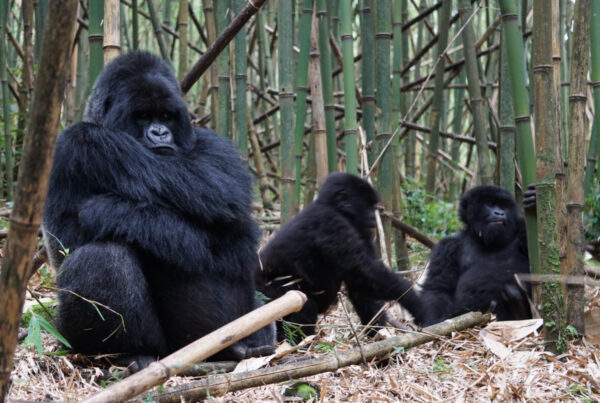
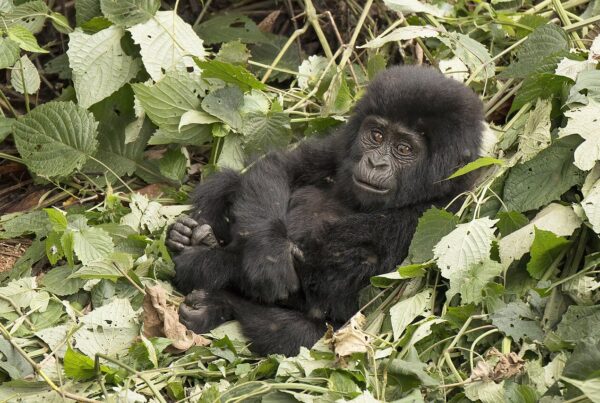
Gorillas sing while eating — a discovery that researchers made not in a laboratory but in the field, when primatologists studying mountain gorillas noticed that the distinctive low humming and belching sounds produced during feeding sessions were more complex and context-specific than simple comfort calls. The research that followed, published in the journal PLOS ONE, found that gorillas produce food-associated calls that vary with the individual animal and with the specific food being eaten, suggesting a level of vocal communication about food that has not been documented in other non-human primates. Understanding what gorillas are communicating when they sing at mealtimes adds another dimension to the experience of watching a gorilla family feed during a trek in Bwindi.
The Discovery
The study, led by primatologists Eva Luef and Simone Pika, compared feeding vocalisations in western lowland gorillas in captivity and in wild populations. The research found that gorillas produced specific vocalisations that were consistently associated with eating — different from the contact calls produced in other contexts and varying in character depending on the individual gorilla and the food being consumed.
The humming sounds — which inspired the informal description “gorillas sing while eating” — are produced in the back of the throat with a quality that researchers describe as indicating contentment. They are distinct from the standard contact call that gorillas produce while moving or resting, and they appear specifically in the context of feeding on preferred or particularly satisfying foods.
What the Vocalisations May Communicate
The research identified two key patterns that have implications for gorilla communication.
Individual Signature
Individual gorillas have consistent, identifiable food-associated vocalisations — their “singing” style is individual to them, in the way that human singing styles are individual. This suggests that the vocalisations carry identity information: other group members can tell who is eating from the vocalisation alone. This may serve a social function in the dense vegetation environment of the forest, where visual identification of individuals is often impossible.
Food Quality Signals
The vocalisations also vary with the food being consumed — different foods elicit different humming patterns, suggesting that the sounds carry some information about what is being eaten. Whether this constitutes intentional communication about food quality (as in “this is good, come here”) or is simply a conditioned emotional response to different tastes is an open question. But the consistency of the variation is sufficient that researchers can, in principle, distinguish what a gorilla is eating from the sounds it makes while eating it.
Comparison With Human Food Appreciation
The comparison with human eating sounds — the involuntary humming, the satisfied sighs, the sounds of enjoyment that people produce when eating something particularly good — is the obvious analogy, and the researchers do not avoid it. The gorilla food-associated calls have a quality similar to human food-appreciation sounds: produced spontaneously, individual in character, varying with the quality and type of food, and apparently communicating contentment to others nearby.
The evolutionary significance of this parallel is real. Both humans and gorillas are great apes, and both have evolved in social contexts where food sharing, food identity communication, and the social dimensions of eating are important. The parallel in eating vocalisations may reflect shared evolutionary roots in ancestral great ape food communication rather than independent evolution of similar behaviours.
The Broader Picture of Gorilla Vocalisation Research
The food-associated calls research sits within a broader programme of gorilla vocalisation studies that have documented over 25 distinct vocalisations in mountain gorillas, each with identifiable contexts and apparent communicative functions. The food calls are among the most recently characterised and arguably the most surprising, because their specificity — individual signatures, food-type variation — implies a level of vocal individuality not previously documented in gorilla communication.
Mountain gorilla vocalisations do not have the syntactic structure of human language — they are not combined in rule-governed sequences that generate new meanings from existing elements. But the documentary picture of gorilla communication, accumulated across decades of field research, is of a sophisticated vocal communication system that serves multiple specific functions and that varies across individuals in ways that parallel human individual vocal identity.
What You Hear During a Trek
The food-associated calls — the singing — are among the sounds you will hear most consistently during your hour with a gorilla family in Bwindi. A family that is settled and feeding actively produces a consistent background of these low, humming sounds that experienced guides describe as the sound of a contented family. Its presence, as guides note, tells you that the morning is going well.
Now that you know what these sounds are, listening to them is different. The background hum of a gorilla family at breakfast is not random noise. It is individual gorillas communicating satisfaction to each other, in their own specific voices, about their own specific food. That is worth listening to carefully.
Uganda gorilla trekking permits are $800 per person. Contact Uganda Gorilla Trekking to book your permit. The gorillas are singing. Come and listen.
Frequently Asked Questions
The Gorilla Habituation Experience (GHEX) allows up to 4 visitors to spend 4 hours with a gorilla family still being habituated to human presence. It costs $1,800 per person (FNR) and is available only in Rushaga sector of Bwindi Impenetrable Forest. You accompany researchers tracking the family through the forest.
Standard trekking: 1 hour with a fully habituated family, groups of up to 8, costs $800. Gorilla Habituation Experience: 4 hours with a semi-wild family, groups of up to 4, costs $1,800. The habituation experience gives far more time to observe natural behaviour — feeding, playing, resting, and inter-family interactions.
The GHEX is available only in Rushaga sector of Bwindi Impenetrable Forest. It is not offered at Buhoma, Ruhija, Nkuringo sectors, or at Mgahinga Gorilla National Park. Rushaga is in southern Bwindi, nearest to the town of Kisoro.
For photographers, wildlife researchers, or repeat gorilla trekkers seeking deeper observation, yes. Four hours versus one hour represents a fundamentally different experience — you see the full morning feeding session and can observe gorilla family dynamics in detail. For first-time visitors, the standard $800 trek is the recommended starting point.
Only 4 permits are issued per day per habituated family in the GHEX programme. This makes it the rarest gorilla experience in Uganda — permits sell out further in advance than standard trekking, often 4–6 months ahead in peak season.