Updated
A mountain gorilla is born after a pregnancy of about eight and a half months, weighing around 2 kg. It clings to its mother’s chest for the first months, rides on her back from about four months, nurses for three to four years, and stays close to her until a new sibling arrives, usually about four years after its own birth. Females start breeding at around ten years old, while males become silverbacks at about 12–15. Here is how a baby gorilla grows up, stage by stage, and what you may see on a trek.
Birth and the first months
Births usually happen at night or in the nest, and single births are the norm; twins are rare. The newborn is tiny next to a mother of around 70–100 kg and can do little except grip her hair and suckle. For the first two to three months it is held or carried against her chest almost all the time, and she nurses it whenever it wants. Other gorillas show great interest, but mothers rarely let anyone else hold a young infant.
3 months to 1 year: first steps
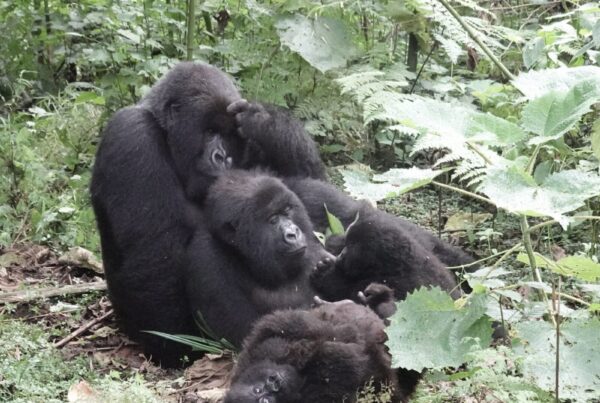
From about three or four months, infants start riding on their mother’s back during travel and begin to sit, crawl and take wobbly steps near her. They try the first bits of plant food at a few months old, copying what the mother eats, though milk remains their main food. By the end of the first year they explore a few metres away, play with other infants and climb small saplings, but scramble back to the mother at any alarm. This stage is a favourite with trekkers, as infants are often playful and curious.
1 to 4 years: learning and weaning
Young gorillas spend more and more time feeding themselves, learning which plants to eat and how to process tough foods like nettles and thistles by watching adults. Play becomes rougher and more social, with wrestling, chasing and chest-beating practice. They still sleep in the mother’s nest. Weaning usually ends between three and four years, often when the mother becomes pregnant again. Silverbacks are often tolerant of youngsters, who rest and play close to them, and if a mother dies, a weaned juvenile may be protected by the silverback.
Juveniles and adolescents
From about four to eight years, juveniles build their own nests and travel independently, but stay socially tied to their mother and peers. Females mature at around eight to ten and usually leave to join another group or a lone silverback before breeding, which avoids inbreeding. Males pass through a blackback stage before the silver saddle appears from about 12 years; many leave to live alone or form their own group, while some stay and become a second silverback. See our guide to gorilla social behaviour.
Why growth is so slow
Like other great apes, gorillas invest heavily in each infant, and a female may raise only a handful of offspring in her life. Infant deaths from illness, accidents and infanticide by males taking over a group mean that only some survive to adulthood. That slow breeding rate is why every loss matters to such a small population, and why the gorilla baby boom recorded in Bwindi in 2020 was welcome news. See our guide to mountain gorilla numbers.
Seeing babies on a trek
Many habituated families have infants, so there is a good chance of seeing one during your hour with the gorillas. Keep at least seven metres back and stay quiet: mothers are protective and a silverback may react if he feels an infant is threatened. Do not try to attract a curious youngster’s attention. The permit costs US$800, or US$600 in April, May and November. See our guides to threats to gorillas in the wild and how trackers read gorilla signs.
Frequently asked questions
Around 2 kg.
About three to four years.
About eight and a half months.
Usually about every four years.