Updated
Mountain Gorilla Grooming: Why Gorillas Groom Each Other
More Than Hygiene: The Social Function of Grooming
Mountain Gorilla Grooming: Why Gorillas Groom Each Other More Than Hygiene: The Social Function of Grooming Grooming — the careful parting of fur to remove debris, ectoparasites, and dead skin — is among the most frequently observed behaviours in mountain gorilla family groups. Grooming — the careful parting of fur to remove debris, ectoparasites, and dead skin — is among the most frequently observed behaviours in mountain gorilla family groups. Visitors during the midday rest period are almost certain to witness grooming between group members, and the behaviour’s frequency and social context reveal it as far more than hygiene maintenance. Grooming in mountain gorillas is the primary currency of social bonding, the physical medium through which alliances are built and maintained, and the behaviour through which social status and relationship quality are expressed and negotiated.
The Mechanics of Gorilla Grooming
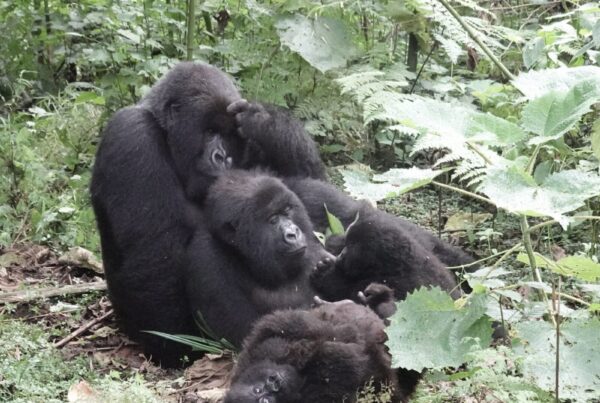
Gorilla grooming involves one individual carefully parting the fur of another using fingers, lips, and occasionally teeth, moving systematically through sections of the recipient’s coat. Debris — seeds, leaves, soil particles — is removed and discarded. Ectoparasites (ticks, mites, lice) are identified and removed, sometimes consumed. Dead skin and dried secretions are cleared from areas of skin that the animal cannot easily groom itself. The grooming giver works with focused attention, often spending several minutes on a small section of the recipient’s coat before moving on.
Recipients of grooming show behavioural indicators of relaxation and pleasure: relaxed body posture, closed or half-closed eyes, slow breathing, and often a particular low vocalisation — a quiet, regular exhalation — that appears to be a specific grooming-associated signal. The relaxation response to grooming is genuine and physiological: research on primates has shown that receiving grooming reduces cortisol levels and heart rate, producing genuine neuroendocrine relaxation effects beyond the simple cessation of movement.
Who Grooms Whom: The Alliance Map
The pattern of grooming exchange in a gorilla group is not random — it maps the social relationships that matter most to each individual’s reproductive and survival interests. Adult females direct significant grooming attention toward the silverback, investing in the relationship with the group’s dominant male whose protection and tolerance they require for reproductive success. The silverback’s response to female grooming — whether he tolerates it, reciprocates, or redirects it — signals the current state of that pair’s social bond.
Between adult females, grooming patterns reflect alliance structures that are sometimes cooperative (females who are close social partners, often with shared histories in the group) and sometimes competitive (females who compete for silverback attention or priority access to food). Long-term monitoring of specific groups has shown that female grooming networks are relatively stable over years, with preferred partners maintained across long periods.
Juveniles groom peers, their mothers, and occasionally more dominant individuals in ways that appear to reflect early social positioning. A juvenile that grooms a higher-ranking individual is investing in a relationship that may provide future access, tolerance, or social support. These juvenile-adult grooming interactions are observed less frequently than adult-adult grooming but represent early expressions of the social investment behaviour that will shape the individual’s adult relationships.
Mutual vs Unidirectional Grooming
Grooming can be mutual (both individuals grooming each other, either simultaneously or in alternating bouts) or unidirectional (one individual grooming without reciprocation). The direction and mutuality of grooming encodes information about relative social status: in many primate species, lower-ranking individuals groom higher-ranking ones more than the reverse, reflecting the subordinate’s interest in maintaining tolerance from a dominant who controls access to resources.
In mountain gorillas, the relationship between grooming direction and social rank is present but not absolute. Silverbacks receive more grooming than they give, but they do participate in mutual grooming with favoured females and occasionally with subordinate males. The quality and intimacy of these interactions — the degree of relaxation shown by the silverback, the amount of time he allows the grooming to continue — varies with the individual relationship and appears to reflect genuine social preferences beyond simple status maintenance.
Self-Grooming
In addition to social grooming, gorillas engage in self-grooming — examining and cleaning their own fur, removing debris from accessible body surfaces, and scratching. Self-grooming is more limited in scope than social grooming because of the obvious constraint that gorillas cannot effectively groom their own backs, the nape of their necks, or the top of their heads. Social grooming therefore provides access to body regions that self-grooming cannot reach — a functional benefit that adds an element of reciprocal utility to what is primarily a social behaviour.
Rates of self-grooming increase during periods of social stress, providing a simple visible indicator of an individual’s current social environment. A gorilla that is self-grooming frequently without concurrent social grooming may be socially isolated, in conflict with group members, or experiencing environmental stressors. Field researchers use self-grooming rates as part of broader welfare assessments for habituated populations.
Grooming and Infant Development
Infant gorillas receive extensive grooming from their mothers from the first days of life. Maternal grooming of infants combines genuine hygiene function (removing birth debris, maintaining infant skin health) with the same social bonding function that grooming serves in adult relationships. The physical contact of grooming is part of the continuous tactile stimulation that infant gorillas require for normal neurological development — deprivation of maternal contact in great apes, as studies of orphaned and hand-raised individuals have shown, produces lasting developmental consequences.
As infants develop, their mothers gradually groom them less frequently, and the infants begin engaging in social grooming with siblings, other juveniles, and eventually with a wider range of group members. This expanding grooming network is part of the broader social integration process through which the growing gorilla builds the relationships that will constitute its adult social world.
What This Means for Trekkers
Observing grooming during your Bwindi encounter is an opportunity to see social intelligence in action. The pair of adult females grooming during the midday rest have a relationship history that predates your visit by years. The juvenile persistently approaching an adult to initiate grooming is practising the social investment behaviour it will use throughout its life. The silverback allowing a favoured female to groom his massive back is expressing a social preference through physical contact. None of this is random — it is all the expression of specific social relationships in a specific social world.
Final Thoughts
Mountain gorilla grooming is the most visible and most socially significant maintenance behaviour in their daily repertoire. It connects the physical and social aspects of gorilla life in ways that cannot be separated: good grooming relationships contribute to good health, good social standing, and good reproductive outcomes. A gorilla that grooms well is investing wisely in the social relationships that gorilla life requires. In that sense, grooming is among the most important things a mountain gorilla does all day.