Water and Gorillas: A Complex Relationship
The question of whether gorillas can swim is more nuanced than a simple yes or no answer. Mountain gorillas inhabit forests with numerous streams and rivers, regularly cross water in the course of their daily movement, and yet show distinctive caution around water bodies that suggests discomfort with deep or fast-moving water. Understanding the relationship between mountain gorillas and water — from physiological capacity to behavioural preference — reveals an animal that is neither aquatically capable nor entirely water-avoidant, but something more interestingly intermediate.
The Physiological Question: Can They?
Physiologically, gorillas are capable of the basic locomotor movements required for swimming — the limb-cycling motion that produces forward propulsion in water is accessible to any animal with functional limbs. However, several physical characteristics make swimming energetically costly and potentially dangerous for gorillas. Their muscle density (denser, heavier muscle relative to fat compared to most swimming mammals) reduces buoyancy. Their large, heavy build means that maintaining body position at the water surface requires more effort than for lighter or more buoyant animals.
The arm-to-body ratio of gorillas — long arms relative to body length — is adapted for arboreality and knuckle walking rather than swimming. While the powerful arms could in principle generate swimming propulsion, the stroke mechanics required for effective swimming are not the natural movement pattern of gorilla limb use. Unlike otters, crocodilians, or even elephants whose physiology is well-suited to water movement, gorillas entering deep water would face genuine challenges in maintaining direction, avoiding submergence, and returning to a shore.
Observed Water-Crossing Behaviour
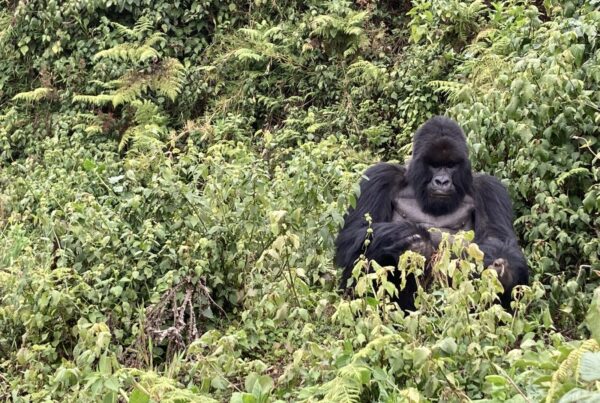
In practice, mountain gorillas in Bwindi and the Virungas approach water crossings with considerable caution. When a group must cross a stream to reach a feeding area or continue on a route, the silverback typically assesses the crossing point first — testing depth with his hands, choosing the shallowest crossing, and evaluating the substrate of the stream bed. Adult females and juveniles follow, often using the same crossing point and sometimes exhibiting visible hesitation before entering the water.
The crossing technique is wading rather than swimming: gorillas walk bipedally through shallow crossings, keeping their bodies largely above the water surface. The characteristic hand-before-foot bipedal posture during water crossings keeps the gorilla’s head and most of its body dry. Even in crossings where water reaches waist level, gorillas typically maintain some contact with the substrate rather than committing to full buoyant swimming.
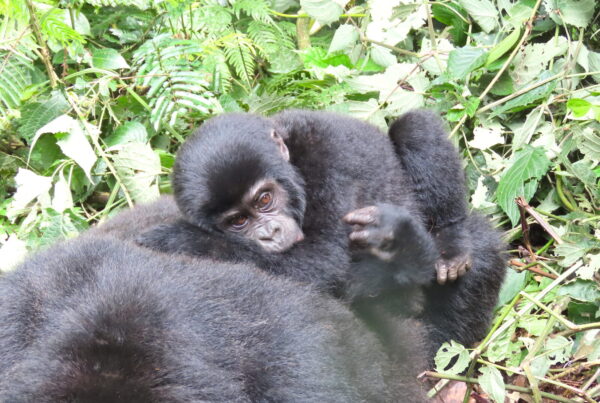
Young infants are carried on the mother’s back during water crossings, keeping them above the waterline. This carrying behaviour reflects both the infant’s inability to cross independently and the mother’s instinctive protection of her infant from the water — additional evidence that water is treated as a potential hazard requiring active management.
Fear of Water: Instinct or Learning?
Mountain gorillas’ wariness around water appears to be a combination of instinctive caution and learned avoidance. The instinctive component likely evolved in response to real historical predation risks at water margins — crocodiles, which historically occupied water bodies across much of gorilla range in Africa, represent exactly the kind of ambush predator that would impose strong selection pressure for water caution. An animal that approaches water carelessly in crocodile habitat is at elevated predation risk; one that assesses water margins carefully and minimises time in or near water survives longer and reproduces more.
The learned component is evident in the variation between individuals and groups in their water-crossing behaviour. Groups that regularly cross streams in their home range develop comfortable, efficient crossing routines. Individuals who have been led to specific safe crossing points by experienced adults know those points and use them reliably. The transmission of safe water-crossing knowledge through social learning is another example of the cultural information transfer that shapes mountain gorilla behaviour.
Water Sources Within Gorilla Home Ranges
Despite their caution around deep water, mountain gorillas regularly interact with water in their home ranges. Stream margins are productive foraging areas — the increased moisture supporting higher growth rates of preferred food plants, and the open canopy at stream edges allowing light penetration that stimulates diverse plant communities. Gorilla groups in Bwindi often forage along stream margins and spend considerable time in stream-edge vegetation without approaching the water itself.
As discussed in the gorilla hydration article, gorillas occasionally drink directly from streams when dietary moisture is insufficient, using the cupped-hand drinking technique that keeps them in an upright posture at the stream margin rather than immersed in the water. This technique is consistent with the general pattern of minimising body contact with water while still accessing it for specific purposes.
Captive Gorillas and Water
Observations of captive gorillas in zoo environments with access to water features add information to the wild data. Captive gorillas consistently show a preference for avoiding deep water features in their enclosures, choosing to walk around rather than through water obstacles when routing options allow. Zoo exhibits designed with water features typically include shallow sections or stepping stones that gorillas readily use rather than swimming across deeper sections.
Rare exceptions — individual captive gorillas that appear comfortable playing in shallow water, particularly younger animals — suggest that the water avoidance is not absolute and that some individuals are less water-averse than others. These individual differences parallel the variation in risk tolerance and boldness seen across other behavioural domains in gorillas.
Final Thoughts
Mountain gorillas can probably survive a brief, calm water crossing if forced to, but they are not swimmers in any practical sense and actively avoid deep water. Their caution around water reflects evolved predator avoidance, physical characteristics that make swimming energetically costly, and learned preferences developed through social transmission of safe crossing behaviours. When you see gorillas crossing a stream in Bwindi — careful, deliberate, wading rather than swimming, with the silverback leading and assessing the route — you are watching a behaviour shaped by millions of years of evolution in environments where water margins were not safe places to be careless.