Updated
baby gorilla birth weight 2kg smaller than human newborn is a subject central to Uganda’s wildlife tourism, where mountain gorilla conservation and responsible visitor experiences go hand in hand. Baby gorillas are born at only around two kilograms — smaller, typically, than the average human newborn, which weighs approximately 3.4 kilograms. This fact seems wrong the first time you encounter it. A species that produces the largest land primate on Earth, with silverback males reaching 200 kilograms, begins life smaller than a human infant. The explanation is biological and interesting, the implications for infant development and maternal behaviour are significant, and the sight of a two-kilogram infant gorilla clinging to its enormous mother is one of the most affecting images available to a gorilla trekking visitor in Bwindi.
Baby Gorillas Are Born at Only 2kg: Smaller Than a Human Newborn
Why Gorilla Infants Are Born So Small
The size of a newborn gorilla relative to its eventual adult size is a consequence of gestation length, brain development patterns, and the overall life history strategy of great apes. Mountain gorillas have a gestation period of approximately 8.5 months — slightly shorter than the human gestation of nine months, and considerably shorter than what would be required to produce a more developmentally advanced infant.
The Altricial Strategy
Great apes, including gorillas and humans, follow what biologists call an “altricial” developmental strategy — being born relatively undeveloped and dependent, with significant brain and body development occurring after birth. This is in contrast to “precocial” mammals (like horses and wildebeest) that are born relatively developed and can walk within hours.
The altricial strategy has advantages: it allows large-brained species to complete significant brain development in the more nutritionally rich and physically safer postnatal environment (continuous maternal milk, constant protection, social learning opportunities) rather than cramming it all into the gestation period. For gorillas, which have a large and cognitively complex brain relative to body size, this postnatal developmental period is lengthy — gorilla infants are dependent on their mothers for three to four years.
Pelvic Constraints
In humans, the relatively small pelvic opening compared to the large head of a newborn is a significant obstetric constraint — human birth is uniquely difficult among primates partly because of this. In gorillas, the birth canal is proportionately larger relative to infant head size, reducing this constraint. But the small birth weight is still partially a consequence of the need to pass through the birth canal of a bipedally-adapted or knuckle-walking skeleton.
Gorilla Infant Development: The First Year
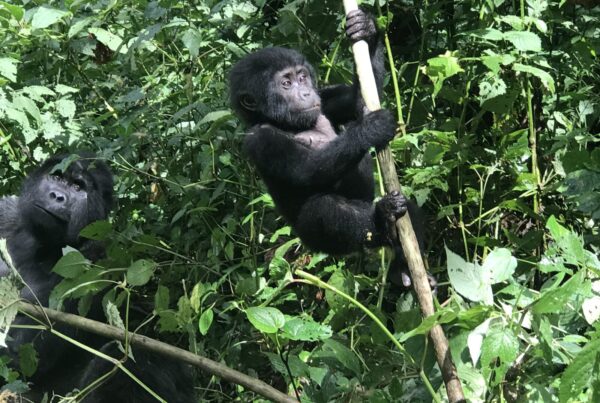
A newborn gorilla at two kilograms is entirely dependent, unable to support its own head, and spending virtually all its time attached to its mother. The grip reflex in newborns is strong — this is the same reflex present in human newborns, inherited from the common primate ancestor and historically essential for clinging to a moving mother through the forest.
Growth Rate
Gorilla infants grow rapidly in the first year, reaching approximately 5 to 7 kilograms by their first birthday. By age three, when they typically begin to be weaned, they may weigh 15 kilograms or more. The growth rate during the nursing period is supported by the high-fat milk of the gorilla mother, which is nutritionally dense and continuously available during the extended nursing period.
The Three-Year Dependence
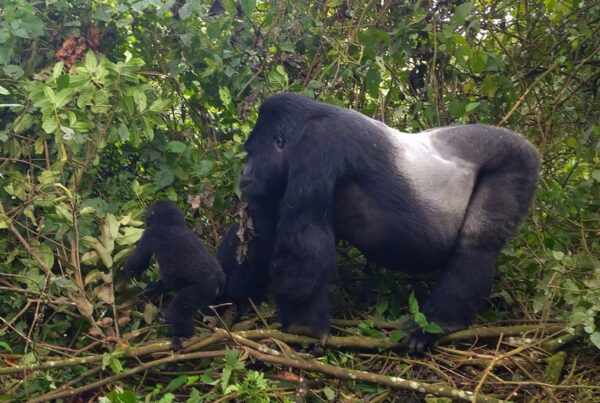
Mountain gorilla infants nurse for an average of three to four years. During this period, they travel on their mother’s back for the first two years, progressively spending more time on the ground as they develop. They sleep with their mother until they are old enough to build their own nests. The extended dependence period allows for the transmission of social and ecological knowledge that cannot be genetically encoded — which plants are edible, how to navigate the family’s home range, the social rules of the group.
What Newborn Gorillas Look Like
Newborn mountain gorillas are born with a sparse coat that becomes denser in the first weeks of life. They have a distinctive white or pale tuft of hair on their buttocks that persists until about three years of age — a visual signal, researchers believe, that marks the infant as young and elicits protective responses from adult group members. The eyes are large relative to the face, giving newborns the oversized-eye appearance common to young mammals and the specific quality of dependency that triggers caregiving responses in both gorilla and human observers.
The face has the specific quality of great ape infants: ancient and new simultaneously, as though the deep evolutionary history of the primate lineage is visible in miniature. Visitors who encounter infants during gorilla treks consistently describe this quality — the sense that the face is somehow both very young and very old — as among the most affecting aspects of the encounter.
Infant Mortality and Conservation
Mountain gorilla infant mortality in the first year of life has historically been significant — estimated at around 15 to 20 percent of live births not surviving to one year, based on long-term monitoring data from Bwindi and the Virungas. The causes include disease (respiratory infections and parasitic disease are significant), accidental injury, and — in cases of infanticide by a competing silverback after a family group changes leadership — direct violence.
The Mountain Gorilla Veterinary Project’s intervention program has reduced some causes of infant mortality by providing veterinary care for sick and injured infants that would previously have had no survival chance. Respiratory infections that would kill an unattended infant can now, in many cases, be treated with antibiotics delivered through non-invasive or minimally invasive methods. This intervention program has measurably contributed to the population growth that has seen mountain gorilla numbers recover from 620 in 1989 to over 1,100 today.
Seeing Infants on a Trek
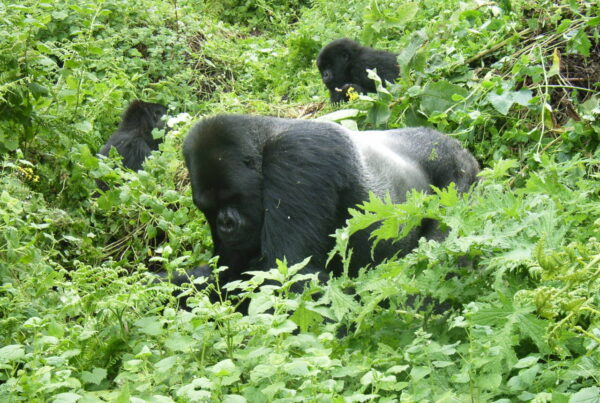
Infant gorillas are among the most sought-after sightings on gorilla treks, and families with young infants generate the most consistent emotional responses from visitors. The sight of a two-kilogram infant — small enough to hold in two cupped hands — clinging to the fur of a mother that may weigh 90 kilograms contextualises the species in a way that adult observation alone does not. The dependency, the trust, the specific quality of the infant’s grip — all of it is affecting in a way that connects directly to the most universal aspects of mammalian parenting.
Guides will know which families currently have young infants and can factor this into trek recommendations.
Uganda gorilla trekking permits are $800 per person. Contact Uganda Gorilla Trekking to book your permit. The infants are there, small and dependent and completely unaware of how extraordinary they are.
Frequently Asked Questions
Uganda is home to the mountain gorilla (Gorilla beringei beringei), one of two subspecies of eastern gorilla. They live exclusively in the Virunga volcanic highlands (Uganda/Rwanda/DRC) and Bwindi Impenetrable Forest (Uganda only). Mountain gorillas are the only gorilla subspecies that cannot survive in captivity — every individual you can trek is a wild animal.
The standard gorilla trekking permit gives you exactly 1 hour with the gorilla family. This time begins when you make first contact with the family — the ranger signals the start. The Gorilla Habituation Experience gives 4 hours with a semi-wild family. The walk to find the gorillas can take 30 minutes to 5 hours depending on where the family has moved.
Stay calm, crouch down slowly, avoid direct eye contact, and remain quiet. Do not run — running triggers a chase response. Rangers accompanying your group manage close approaches. Habituated gorillas are accustomed to humans and almost never make contact, but a charging silverback is managed by staying still and following ranger instructions immediately.
A maximum of 8 visitors per habituated gorilla family per day for standard trekking. The Gorilla Habituation Experience has a maximum of 4 visitors per family per day. These limits are set by UWA to minimise stress on the gorilla families and maintain the quality of the experience.
Uganda is home to the mountain gorilla (Gorilla beringei beringei), one of two subspecies of eastern gorilla. They live exclusively in the Virunga volcanic highlands (Uganda/Rwanda/DRC) and Bwindi Impenetrable Forest (Uganda only). Mountain gorillas are the only gorilla subspecies that cannot survive in captivity — every individual you can trek is a wild animal.