Updated
gorilla mother nursing 3 years infant development bonding is a subject central to Uganda’s wildlife tourism, where mountain gorilla conservation and responsible visitor experiences go hand in hand. Gorilla mothers nurse their young for up to three years, and the extended nursing period of mountain gorillas is one of the most significant factors in gorilla social development, cognitive development, and the population dynamics of a species that reproduces slowly enough that every infant’s survival matters enormously. Understanding what the three-year nursing period involves, what it produces in the developing infant, and why it has evolved in this form illuminates some of the most affecting observations available during a gorilla trek — the intimacy of a nursing pair, the quality of the mother-infant relationship, and the developmental arc that turns a two-kilogram newborn into the beginnings of a full gorilla adult.
Gorilla Mothers Nurse Their Young for Up to 3 Years: The Bonding Explained
The Duration and Intensity
Three years of nursing is not three years of continuous breastfeeding in the human sense. The nursing relationship in mountain gorillas evolves significantly across the period. In the first six months, nursing is the infant’s primary nutrition source — they consume milk on demand, several times an hour, in the pattern typical of altricial infant mammals. From six months, solid food begins to supplement milk, and the proportion of the diet coming from nursing gradually decreases as the infant’s ability to select and process vegetation develops.
By age two, nursing is less about nutrition and more about comfort, social bonding, and the maintenance of the physiological relationship between mother and infant that regulates both the infant’s stress response system and the mother’s reproductive cycling. Gorilla mothers do not typically ovulate during active nursing, meaning that the three-year nursing period also functions as a reproductive spacing mechanism: gorilla birth intervals are typically four to six years, with nursing duration as one of the key regulatory factors.
The Mother-Infant Bond
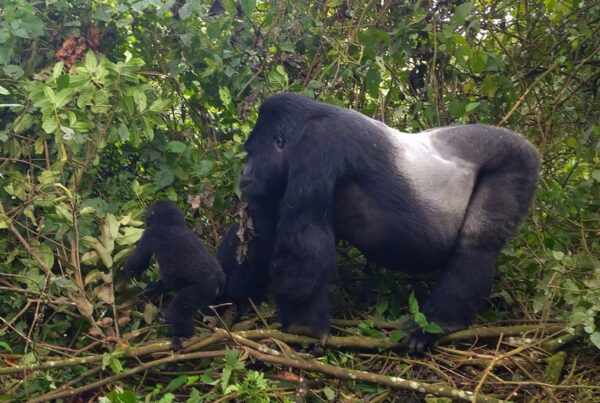
The physical and social bond between a gorilla mother and her nursing infant is the most intense relationship in gorilla social life — more constant than the silverback’s relationship with any individual family member, more physically immediate than any adult-adult relationship. The infant is in continuous physical contact with the mother for the first two years, sleeping with her, riding on her back when the group moves, nursing on demand, and receiving the continuous social and environmental information that maternal proximity provides.
What the Infant Learns
The infant’s development during the nursing period is not only physical. The mother is the primary channel through which the infant learns the social and ecological knowledge it will need as an adult: which plants are edible, how to process them, where the family’s home range provides reliable food, who the other family members are and what their relationships are, and the basic rules of gorilla social life that the silverback enforces.
This transmitted knowledge is the cultural component of gorilla development — information that is not genetically encoded but that is essential for survival and that is acquired through the sustained proximity of mother and infant. The three-year nursing period is, in this sense, the duration of gorilla childhood education.
The Stress Regulation Function
Research on primate mother-infant bonding has established that the physical and social contact of the nursing period plays a critical role in developing the infant’s stress regulation systems. Infants with close, consistent maternal bonds develop more stable stress response systems — they produce appropriate amounts of stress hormones in stressful situations and return to baseline more quickly — than infants whose maternal bond is disrupted. In a wild animal whose life will include genuine physical threats and social challenges, this stress regulation capacity has direct fitness consequences.
Weaning and Its Social Dimensions
Weaning — the gradual reduction and eventual termination of nursing — is not a clean event in gorillas but a process that unfolds over months. The timing and pace of weaning reflect both the infant’s development (its increasing ability to meet nutritional needs independently) and the mother’s reproductive state (the reproductive pressure to begin cycling toward the next pregnancy as the current infant approaches independence).
Weaning is often the period of highest conflict between mother and infant in gorilla social life — the infant resists the reduction in nursing access that the mother imposes, and the conflicts that result are among the most intense in the mother-infant relationship. Field researchers have documented prolonged weaning conflicts, including periods when the infant clings and protests while the mother physically prevents nursing access, that can last weeks or months.
After weaning, the infant does not immediately separate from the mother — it typically sleeps with her and maintains close proximity for another year or more, the nursing relationship replaced by a different but still close social bond. The independence is gradual: the infant first becomes a juvenile, travelling on foot rather than riding, sleeping in its own nest rather than with the mother, but maintaining proximity and the social relationship that will persist throughout its life in the family group.
What You See During a Trek
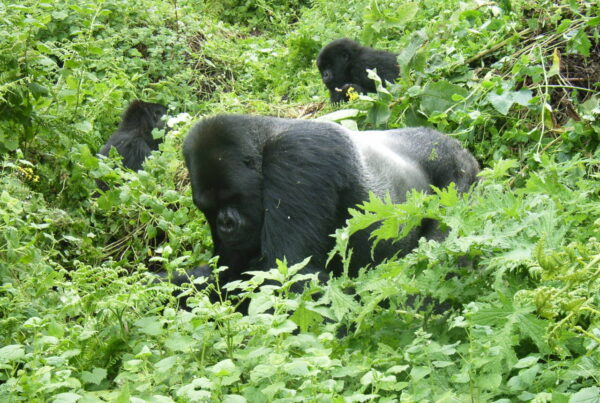
Nursing is one of the most commonly observed behaviours during a gorilla trek, particularly in families with young infants. The physical intimacy of a nursing pair — the infant pressed against the mother’s chest, the mother’s posture adjusted to facilitate nursing while she continues to eat or groom — is immediately accessible as an observation and immediately affecting in its quality of tenderness and dependence.
Experienced guides can estimate infant age from nursing behaviour and the infant’s developmental stage — how much time it spends on foot versus on the mother, how it responds to disturbance, how it interacts with other family members. This information contextualises the observation: a two-month-old infant and a two-year-old infant look and behave very differently, and knowing the difference enriches what you are watching.
Uganda gorilla trekking permits are $800 per person. Contact Uganda Gorilla Trekking to book your permit. The nursing pairs are among the most moving sights in Bwindi. Come and see them.
Frequently Asked Questions
Uganda is home to the mountain gorilla (Gorilla beringei beringei), one of two subspecies of eastern gorilla. They live exclusively in the Virunga volcanic highlands (Uganda/Rwanda/DRC) and Bwindi Impenetrable Forest (Uganda only). Mountain gorillas are the only gorilla subspecies that cannot survive in captivity — every individual you can trek is a wild animal.
The standard gorilla trekking permit gives you exactly 1 hour with the gorilla family. This time begins when you make first contact with the family — the ranger signals the start. The Gorilla Habituation Experience gives 4 hours with a semi-wild family. The walk to find the gorillas can take 30 minutes to 5 hours depending on where the family has moved.
Stay calm, crouch down slowly, avoid direct eye contact, and remain quiet. Do not run — running triggers a chase response. Rangers accompanying your group manage close approaches. Habituated gorillas are accustomed to humans and almost never make contact, but a charging silverback is managed by staying still and following ranger instructions immediately.
A maximum of 8 visitors per habituated gorilla family per day for standard trekking. The Gorilla Habituation Experience has a maximum of 4 visitors per family per day. These limits are set by UWA to minimise stress on the gorilla families and maintain the quality of the experience.
Uganda is home to the mountain gorilla (Gorilla beringei beringei), one of two subspecies of eastern gorilla. They live exclusively in the Virunga volcanic highlands (Uganda/Rwanda/DRC) and Bwindi Impenetrable Forest (Uganda only). Mountain gorillas are the only gorilla subspecies that cannot survive in captivity — every individual you can trek is a wild animal.