Are Mountain Gorillas Only in Uganda? Understanding Their Global Distribution and Conservation Significance
Mountain gorillas are not found only in Uganda, though Uganda does harbour the largest single population of this critically endangered subspecies. In total, mountain gorillas live in just two small, isolated regions of Central Africa: the Virunga Massif, which spans three countries, and Bwindi Impenetrable Forest in Uganda. These two populations are separated by approximately 25 kilometres of human-modified landscape and have been genetically isolated from each other for thousands of years. Understanding where mountain gorillas live, how the populations in different countries compare, what makes their habitat so specialised, and what this geographic restriction means for their conservation is essential context for any wildlife enthusiast, conservationist, or prospective gorilla trekker planning their first encounter with these extraordinary great apes.
The Two Mountain Gorilla Populations
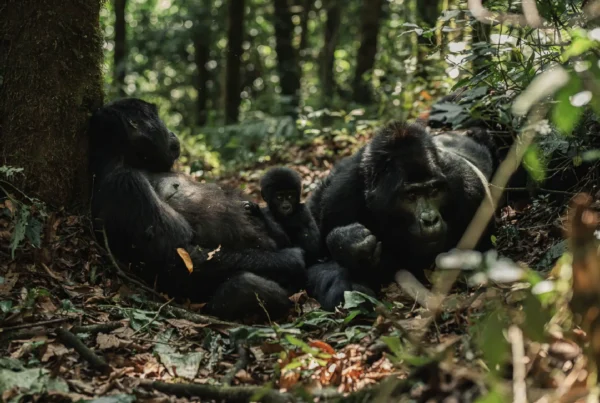
Mountain gorillas are divided into two distinct populations that do not mix and have developed subtle genetic differences over millennia of separation. The Virunga Massif population inhabits a chain of volcanoes spanning Uganda’s Mgahinga Gorilla National Park, Rwanda’s Volcanoes National Park, and the Democratic Republic of Congo’s Virunga National Park. This population numbers approximately 604 individuals and is further subdivided into family groups that range across the slopes of volcanoes including Karisimbi, Bisoke, Mikeno, and Muhabura. The Bwindi population, entirely within Uganda’s Bwindi Impenetrable National Park, numbers approximately 459 individuals. Together, these two populations constitute the entire global mountain gorilla population of roughly 1,063 animals, making this one of the most geographically restricted large mammal species on Earth.
Mountain Gorillas in Rwanda: Luxury and Accessibility
Rwanda’s Volcanoes National Park is home to approximately 12 habituated gorilla families that receive tourists daily. Rwanda has strategically positioned itself as the luxury gorilla trekking destination, with permit prices of $1,500 per person, more than double Uganda’s $800 and nearly four times the DRC’s price when available. The terrain in Volcanoes National Park is generally gentler than Bwindi’s, with more open bamboo forest and less dense undergrowth, though treks can still be strenuous and last several hours. Rwanda’s gorilla tourism industry is highly developed, with excellent road infrastructure, world-class lodges including Bisate Lodge and Singita Kwitonda, and a reputation for seamless organisation. The park is also the site of Dian Fossey’s Karisoke Research Center and her grave, adding historical significance for visitors interested in the conservation legacy.
Mountain Gorillas in the Democratic Republic of Congo
The DRC’s Virunga National Park, Africa’s oldest national park, contains a significant portion of the Virunga Massif gorilla population. When security conditions permit, gorilla trekking in Virunga is possible at approximately $400 per permit, the lowest price of the three countries. However, the park has experienced repeated closures due to armed conflict, militia activity, and the 2021 assassination of park director Emmanuel de Merode. Travellers must verify current security conditions through official channels before considering this option. When open, Virunga offers a genuinely wild and untouristed gorilla experience that contrasts sharply with the more developed industries in Uganda and Rwanda.
Why Mountain Gorillas Are So Geographically Restricted
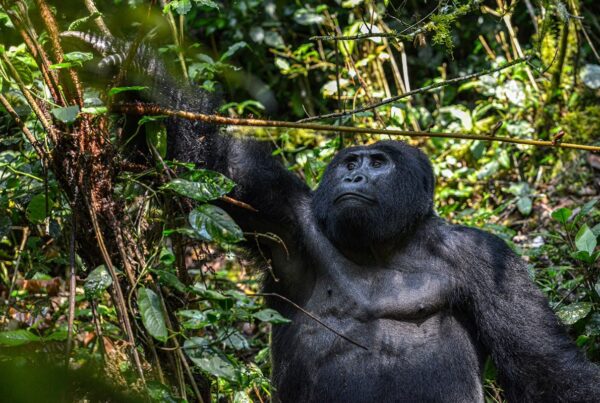
Mountain gorillas are confined to this tiny area because they are highly specialised for life in high-altitude tropical forests between 2,200 and 4,300 metres elevation. Their diet consists almost entirely of vegetation found in these specific montane and bamboo forests, including wild celery, nettles, bamboo shoots, and galium vines, and they cannot survive in lowland habitats where their specialised food plants do not grow. The glaciers, volcanic soils, and unique plant communities of the Virungas and Bwindi create the only suitable habitat on Earth for this subspecies. When these forests were more extensive during past climatic periods, mountain gorillas likely ranged more widely across Central Africa, but habitat loss over millennia has confined them to their current tiny range.
Other Gorilla Species and Subspecies Worldwide
It is important to note that mountain gorillas are just one subspecies of gorilla. Western lowland gorillas, found across Central Africa from Cameroon to Angola, are far more numerous with a population estimated at several hundred thousand, though they also face severe threats from Ebola, poaching, and habitat destruction. Eastern lowland gorillas, or Grauer’s gorillas, inhabit the lowland forests of eastern DRC and are critically endangered with fewer than 4,000 remaining. Cross River gorillas, the rarest of all, number fewer than 300 individuals in the Nigeria-Cameroon border region. None of these other populations are currently accessible for tourism, making mountain gorillas the only option for travellers seeking a wild gorilla encounter.
Final Thoughts
Mountain gorillas are not exclusive to Uganda, but Uganda is the best destination for most travellers seeking a balanced combination of population size, permit affordability, trekking variety, and overall value. Rwanda provides a more luxurious experience with gentler terrain, while the DRC offers the cheapest permits but with significant security concerns that make it unsuitable for most visitors. For the majority of travellers, Uganda strikes the optimal balance of accessibility, affordability, multiple trekking sectors, and extraordinary wildlife encounters that have made it one of Africa’s most compelling destinations.
Frequently Asked Questions
Uganda is significantly cheaper. Uganda’s standard permit costs $800; Rwanda’s costs $1,500. For 4-hour gorilla habituation, Uganda charges $1,800 — Rwanda has no equivalent experience. The $700 saving on a standard permit is the primary reason most budget-conscious travellers choose Uganda.
Uganda. Bwindi and Mgahinga together have 20+ habituated gorilla families and issue more daily permits than Rwanda’s Volcanoes National Park. Uganda also offers the Gorilla Habituation Experience, which Rwanda does not. Rwanda’s advantage is accessibility — Volcanoes NP is 2 hours from Kigali airport.
Yes — this is a popular combination. The Kigali to Bwindi road journey takes approximately 4 hours via Kabale. Some visitors trek in Mgahinga (Uganda) one day and cross into Rwanda for Volcanoes the next. Note that your Uganda permit cannot be used in Rwanda and vice versa — separate permits are required.
Rwanda’s Volcanoes National Park offers easier access (2 hours from Kigali airport), high-end lodge infrastructure, and the Dian Fossey research legacy. Rwanda also offers golden monkey trekking in the same park. However, at $1,500 per permit, it costs nearly double Uganda’s $800 rate for the same 1-hour trek.
Uganda is home to the mountain gorilla (Gorilla beringei beringei), one of two subspecies of eastern gorilla. They live exclusively in the Virunga volcanic highlands (Uganda/Rwanda/DRC) and Bwindi Impenetrable Forest (Uganda only). Mountain gorillas are the only gorilla subspecies that cannot survive in captivity — every individual you can trek is a wild animal.